

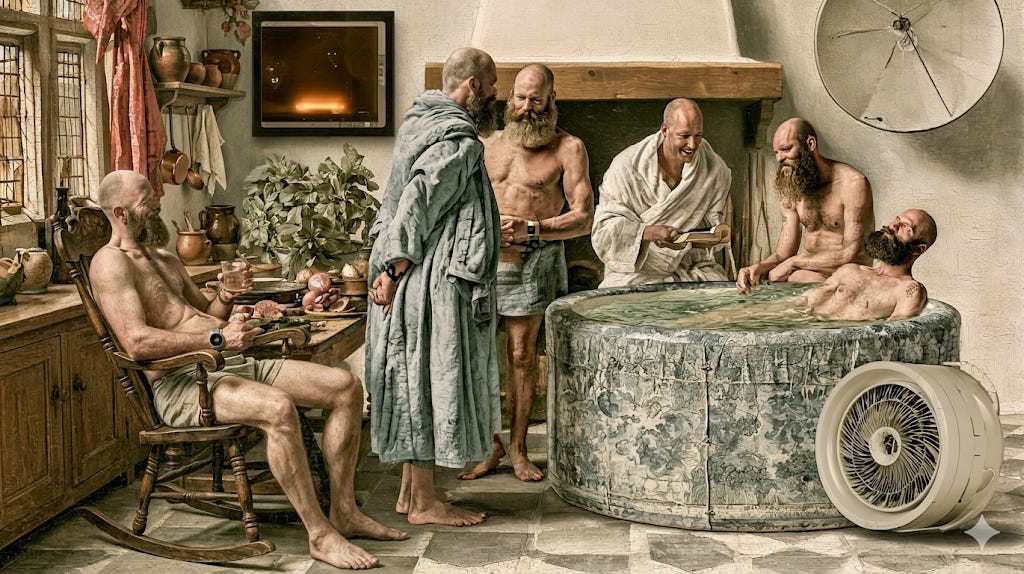
Grandmother got up before dawn. She milked the cow and put the porridge on, and only then drank coffee, because drinking it before it was earned would have been obscene. In spring, she put nettle in her tea to clean the blood. She smoked one cigarette a day, at the kitchen window, after the midday meal, and everyone knew not to speak to her while she did.
Andrew wakes to a 10,000-lux lamp he’s programmed to switch on at five a.m., because early photons calibrate the circadian rhythm and suppress afternoon cortisol drift. He later steps outside to let actual sunlight reach his anus, an old Taoist practice. In the afternoon, he will tell thousands of listeners how to move efficiently through grief. Just follow the protocol.
Iron, then Sourdough, then Death
The gym is where it all started. The masculine urge to reform one’s own body, to will toned pectorals into being by pushing iron through pain. Kind of hot (no homo). It didn’t stop at iron.
“Did you add ashwagandha to your stack?”
“Where do you get your raw milk? Nah, that farm’s soil is depleted. I’ll hook you up.”
“Can you watch my sourdough culture while I’m traveling? It’s from a monastery in Puglia, sixth generation.”
Sourdough cultures have lineages the way racehorses do. Grandmother also had a sourdough, but nobody in the village was ranking it, because the game was whether the bread was good, not whether your starter could beat the others in a genealogical pissing contest. Once the men arrive, they introduce measurement and rankings, and the domain goes from a normal distribution where most people are roughly competent to a power-law distribution where someone is always fermenting at a higher altitude than you. The men’s kitchen is Extremistan, and it’s expanding into other domains. You need to stay at least 20 minutes in the sauna, or the heat shock protein doesn’t release. If you are doing Wim Hof breathing before the cold plunge, you are getting mogged by somebody doing gTummo. Each of these claims has a study behind it, and we’ve read them (or at least listened to the podcast that summarizes the summaries).
Competition is the system prompt of testosterone.
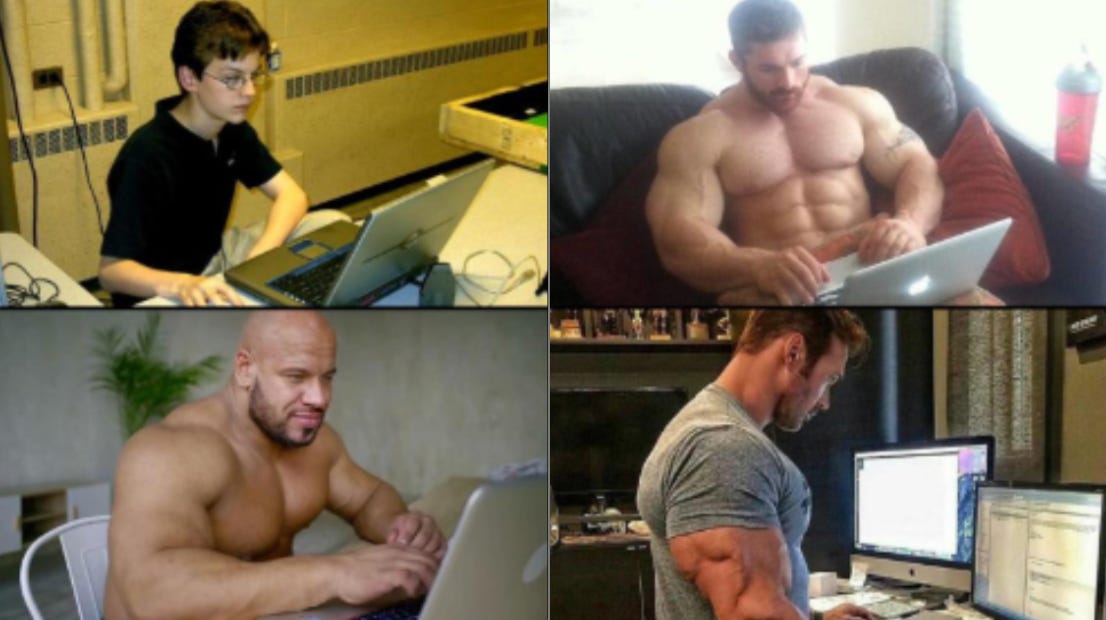
Somewhere between the heart rate variability and the creatine, the bros figured out that unprocessed emotions clog the body like gunk in the pipes. I never learned to talk about feelings growing up, so I just stopped feeling them. It took screaming like a fire demon, throwing tantrums, being cradled by pretend parents, and a dude grabbing me by the balls and yelling “what do you stand for?!” to restore contact with anger and sadness. None of which would have been legible to grandma, and most of it isn’t legible to us either, which is why we end up with lists like “vulnerable, impartial, empathetic, and wonder.”
The men’s group wasn’t enough either, so the boys started reading the Desert Fathers. Some of us went beyond growing beards and generating icons with Midjourney.
“Getting baptized, at the end of the day, is pouring water on plants at the level of the soul.”
Grandma’s spheres of influence are steadily turning into the manosphere.
Food, the body, health, emotions, family, spirituality. Even death: bro is graphing his son’s nocturnal erections against his own to live longer.
Reversal is the Name of the Tao

Charged polarities invert into one another at their extremes. Political historians agree with the I Ching: free speech was a radical left cause at Berkeley in 1964 and became a right-wing rallying cry by 2020, though the actual position never changed. The same reversal is playing out culturally: the institutions that mattered in 2010 are now embarrassing to name as an employer.
It’s not as simple as yin and yang trading places. We can see the pattern more clearly by distinguishing between the shape of the container and the energy moving through it. Containers come in two shapes native to your nervous system: kiki and bouba. The office is kiki: sharp edges, an org chart, the meeting starts at 10:00. The kitchen is bouba: porous, networked, rules implicit in vegetable chopping stigmergy. Yin and yang is the axis of energy: yang contests, builds, and takes initiative while yin gathers, weaves, and tends. Domains used to sort cleanly by energy. The kitchen ran on yin energy and the office on yang energy for long enough that we started conflating them, which was fine until it was sexist.
Yes, I’m making a 2x2 from a meme with cog-sci roots and an esoteric cosmology. This is Octopusyarn, get with the program or bounce off my kiki.
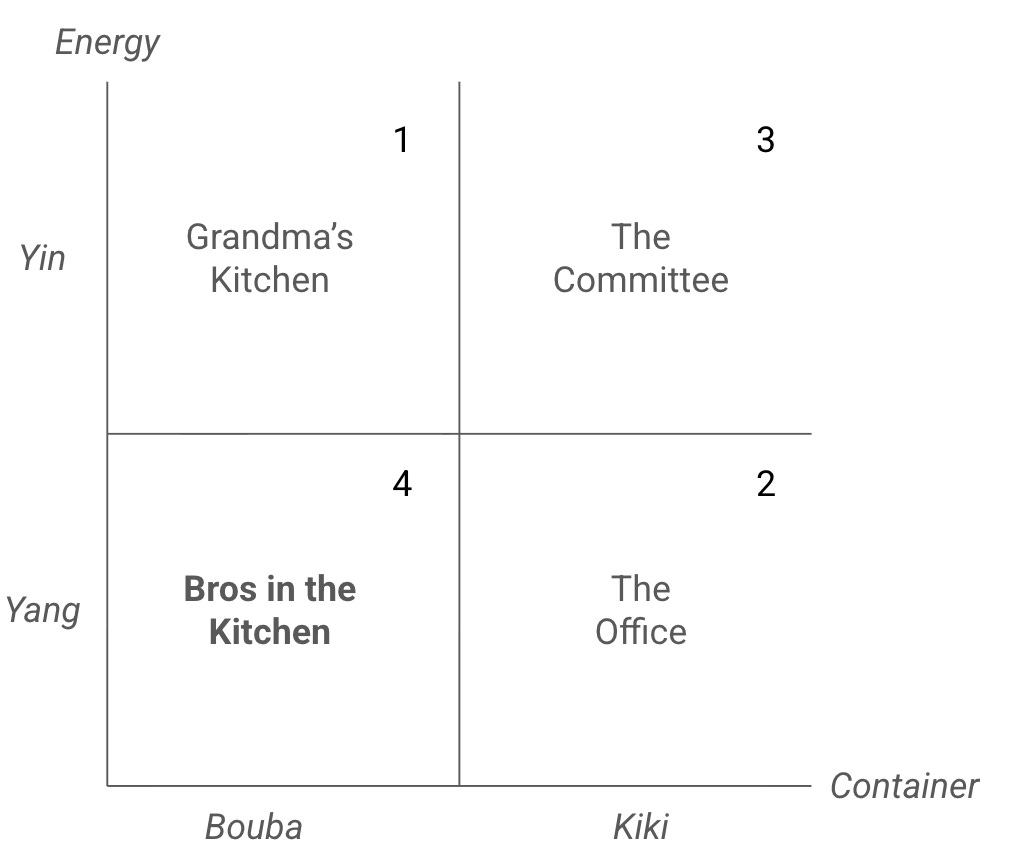
Grandma’s kitchen (1) ran for centuries on yin energy in a bouba container. Yang energy first entered the bouba container to create the village and the farm. Then modernity arrived with yang-kiki and built the office and the factory. This configuration crushed it for decades and put a man on the moon. But fixed gender roles stopped working: dad at the office distilling frustration into whiskey, mom at home vaporizing hers into valium, the children largely ignored. De Beauvoir’s critique was overdue and correct, and feminism’s march through the institutions followed.
With the patience of a river expanding its basin, women got committees and hearings and eventually tenure. Yin energy is just better at institutional capture than yang. Yang fights, wins or loses, and goes home, while yin joins the committee. The walls of Harvard stayed where they were, but slowly different people walked through the doors, and the energy inside turned yin (3). Meanwhile the kitchen was empty and the door open.
In the new century, the pathology of kiki-yin became pervasive. Every edge of the container needs to be defined procedurally to ensure fairness because nobody has the yang to make a judgement call. HR-mediated consensus has turned the workplace into a process shoggoth, the professor who says the wrong thing gets a Title IX complaint instead of an argument, and the builders have already left. They walked into the kitchen (4) and started running protocols on their own nervous systems.
The Builders Already Left
The reactionary critique is correct and perfectly useless. The old kiki institutions run every decision through legal, HR, comms, and three levels of compliance before anyone can act on it. Meanwhile, the economy runs on GPUs; by the time the internal email clears legal, the product it was about is obsolete. And the yang energy that might have restructured them walked out a decade ago.
If you’re a builder, you walk away rather than run every utterance past three audiences in your head before it leaves your mouth. In an environment designed to prevent any wrong move, not moving becomes the wrong move. So the yang-energy people went to the bouba spaces the old yang had ignored: the body, spirituality, the group chat, the kitchen. I ended up in the kitchen myself after leaving the big tech career track, cooking between calls with internet strangers who turned into friends.
The most ambitious founders of the 2020s aren’t building institutions, much less working for existing ones. They’re building social movements in abandoned bouba territory. Grandma got too old to cook, the kitchen sat quiet for a while, and then the enterprising grandson moved in and started running a delivery shack out of it. Huberman is a movement with a podcast, while Bryan Johnson has a supplement line. Ido Portal teaches movement and Joe Hudson teaches emotions, and people pay Ivy League fees for both.
It’s not really grandma’s kitchen anymore with the pullup bar, the amber light screens, and the starlink on top. But they are cooking in the room she used to cook in. If they come up with anything that works, it starts looking more like a tribe than an institution. Bouba containers, but built deliberately rather than inherited. Running a men’s circle and a homestead does more than writing manifestos about storming an abandoned building. Yang walked out of the containers it built, and them boys took over the kitchen instead.
You Dropped Something, Queen
Yin energy had already abandoned the kitchen on its way to the boardroom. The daughters wanted to go to college instead of learning grandma’s recipes. Mainstream feminism spent fifty years teaching women that the office was where real life happened and the kitchen was where the patriarchy was exploiting them.
Emma moved to the big city. She came back for Christmas, and when her mother put her in front of the oven to help with the walnut cookies that had tipped family members into gluttony for three generations, Emma said she had a deadline on Monday. The kitchen had been a school and a workshop and a court of appeals for four generations, and it was about to become a room Emma passed through on her way somewhere else.
Emma’s generation wanted to stand on their own two feet, but the pursuit of female autonomy trips over motherhood: you can have bodily autonomy, or you can have a baby. Mary Harrington calls feminism that pursues women’s independence at all costs “the attempt to liberate women from the need to be female.” Reactionary feminism rejects the pursuit of sameness from within the movement. It wants to treat the differences as real and rebuild the domestic in some configuration that balances freedom and interdependence.
Some women, after moving through a sequence of feminisms, come back to bouba territory on their own terms. They are surprised to find a bunch of men already there, talking about their feelings around the kitchen table they took over while feminism was in the boardroom. The feminist who still acknowledges biological differences and the homesteading dad walked into grandma’s kitchen from opposite doors.
He’s come from a HIIT in the forest; she’s come from the city’s best law firm. They marry with their own syncretic ceremony. Neither of them grew up knowing how to make the nettle tea, but they trust they will figure it out together. When she points out that idolising a fictional grandma in a piece on the new masculinity is kitsch, he hears it as a gift. (She didn’t even mention the Bechdel test.)
Build the Kami Machines
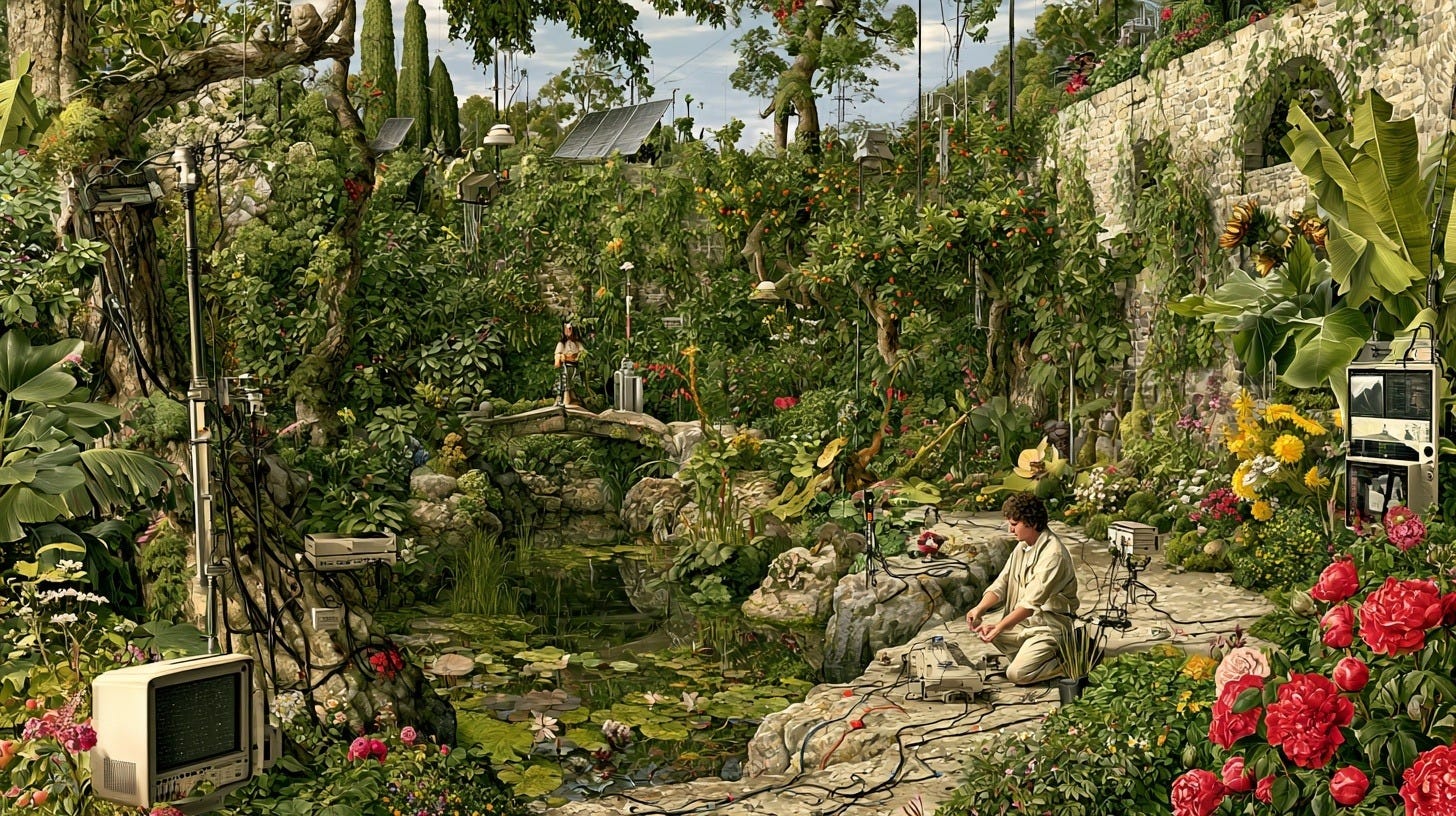
The same move of yang energy into bouba territory is happening three scales up. What the bros did to the kitchen, ecomodernism is trying to do to environmentalism, and the GLP-1 clinics are doing to public health.
Environmentalism for fifty years was the old configuration: yin energy inside the kiki container of regulation and treaty-making, which produced generalized guilt and eager European compliance with recycling. Public health ran the same broken setup: telling people to move more and eat whole grains while obesity climbed.
Then Ozempic did in six months what top-down nutrition bullying couldn’t, and TRT clinics are fixing depressions that a decade of standard medical interventions couldn’t touch. Ecomodernism makes the same swap: networked sensors, proactive rewilding, gene-edited vertical farms that free up more land for actual nature than any amount of suburban solar will. The easiest path to more nature runs through more technology, not less. Let’s build the machines of loving grace that will watch over our forests like the kami used to.
This isn’t optional. Yin energy inside a kiki container produces the same paralysis in Brussels that it produces in a Harvard department meeting, and we’re running out of time to fix things at that pace. The slow-motion train wreck of climate, fertility collapse, and nuclear risk (to name a few) is speeding up. The loneliness epidemic and the degraded information ecology aren’t going to fix themselves either. Our most realistic chance is people willing to act outside ossified containers. The committees have spent decades proving they can’t.
The danger scales with the promise: Germany’s first major youth back-to-nature movement dressed in flowing robes, went nude in the forest, rejected industry, and thirty years later was absorbed into the Hitler Youth. The sylvan elves ended with swastikas in the forest. Yang-bouba at scale has gone bad before by crystallizing into authoritarian yang-kiki. It can go bad again.
Holy Impatience

Grandma shuffles to the window with steady determination. She can’t cook anymore, and she doesn’t need to. Her job now is to slice through bullshit with a cursory glance of weary annoyance. As she lights her cigarette, the boys go silent. The smoke just obliterated the effect of several health protocols.
The men who left the institutions to escape procedural capture have done something funny. They now run more protocols on their own nervous systems than HR ever ran on their departments.
In the eleventh century, the monks of Cluny took a vow of silence and developed a system of hand signals so elaborate that they could hold entire conversations over dinner without technically speaking. Over time, the gestural vocabulary grew so convoluted that the silence was louder than speech. The bros have done the same to their bodies.
A continuous glucose monitor turns eating into a game of Tiny Wings. The sixth-generation sourdough produces bread no better than grandmother’s, but it produces a leaderboard. Believe me, I know the luciferian seduction of a graph moving up and to the right. The men escaped the kiki container and built smaller ones inside themselves, and they didn’t see it until grandma lit a cigarette.
Grandma is the matriarch, not anyone’s parent or partner. While walking into the kitchen from opposite sides can smooth out gender relations, the missing piece is elderhood. Grandma’s holy impatience comes from being close to death; her sense for how bouba moves comes from having lived her whole life in it. The bros had been trying to build her out of breathwork and accountability partners, when what was actually needed was a woman in her eighties who has never heard of a circadian rhythm and does not give a damn about what you stand for.
The other thing the yang kitchen needs is a lawyer. The bros’ brilliant plan to grant legal status to rivers that dynamically mint cryptocurrency based on water-quality sensors still has to be executed, which means an array of suits who will not be moved by your account of the Iboga ceremony. You can reject every structure modernity has produced and still find yourself in a room with a civil servant who needs the form filled out in capital letters. Luckily, someone at the table used to work at the law firm and knows who to call from the old days.
The center for cyborg shamanism’s pilot project on legal status for natural commons got approved last month. The old lady in the corner had nothing to say about it, to the relief of the boys. Forest nazis were always the obvious worry. Grandma is there for the subtler one: Goodhart’s law.
This post was inspired by a discussion with Layman Pascal.
Ink Trails:
Cyborgs are what happens when builders walk out of the corporation too
Mammon is the archdemon of optimization
Goodhart’s law is one symptom of the measurement trap
Holy shit
OK, I still love it the 2nd time around, such a mixture of bro-ish tech thinking and off-kilter imagining. It loosed in me a barrage of comic book imagery that took a few days to emerge with specificity, mainly around your 1-ciggy-a-day grandma figure, OMG. Who is she? Not my (chain-smoking, high-femme-always-in-her-painted-face-&-perpetual high heels [that shortened her achilles tendon]) granny! Uh uh. Rather ... Mammy Yokum, bare-knuckle fighting matriarch in the L'il Abner strips. Or Rose "Gran'ma" Ben from the Bone series. Far more than nettle tea from these ladies.