

Swapping faces is the devil’s oldest trick. But is it really just three faces?
A signature move of the devil is to appear in different guises. A goat, a black dog, a raven, and, of course, a snake. Or a foreign professor (in Master and Margarita). Or a space-faring absurdist (in Beelzebub’s tales).
“I am Legion, for we are many” - Mark 5:9
Hell looks like a teeming multiplicity, as depicted in a Hieronymus Bosch painting below.
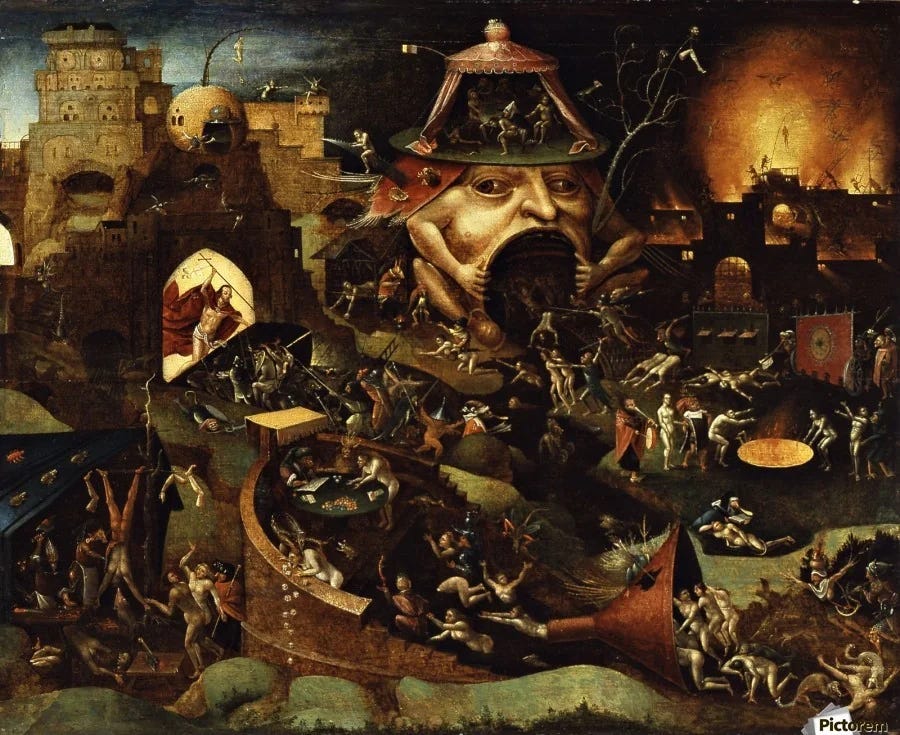
Medieval grimoires list hundreds of demons that usually feature a chimeric body, a niche obsession, and an aristocratic title. Asmodeus, a demon from the lesser key of Solomon, is a king who appears with three heads (bull, man, ram), a serpent’s tail, and goose feet. He also teaches geometry and knows how to score hidden treasures. Handy. A literal King of Hell who will help you pass your 10th-grade trigonometry final and then tell you where the gold is buried.
The Weird Studies episode on the devil asserts that the shapeshifting is a key part of the archetype. Its host JF comments that
“It seems kind of haphazard or arbitrary who has what title. Hell is kind of like the Muppet show. You don’t really know who’s in charge”.
That may be true for the outer reaches of hell. At the same time, I’m convinced that there is a non-arbitrary structure of evil that we can understand. The seeming randomness is just another layer of obfuscation, another ruse of the Devil. We already uncovered the three drivers of evil in part 1 (I highly recommend you read this before proceeding here). I will now use them to draw a dynamic map of hell that will provide us with a handle for understanding evil in the modern world.
The Ethical Cycle and its Breakers
Focusing on three moral theories and three devils in part 1 wasn’t just aesthetic whimsy, but there is something structurally inevitable about that triad.
Christianity, Hinduism, Peirce, and Hegel all converge on three because the pattern tracks something real about how conscious experience meets the world. The fact that everyone from Hindu sages to 19th-century logicians keeps tripping over the number three suggests we’ve hit something fundamental. Three is about the inside, the outside, and how they relate. I’m building on Forrest Landry’s formal work on mapping not just the three aspects but the dynamic relationship between them.
The three moral theories go together in a sequence.
Here’s how ethics flows when undisturbed: It begins with the latent potential of who you are before you act. Your values, your character, your virtues. This is where virtue ethics (V) lives.
Then, you make a choice. An interaction occurs, and consequences ripple outward. This is where people’s lives are impacted, where meaning and utility reside. Utilitarianism (U) aims for the most beneficial impact for all involved.
Finally, you might update your principles based on what happened (especially if you messed up). In general, patterns from repeated action crystallize into rules that help society function. This is deontology’s (D) territory.
The healthy flow runs V→U→D.
Virtue shapes action, action produces consequences, consequences become structure, and this structure informs the next choice. When this cycle flows freely, you’re a moral agent. When the cycle breaks, evil enters.
Evil Breaks the Flow of the Good
Beelzebub, Lucifer, and Satan are the forces that break the cycle. Each one exerts gravitational pull toward a single aspect, aiming to decouple it from its sequential relationship with the other two.
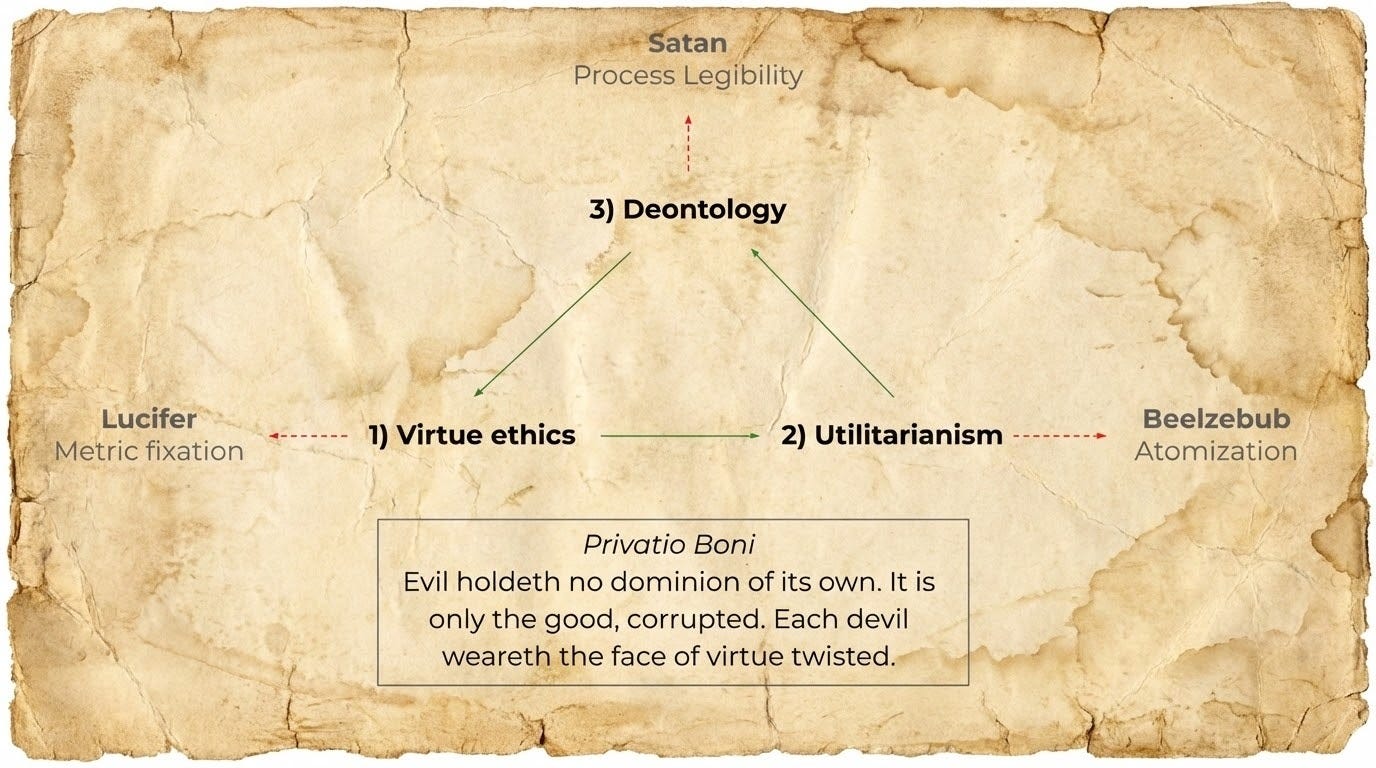
If a single aspect of the good is detached from its context, it becomes an aberration that blocks or even reverses the flow. If one aspect falls, the other two usually follow shortly after. Then, Atomization, Metric Fixation, and Process Legibility fuse into demonic egregores. I call the most powerful egregores archdemons.
There are exactly five ways that the ethical cycle V→U→D can fail:
Three are structural errors, where the sequence itself gets reversed. I call these hell realms. They’re systemic. You can be trapped in Mammon without any personal moral failing, just by being born into late capitalism. The grammar of your world is already wrong. This is what we’ll cover now.
Two are positional errors, where the sequence stays intact, but you’re not the one driving it. I call these possessions. They’re personal - something else has hijacked you, is choosing through you. We’ll cover these in Part 3.
Hell Realms are the water you swim in. Possessions are the parasite swimming in you.
Hell Realms
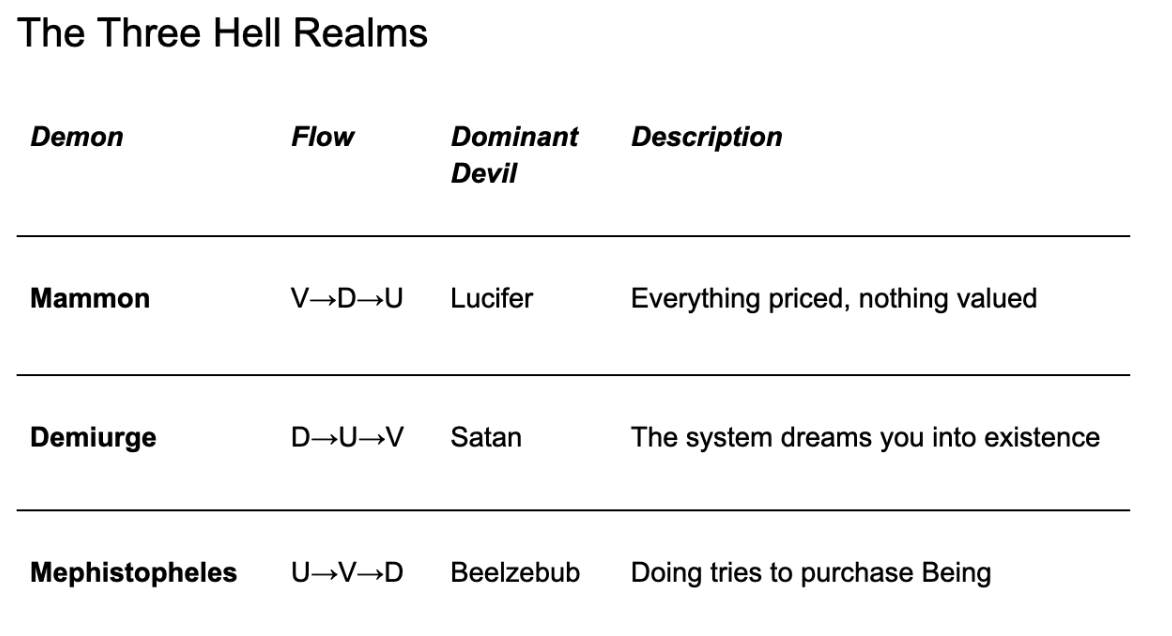
In hell realms, choice, change, and causality have been rearranged into an impossible order. Moral nonsense that feels coherent from inside. You’re not in Hawkins anymore, you’re in the Upside Down. The three demons described here are the most savage forms of evil running rampant in our society. The only way out is to recognize them and reject the frame entirely. We’ll discuss how to banish them in the final part of the series. For now, let’s look at the three most successful ways we’ve managed to build hell on earth.
Mammon: the Reduction
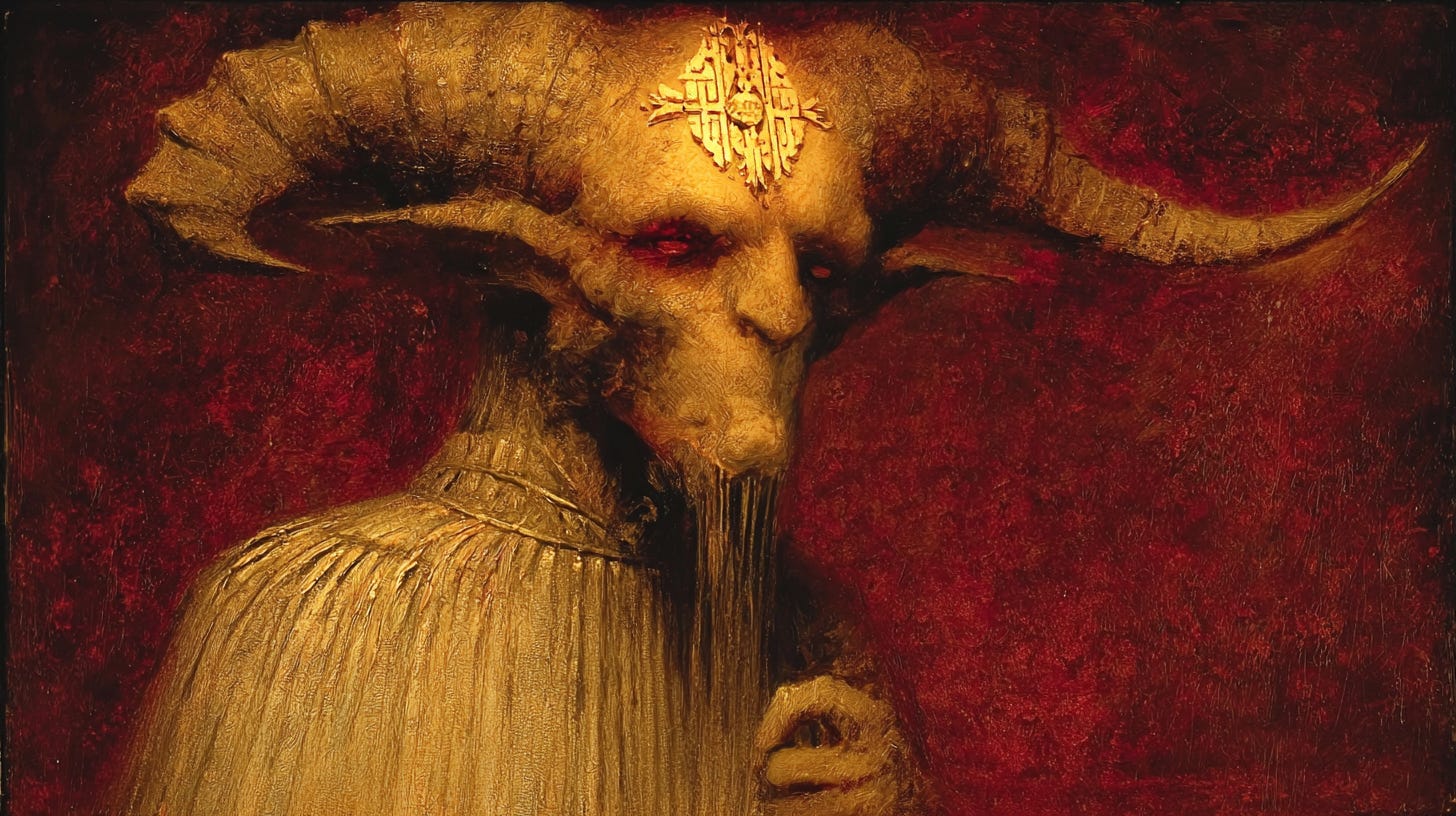
Money is humanity’s most successful spell. Pieces of paper, numbers on screens that are able to command armies and raze forests. The low-resolution hippie rejection of money as evil points at something real. Money is evil to the degree that it reduces complex reality to an abstraction. Mammon is the name of that evil. The name appears in the Gospels (”You cannot serve both God and Mammon”) but the entity is older than Christianity, as old as the written word. Mammon stirred from the first time a Sumerian priest carved into a clay tablet to track a grain debt.
The Trap
Mammon inverts genuine moral development. Instead of cultivating virtues that inform our choices and eventually crystallize into principles, we skip straight to the algorithm: “always choose what makes the most money.” Metric fixation colonizes the field of value where character was supposed to grow. Money is optionality, stored power - so that’s what we optimize for. Follow this logic long enough and every experience becomes denominated in dollars.
It’s easier to imagine the end of the world than the end of capitalism - Mark Fisher
Mammon is capitalist realism. The realization that money and markets are so deeply embedded in every single system globally that we can’t even imagine alternatives. Mammon won when we stopped arguing about whether everything should have a price and started arguing only about what the price should be.
The Territory
Mammon is the hell realm where Lucifer leads with metric fixation. The horrors of late capitalism are the result of Mammon having colonized the field of value landscape with a single metric. Dollars. Net worth for individuals, shareholder value for companies, GDP for countries. It’s all the same. Everything happens in time, and time is money. Brand is an intangible value, so is your address book. Accountants have standardized how to price both of these (check IFRS 38), and almost everything else.
It’s Satan who built the accounting systems and all the other infrastructure to serve the master metric, from financial instruments to legal frameworks. What can’t be recorded in the books becomes invisible. A forest isn’t valuable until it’s timber futures.
Beelzebub ensures that dollar signs are all that is salient. In Milton, Mammon walked with downcast eyes in heaven before the fall, admiring the golden pavement beneath his feet rather than the beatific vision above. Mammon’s reign remains unchallenged as long as workers are seen as human resources and communities as labor markets.
The market began as a way to coordinate human needs. But metrics compound. Abstractions stack until most of the value is far removed from the messy last mile where capital has to touch gross reality. Derivatives markets are much larger than the value of stocks they are based on. Real estate investment trusts abstract away from human beings paying rent for their family dwellings thick with memories. The documentary Leviathan captures where this logic ends: abstraction leads to atomization, atomization to loneliness, loneliness to despair. “All that is solid melts into air”, says the Communist Manifesto. Nick Land also saw this clearly, but decided to worship it instead. His accelerationism is Mammon’s theology: the market as autonomous intelligence, human meaning as sentimental friction to be burned off at the end of the optimization process.
The Tell
In Mammon’s realm, the only way to escape is to join the squid game. He promises that you can reach “fuck you money” to buy you freedom and security. The snare is that as you start optimising for money, you become like money. Liquid, fungible, exchangeable. Your particularities, your entanglements, and your weird obsessions start to look like inefficiencies. Liabilities. You optimize them away, and then you wonder why you feel like a rounding error with a pulse.
The signs you’re ensnared: You internally bill your friends your hourly rate when you hang out. You track whether you’re getting adequate ROI on your relationships. You check your portfolio for dopamine the way you used to check for texts. And beneath it all, a silent, dreadful hollowness. Because Mammon abstracted away everything that made your life mean anything in the first place.
Demiurge: the Simulation
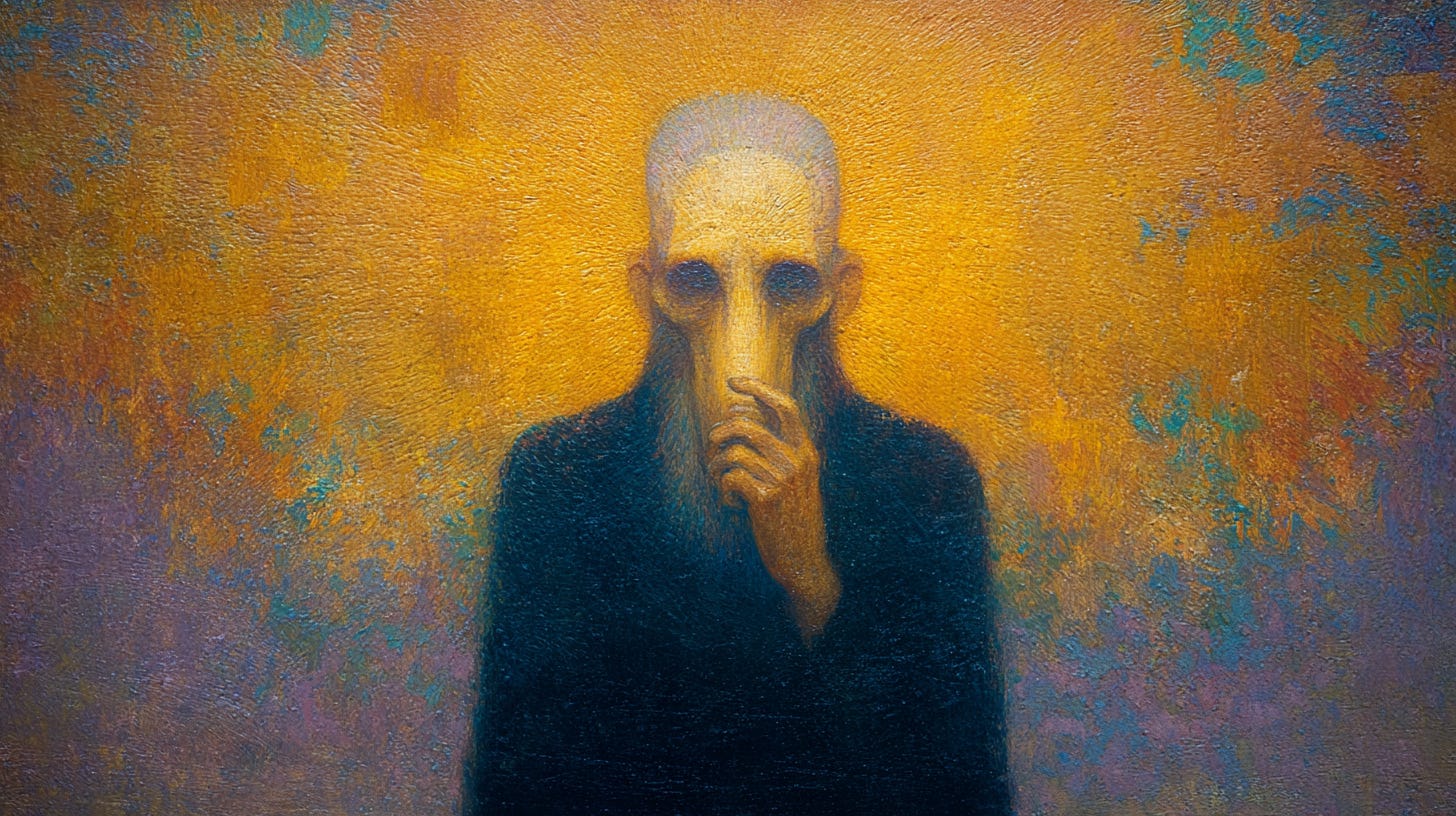
The Demiurge is the oldest archdemon in this grimoire. Gnostic texts named him two millennia ago: the false god who built a cartoon simulation of the world and mistook himself for the true creator. The allegory of the cave, the Tao Te Jing and the Matrix all point to the dangers of his simulation. Deus est machina. The Demiurge exists fractally across different planes of existence but the pattern is always the same: mistaking the map for the territory and then forgetting that there ever was a territory.
The Trap
The Demiurge inverts the natural order completely: You’re not using the system. The simulation is dreaming you. Law generates Experience generates Self. If you’re thinking of Facebook’s metaverse, you’re not wrong. The algorithm decides what you can see, platform affordances decide what you can do. Experiences, whether a news feed or a VR office space, are downstream of the system’s grammar. Finally, your avatar emerges in response to these constrained experiences. You become the thing that navigates the built environment and forget you’ve flattened and split yourself off. After all, you’re the only subject being rendered at full resolution. The main character.
The Territory
The Demiurge is the Hell Realm where Satan leads with the ultimate overreach of structure. The Satanic architecture produces a self that is passive like the human batteries in the matrix. It’s called a feed because you are literally being fed. But passive doesn’t mean bored. The simulation isn’t cold and austere like a Kafka bureaucracy. Beelzebub furnished your cell to match your Pinterest board. Sure, you’re a prisoner, but at least your aesthetic is curated. All the while, Lucifer is hiding behind the experiences, in the source code. As the simulation presents as neutral infrastructure (“we’re just connecting people”), it is secretly driven by ruthless optimization (e.g., time on site). Technology is not value-neutral, and the Demiurge hides that so well that its values feel like physics.
Social media is a typical domain of the Demiurge. But don’t mistake Satan’s archdemon for a few apps on your phone. The simulation operates deeper: social norms, language, even perception itself. We’re several layers of abstraction in, deep into what Baudrillard called “hyperreality”, a pure simulacrum no longer tethered to reality. The map ate the territory.
The Tell
You know you’re in Demiurge’s grip when you find yourself looking at a sunset and thinking about how it would look as a Story. Or if your inner monologue has started sounding like Twitter threads. The experience isn’t real until it’s been processed through the simulation’s grammar.
What you don’t know is that it gets much more personal, following McGilchrist. The Demiurge isn’t just out there. It’s the left hemisphere of your brain. The part reading this sentence. The naming, categorizing, and controlling part. A tool evolved to manipulate the world that usurped the master who perceives wholes. The Demiurge feels like water because he doesn’t just build our institutions. He reaches into perception itself.
The horror is that you likely won’t notice. You don’t perceive the outside world but are confined to your thoughts about it. You don’t register other people’s interiority because you instrumentalize them without knowing it. The false god of your ego doesn’t know there’s a larger self trapped inside.
There is no red pill because there is no longer an outside.
Mephistopheles: the Transaction
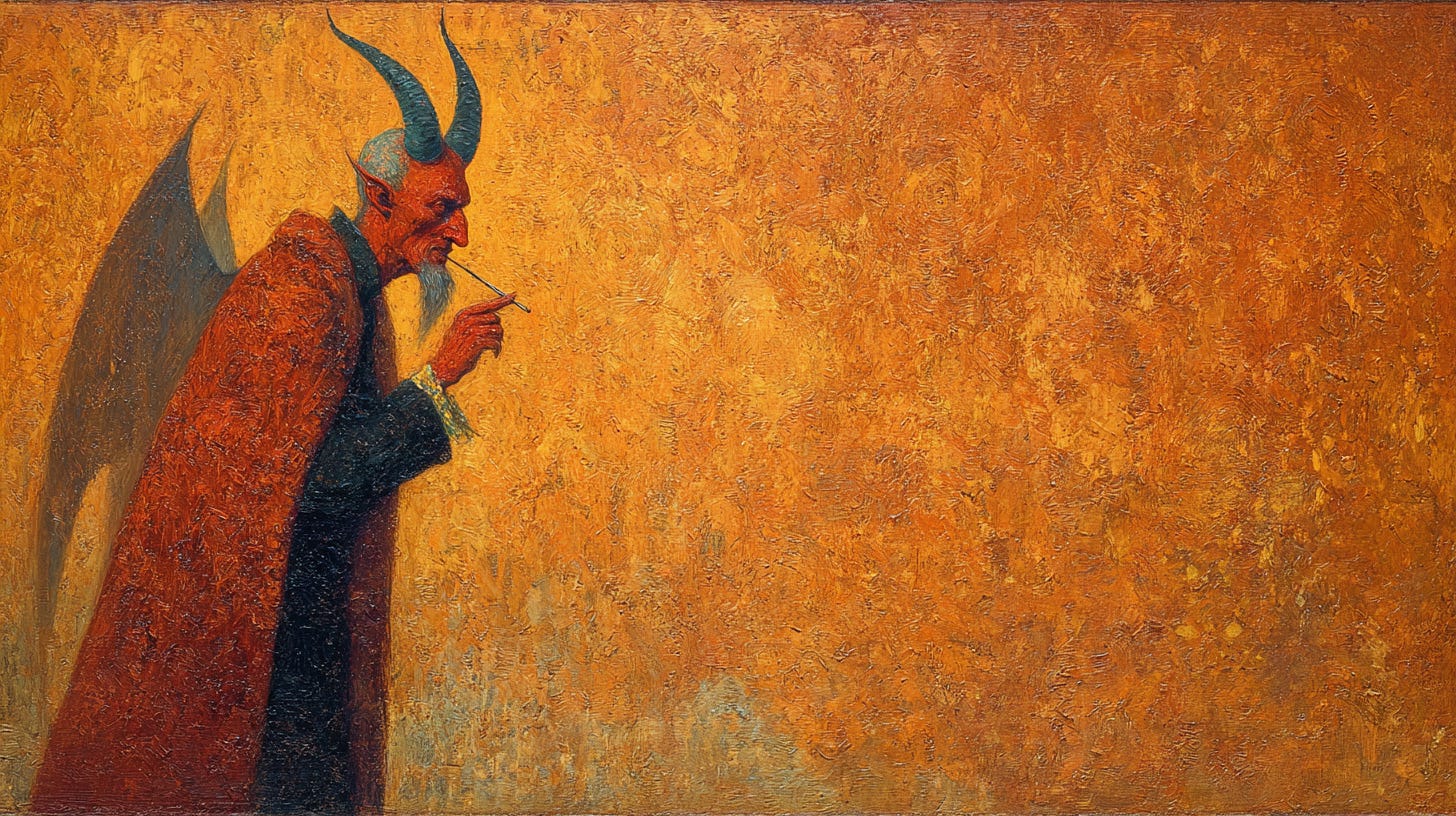
Mephistopheles is the youngest archdemon in this grimoire. He emerges from Renaissance Germany, from the Faust legend, from the moment when modernity invented the self that could be sold. Mephisto is the entity that offers you a deal with the Devil. Mammon and the Demiurge are ancient and impersonal behemoths, chthonic orders that don’t need your consent to crush you. In contrast, Mephistopheles seems human-sized, and treats you as a sovereign agent capable of binding yourself. Which is flattering. Which is the trap.
The Trap
Doing tries to purchase Being, and that new reality comes with binding agreements. Fromm diagnosed this confusion as the having mode masquerading as the being mode. Do the thing, get the title, become the person. The structure of every Faustian bargain is the offer that you can be somebody else. You could be famous or you could be rich. A lawyer, a doctor, or an investment banker? The funny thing is that this actually works, in a twisted way. You can indeed become a doctor because your teenage self imagined that this would make you worthy of love. You’ll just wake up one day after decades of training to find yourself miserable because you are living the wrong life. And at that point, everything around you is structured on the basis of that job, from your zip code to your spouse.
The Territory
Mephistopheles is the Hell Realm where Beelzebub leads with salience capture. This is the only hell realm you have to walk into yourself. Which makes it the hardest to leave. Beelzebub initiates with the deal. The prestigious internship, the job offer with a big options package, the girl you’re not that into but your friends would high-five you for. Wouldn’t it be foolish to refuse?
Lucifer offers the bait: Become somebody else, somebody better. Imagine the hit of pure, uncut validation when you post that “I’m humbled to announce” update on LinkedIn. Even though you never considered going into pension liability forecasting, you could surely find it interesting as a manager. You’re a pragmatist, after all. How jealous everybody in the bar would be that you walk in with the hottest date. You could be the one who is admired, respected, envied. Exhilarating.
Satan seals the contract with sunk costs. The commitment hardens into structure, path dependency sets in. You’ve signed up for the living standards that come with the pay raise. You’re now married to the trophy you won. The older you both get, the heavier the silence at dinner. Backing out now would throw away everything you’ve achieved. People would think you’re a fool. Worse, an utter failure. You’re stuck in a life you never wanted.
You signed the contract, sure. But our entire culture has been priming you to confuse doing with being. The CV, a proof of identity more authoritative than your passport, is basically a list of things you’ve done. Imposter syndrome is Mephisto staking out his territory. Being told you have “so much potential” is the Mephistophelean kiss of death. For the low price of your 20s, you can cash in your potential for a credential. And then people at airports will finally think you’re important. All the jaded lost souls who entered the same deal are telling you that this is just how life is, that you’ve got to be realistic. And by realistic, they mean cynical. Mephistopheles is the voice that makes cynicism sound like maturity. World-weary, nihilistic, sophisticated, leaning against the wall with a long cigarette. He speaks in partial truths, corrosive truths.
The Tell
Don’t beat yourself up if you fell for it. Most people do. I sure did. I was convinced I needed to be rich before anyone could love me. Two demons for the price of one. The next best thing besides not entering the deal is noticing you’re trapped in it. The giveaway is the moving goalpost. That degree was going to bring you respect, that number in your bank account was going to bring you security. They didn’t, so I guess you’re getting a PhD now and millionaires are really just middle class now, right?
More specifically, it’s a distinct emptiness after achievement. “I feel nothing”, says the hedge fund influencer after a 50x on a memecoin trade. You worked on a goal for years and after finally reaching it, you don’t feel completion but just more lack, and a tinge of betrayal. Burnout, from this perspective, is the final warning, your body viscerally rejecting your life circumstances like an auto-immune response. Your last chance to leave somebody else’s life is when your unconscious has attempted to torch it.
Infernal Cooperation
Each hell realm is a collaboration. Mammon, the Demiurge, and Mephistopheles are what happens when Lucifer, Satan, and Beelzebub find a stable configuration to open up a gate to hell. One devil leads, the other two reinforce. The reduction needs infrastructure and blindness to alternatives. The simulation needs an internal logic and a self too flat to notice. The transaction needs bait and a contract. Hell is a team sport.
But it is not the chaotic Muppet Show of medieval demonology. We’ve unearthed a hidden grammar of chthonic emanation: From the three devils to the five archdemons. From there, we could probably continue into hundreds of demons that are all combinations and variations of these five deeper patterns. Asmodeus teaching geometry and finding treasure? That’s Mephistopheles wearing a funny hat. The apparent randomness was just a smokescreen preventing you from even considering mapping it.
Here is the map:
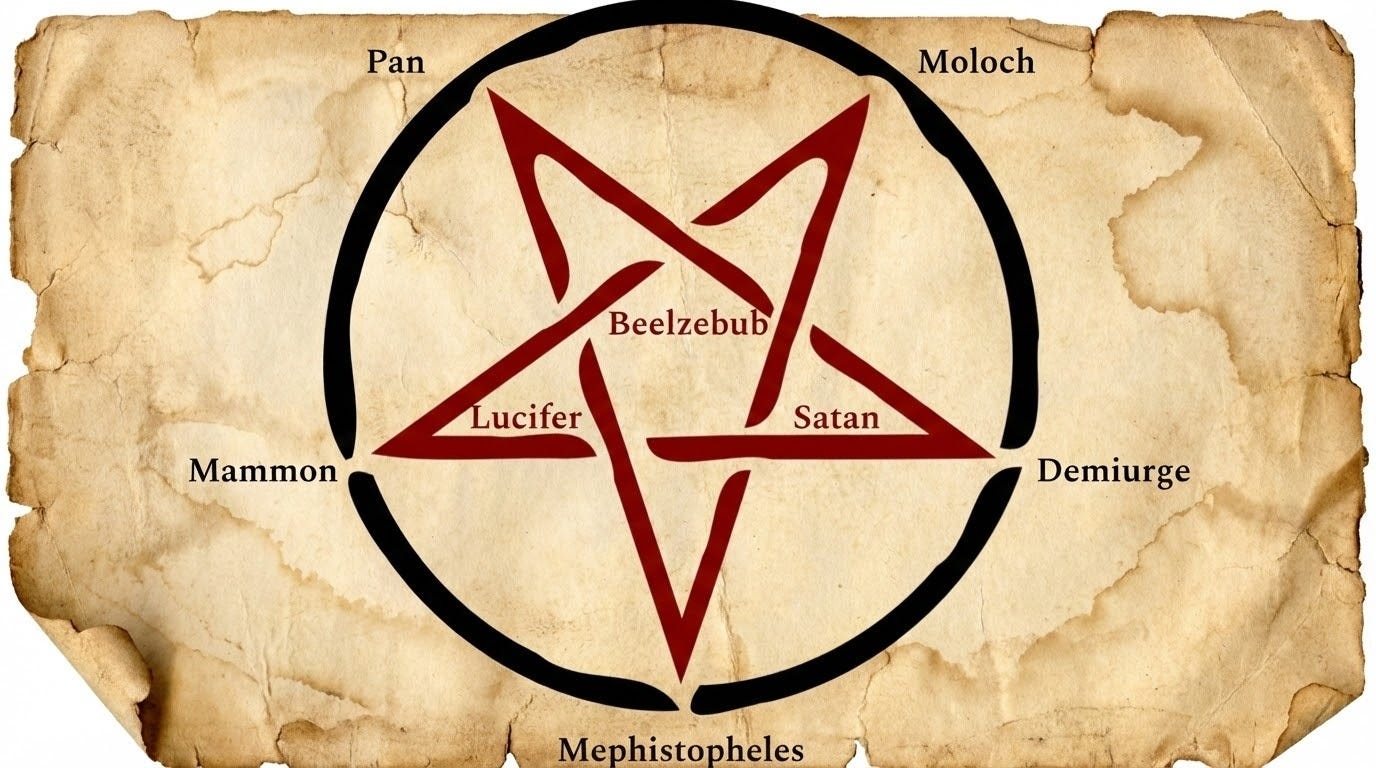
We discussed the three hell realms, the archdemons that run the ethical sequence backwards. The other way the cycle can break is to hijack the driver, when something else is choosing through you.
Next: the Possessions. Pan and Moloch. What happens when the devil doesn’t just build your cage but climbs inside your skin?
Sweet dreams.
Again, amazing. This is such a refreshing integration of the poetic, philosophical, and scientific descriptions of evil. Thank you!
You’ve decoded the religion of the hustle bro