


This post was co-composted with Tutor Vals
Once upon a time, I worked for a big tech corporation that encouraged employees to “bring their whole self to work” (we had bean bags and a meditation room, obviously). I felt oppressed in a weird way. People seemed more fake than usual, not less.
I now understand why.
Striving for authenticity is one of the most insidious and widespread brainworms we are suffering from. “Just be yourself” is up there with “follow your bliss” and “go with the flow”, the unholy trinity of advice that sounds good until you try it.
It’s insidious because it doesn’t look that way at first glance. Who wouldn’t want to live close to one’s personal truth, to express that unique spark freely, unconstrained by superficial expectations? I still fall for the marketing sometimes, so this essay is partly an attempt to disabuse myself of misguided notions of authenticity.
The Error and the Trap
Authenticity presumes a fixed self to excavate, to be expressed fully. That self doesn’t exist. Think of how different you are with your parents versus your closest friend versus alone at 3am. Different sub-personalities with different goals, desires, and fears. These aren’t masks over a true self, they’re different configurations of the same multiplicity, each as “real” as the others. I’ve been harping on about this for a while and will assume you are with me (check out “Self as Multiplicity” if you’d like more context).
If we crystallize an identity (e.g. “I’m a good person”), we become its prisoners (e.g. “I need to be perceived as virtuous”). Buying into the fiction of a fixed self will waste your time at best. At worst, the endless attempt to grasp or express something that doesn’t exist will slowly erode your sanity. It also punishes change: If you used to like basketball and now you don’t, was your past self or present self the inauthentic one? Better not change your mind about anything important. Your Spotify Wrapped is watching.
Assuming a fixed self, if you find yourself triggered and trapped in a reactive pattern, the “authentic” response is to keep replaying that. The depressed person’s “authentic” cynicism and the anxious person’s “authentic” hypervigilance. This view sanctifies the coping mechanisms you developed at age 7. Growth means transforming them, not enshrining them. You are also taken hostage by all of your past opinions - this is how politicians are prohibited from ever learning anything new and changing their minds.
It gets even worse. Paradoxically, trying to be authentic will trap you in performativity.
The moment you try to be authentic, you’ve created an auditor evaluating the performer (see more on this in my piece on doubling). Say you’re at a party trying to be your “authentic self.” You make a joke. It lands. But instead of just enjoying the moment, the auditor pops up: Was that genuine or were you performing for approval? So you try to be more genuine. You share something vulnerable. But now you’re wondering: Did I share that because I actually wanted to, or because vulnerability is what authentic people do? The auditor is now auditing the auditor. Each attempt to close the gap between you and your “real self” creates another layer of self-observation, generating exactly the self-consciousness that authenticity promised to dissolve. It’s like trying to fall asleep or trying to catch your own shadow. A self-defeating effort.
So far I’ve described authenticity as a psychological trap. But there’s a social dimension to this trap as well, one that reveals something important about the nature of selfhood:
The reason why “bring your full self to work” is so oppressive is because it creates a double bind. It does so through a contradiction with the implicit part of that message: “...but make sure that self is socially acceptable, professional, marketable”. It’s a double bind because refusing to play along would make you seem inauthentic (or sketchy). And if you acknowledge the contradiction out loud? Now you’ve failed to be authentic in a professional context. You need to keep trying while denying the impossibility of being both fully authentic and professional. You’re trapped.
Performance & Legibility: The Mask won’t come off

The inherent contradictions between professionalism and full authenticity point to an important truth about the self: A key part of our self is its social dimension. “Persona” originally meant mask. This is still true today: we perform a social persona to be able to interact with others, to play our part. Part of becoming a civilized adult is limiting some of our urges and drives when we’re in the company of others.
However, the mask is not just a filter over our true selves. Rather, it co-creates the self. Consider someone who reluctantly takes on a leadership role at work. At first it’s pure performance, they are just imitating what they think a leader looks like, feeling like a fraud. But over months, something shifts. The performance starts to reshape the performer. They develop confidence they didn’t have, learn to hold space for conflict, and begin thinking strategically. The mask grew a face behind it. This is why we become more like our roles over time: spouse, parent, teacher, etc. The performance is composting into the self.
If we rethink “authenticity” from the social perspective first, it’s about creating authentic masks, rather than unmasking a raw, unfiltered true self. A persona is the meeting point of a social role (e.g., policeman or father), the context (this particular police station, this particular family), and the multi-layered self with all its idiosyncrasies. Socially, an authentic persona is clear, sticks to its commitments, and fulfils its role.
The concept of “legibility” captures this social aspect of authenticity.
Legibility means both having a bit and committing to the bit. If an off-hand remark accidentally triggers some part of me at the office, suppressing the desire to throw a tantrum is actually more authentic than giving in to it. And instead of pretending that my “whole self” is some perfect shoeshine trooper, I’d rather just commit to being professional as long as I’m in the office.
An authentic persona is also one that gracefully incorporates as much as possible from the personality. I’m not saying you should get that boring office job, only that the fact that it comes with social expectation doesn’t mean you’re being inauthentic if you commit to it.
Wait, so I’m still validating the experience of authenticity, right? Yes, the experience is real. It feels different to be among friends rather than co-workers. That is because we tend to share more interests, aesthetics, and values with our friends. It feels more authentic because there is more of an overlap. The concept of “congruence” captures this aspect of personal fit that would be missing if we only considered legibility.
Balancing Congruence and Legibility
Carl Rogers used “congruence” to describe the matching of internal experience with external expression.
If I’m angry, I feel that I’m angry and I express it to whoever just pissed me off. But congruence starts before expression. It’s the inner contact, the honesty with yourself about what’s actually happening. You’re in a meeting and notice a flicker of resentment when a colleague takes credit for your idea. Congruence doesn’t require you to say something. It requires you to register the resentment rather than immediately suppressing or explaining it away.
This sounds simple, but most of us have spent decades learning not to feel certain things. Congruence requires un-learning that suppression, developing enough inner contact to notice the preferences, reactions, and intentions we’ve been trained to skip over.
Where legibility is the external aspect of authenticity (expressing yourself in ways that are coherent and socially intelligible), congruence is the inner aspect. More congruence means more refined access to all the (often conflicting) parts of yourself, and more freedom to let them into the room. If you create your own job or consciously renegotiate the agreements of your relationships, this can feel more authentic because more of your internal complexity has been folded in.
Congruence and legibility are two different dimensions (internal vs. external). An authentic person would be high on both.
Yes, I’m giving you a 2x2 matrix. Bear with me.
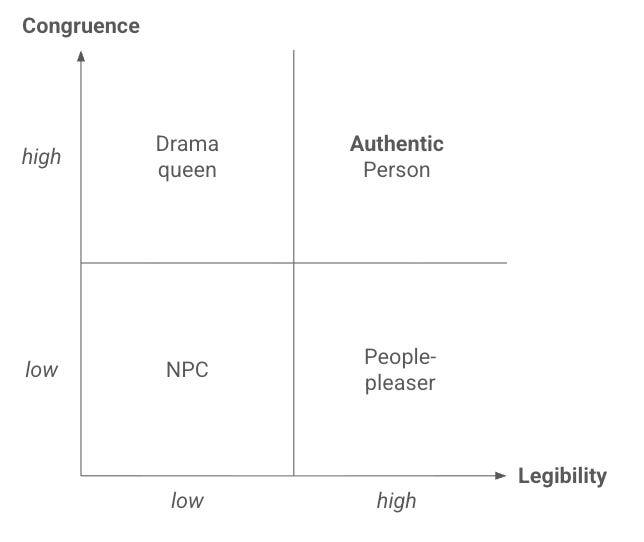
High congruence, low legibility: Drama queen, the friend who shares every feeling as it arises, whose moods set the weather for every interaction, who you never quite know how to count on. Authentic but exhausting.
Low both: NPC, practically dead inside. Heidegger’s “the they”, the person who has outsourced their opinions and actions to what “one” does.
High legibility, low congruence: People pleaser, the friend who always shows up, always says the right thing, but somehow you never feel like you know them. Reliable but hollow.
High both: the authentic person, a friend who you can read, who keeps their commitments, but who you also feel is actually there, with their own texture and reactions. That’s what we’re after.
Even though congruence and legibility are different dimensions, there can be (productive) tensions between them. A therapist might feel genuine warmth for a client. That’s congruence. But she doesn’t hug them at the end of sessions or text them on weekends. That’s legibility: the boundaries that make the role intelligible and safe. Things get interesting when they pull against each other. A client shares something devastating and the therapist feels an impulse to drop the professional frame, to respond as a fellow human rather than a clinician. Following that impulse would be high congruence. Maintaining the container would be high legibility. The skill is holding both, acknowledging the warmth internally and letting it inform her presence while preserving the structure the client actually needs.
We have redefined authenticity into legibility and congruence. But distinguishing these concepts is only half the work. The deeper question is how we relate to them.
Concepts can be a Map or a Compass

You may have noticed that authenticity as a concept is not really the problem; the problem is searching for it. Authenticity describes a resulting experience, but pursuing it directly is problematic because it traps you into crystallizing a fixed self and into performativity. The concept also points to different aspects, and mixing them together leads not only to confusion but also, frequently, to a double bind.
We gain in clarity and avoid most of these traps by distinguishing between congruence (internal; fit with experience) and legibility (external; social alignment). “Congruence” has much more fluid connotations; situations can be more or less congruent and congruent in different ways. “Legibility” foregrounds the importance of communication and social commitments over time that are otherwise easy to overlook.
Another distinction that seems important here is between descriptive and prescriptive language. A map tells you where the mountain is. A compass tells you which way to walk. “Authenticity,” “congruence,” and “legibility” are all maps. They describe an experience or situation from the outside. Useful for orientation, but you can’t navigate by staring at them. Prescriptive concepts are compasses. They give you something to move toward. Your yoga teacher doesn’t say “achieve spinal alignment,” she says “stand like a tree in the wind.” One describes, the other directs.
So what do the compasses look like?
For congruence, the sense of aliveness can act as a compass.
If you feel more alive, this usually means that different parts of yourself are all online and engaged. Conversely, you feel numb if much of yourself is disengaged or suppressed.
Notice the difference between a conversation where you’re monitoring yourself, curating your responses, and one where you lose track of time. That loss of self-monitoring is aliveness. Following it leads to more congruence across timescales, from having more interesting conversations to creating a life that suits you.
To complement that, the compass concept I recommend for legibility is “responsive commitment”.
“Commitment” because it’s about reliability, about generating trust by repeatedly showing up in a way. To avoid rigidity, “responsive” adds a relational emphasis. Am I actually receiving what others are communicating? Am I adjusting accordingly?
Think of a friend who always tells you the hard truth. That’s a commitment. You know what to expect from them, it’s part of what makes them legible as this particular friend. But responsive commitment means they also read the room. They know the difference between a moment when you need honest feedback and a moment when you need someone to just sit with you.
This is different from people-pleasing, which is all responsiveness and no commitment, shape-shifting to match whoever’s in front of you. And it’s different from rigid role-adherence, which is all commitment and no responsiveness, the cynical uncle who badmouths your father at his funeral because “that’s just who I am.” Responsive commitment holds a consistent shape while remaining porous to feedback.
Performing Authentically

The promise of this exploration is that we can get rid of conceptual tangles, avoid social traps, and go after authenticity after all. We can do so by following our aliveness, which guides us to higher congruency, more and more facets of ourselves are in play. At the same time, we are creating masks as required to be in responsive commitment with the people around us. We want our masks to be legible, but are ready to take them off if we stop feeling alive.
This stance allows us to escape the seemingly binary trade-off between authenticity and performance. Instead, we can perform authentically. We fold more and more of our complex selves into our performances, we create custom roles to maximize congruence. In a way, there is a return to clearly defined social roles - it’s just that these roles are more adjustable and customizable. Instead of being cast in a social role without recourse (“I’m a carpenter and a father”), we can create roles that fit us better, but are still legible (“I’m a friend who will always call you out on your bullshit”).
Social roles can also become less identified with a given person. In a professional context, roles like “project manager” or “devil’s advocate” could rotate rather than being assigned to one person (who will likely get tired of it).
If I had to go back to that tech company, I’d want a different deal. I don’t want to pretend to bring my “whole self.” The boundary between work-self and home-self should neither be too rigid nor dissolved entirely (you’ve watched Severance, right?). I want to bring a self to work that I can commit to, one where as many parts as possible get to contribute. Yes, I’m wearing a mask, and that mask works best when it’s not suffocating me. Not a whole self. A living one.
Ink Trails:
Why you can’t catch yourself being real
There was never a single self to be true to
The outside leaks into the inside
Fun read! I think I'm picking up everything you're putting down, but I want to bat around maps/compasses. As you say, ideas can be either; a map "this is Authenticity" or a compass "how to Be Authentic". The problem with Authentic-Map is its lack of detail: I think of rationalist catchphrases "the map is not the territory", and "Not Even Wrong". A false map would point the wrong way, but the Authentic map/description/persona/top-down doesn't "point" at all. And as naive advice, the prescriptive form "be authentic" is similarly useless, because most people don't have the skill to orient that compass towards any consistent "magnetic field". But what if they could? Maybe this is a stretch of a steelbot, but the prescription "be authentic" might really signify "know Thyself" and the shapes of thy "magnetic field", which is to say - the bottom-up knowledge and Truth about your lived experience, the sensation of Aliveness. Maybe the ur-consultant knew this, and failed to transmit the gnosis through all the capitalist layers of reproduction. Anyway, if you're still here after this pedantic navel gazing -- "your Spotify Wrapped is watching" hit me like a lightning bolt, I adore that bit
Playing your role is also critical for coordinating work. People have to know and rely on you to do a predictable thing. Family relationships also demand reliability and become some of the most defining roles that we play.