

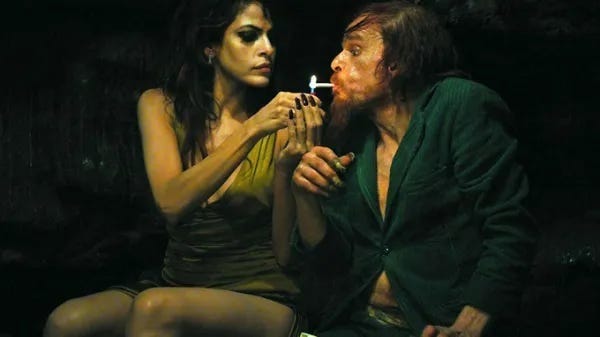
My partner walked away after 10 minutes, my brother after 50. I watched the remaining 65 minutes of Leos Carax’s Holy Motors by myself, equally bewildered but somehow entranced. There is no plot; the protagonist Oscar jumps between completely unrelated scenes. Or there is too much plot. The whole thing is so saturated with narration that there is no more thread to follow.
Early in the day, Oscar climbs out of his limousine as a hunched, ancient beggar woman, mutters on a bridge for several minutes while being ignored by tourists, and gets back into the car to read the file for his next appointment. Over the course of the day, he will also become a motion-capture fuckboi, a disappointed father, a sewer-dwelling troll who kidnaps a fashion model, an accordion bandleader, and a killer who turns out to be the man he kills. Between each, he changes costume in the back of the limousine.
Near the middle of the film, the weary actor confesses he misses the cameras and is unsure there is any audience left. When asked why he carries on, he says the same reason he started: “The beauty of the act”. On that account, it doesn’t matter much whether anyone is watching (which is convenient, because in Carax’s case nobody really was). But the position of the implied spectator doesn’t go away. The world is a stage, even if you are only performing for yourself. And how we frame that position changes how meaning is made.
“Do it for the plot” is Gen-Z’s version of “YOLO”. It emerged from TikTok in pandemic-era 2021, when most people’s milestones had collapsed and re-engagement with life needed a new permissioning. On the surface, it’s a reframe of potential negative outcomes. Even if you fail, you will at least have a good story to tell. “Do it for the plot“ decenters the present by treating it as one beat in a longer story, then demands you act anyway because plots don’t advance on their own.
Funhouse Mirrors
The TikTok version of the meme is helpful: it nudges you out of paralysis, and it places you in a universe of story. The implicit question is “Who is receiving that story?”. The empty slot of the beholder is the most interesting thing about the meme.
Most people will instinctively fill that slot according to their dominant mode of relating. For a meme that spread on TikTok, the default beholder is the social media audience. The anonymous and mostly imagined audience is the kind that fails Oscar in Holy Motors. People don’t give a shit about your story.
For the lucky or oppressed who spend more time in real-world social interactions than on screens, the beholder is intuitively filled with their partner, family, or friends. While probably healthier, this version inherits a deeper problem. Your dad, your partner, and your friend group sit at the same level as you, and what they see isn’t really you. It’s you filtered through what their psyche needs you to be. Performing for that gaze means subtly contorting yourself to fit their expectations. You might chase the image of your dad finally proud, except the original is of him withholding approval (which is more his problem than yours). You wouldn’t be the first to spend a life on that mirage.
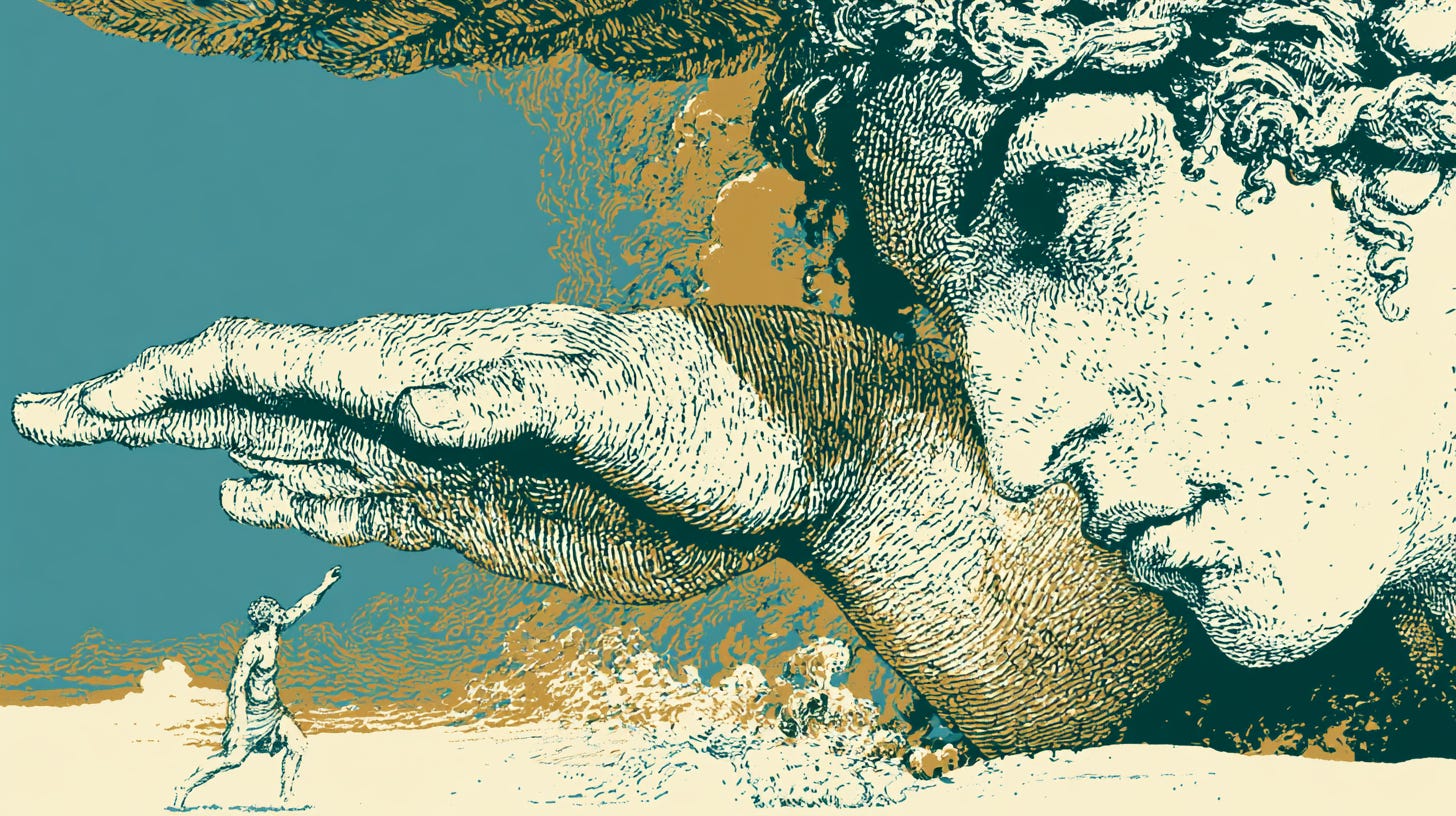
Both the imagined audience and the relational other are on the same level as the self. If we fill in a beholder of a different order than the self, “Do it for the plot” can transcend the failure modes of Holy Motors and become a holy motor.
The Eye of the Beholder
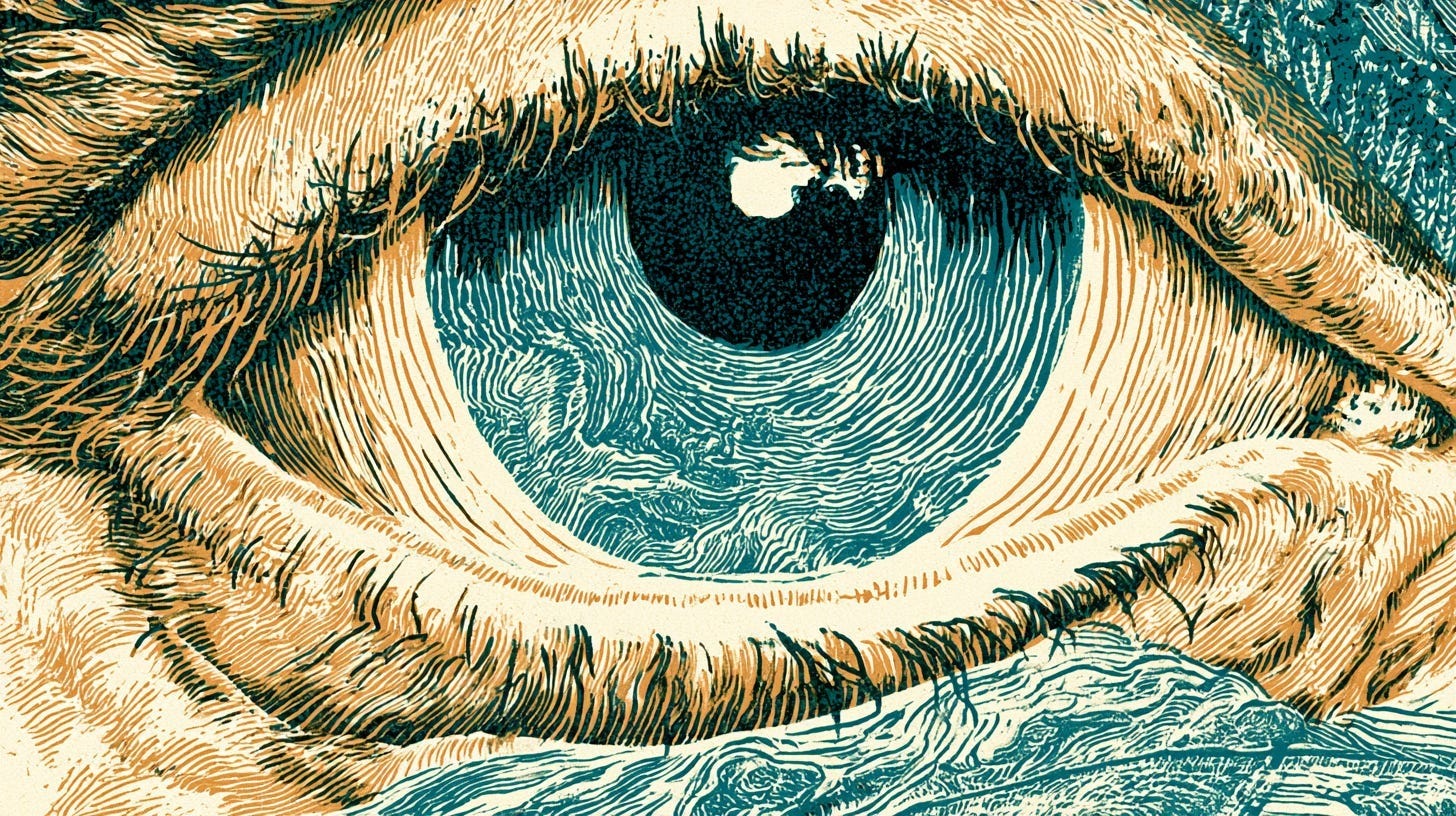
When Oscar said he carries on performing “for the beauty of the act”, even if nobody is watching, he added a vertical dimension to the position of the beholder. Oscar is performing for the part of him that recognizes and appreciates beauty. It doesn’t matter whether we call that his inner artist, his soul, or his Daimon. It doesn’t even matter whether such a thing exists. We can only ever perceive an internalized version of the other's gaze. As such, the question is not whether the watcher exists, but what kind of image we hold of them. Different images of the beholder make different meanings of the same situations.
Like Oscar, Carax isn’t making a movie to please an audience. Even if the different vignettes lack any coherent narrative strand, they each have a startling aesthetic precision. With the imagined gaze of the inner artist, the beauty of each scene is what matters, not the plot. The choice of the beholder changes what the film is. “Do it for the plot” holds an esoteric secret: consciously choosing the beholder of your plot changes the meaning of everything you do.
This displaced witness has been named many things across traditions. What matters is that the beholder is of a different order than the ego doing the performing. Verticality has two axes: how other the beholder is, and how much time their gaze covers. A relatable version would be your future self on her deathbed. More traditional would be Jesus’ gaze, or the eyes of your ancestors.
The deathbed self is still you, just looking back. But the horizon of death reorders almost everything in front of it. You most certainly won’t remember the email you’ve been ruminating about (especially given your genetic predispositions). And maybe you should call your mom, for the plot. This beholder might make you take that trip to Japan you’ve been dreaming about.
If you choose something like the soul, a slower, older quality ensues. The plot becomes less of a linear story, and more mythical, archetypal. Your life starts to seem like a fairy tale or a dream. You don’t care as much about whether you got that promotion but whether you could overcome the patterns you’ve been repeating on the way. On the level of the soul, tragedy is more meaningful than comedy. Becoming a wounded healer is juicier than getting your back fixed. By this point, a little bit of other has worked its way into the self.
Further into the spectrum, we shift into a higher gear. Across traditions, there are figures right in the middle ground between self and other: the Jungian Animus/Anima, the Holy Guardian Angel of Western esotericism, the Daimon of the Ancient Greeks, the tantric personal deity. All partially other and partially self, but of a different order than the everyday ego. This is the range of the imaginal, where interior and exterior start to blur.
The figures are not interchangeable. The Daimon wants the art that’s specifically yours to deliver. The Holy Guardian Angel wants you to become the version of yourself who can play an active role in the unfolding of reality. The Anima irresistibly demands integration. Different figures also sit at different spots between self and other. While tantric deities are designed to point to qualities within yourself, their otherness is made unmistakable by, among other things, the number of arms. Each imaginal figure organizes a different life around itself. Performing for the Daimon and performing for the Anima produce different people. The vertical tension under this gaze becomes palpable. Your life becomes a test or an offering, depending on which figure you’ve chosen (or which one has chosen you).
Some beholders are fully other but still local, like spirits. That’s who Butoh dancers perform for, not the philistine eyes of a human audience. Spirits can see right through you, so the inner state of the dancer matters at least as much as the outer form. Depending on the spirit, they might care more about beauty or truth. They don’t owe you anything, which is what makes their recognition consecrating.
Lord, I am not worthy that thou shouldest enter under my roof, but speak the word only and my soul shall be healed — Matthew 8:8
The Abrahamic Gods are so vertical that it starts getting creepy. Fully other, always watching, everywhere all at once. The dead and the unborn max out the temporal dimension too, but stay human. If your ancestors and descendants watch from outside your lifetime, consequence beats experience. Maybe working in AI safety is indeed the only thing that matters.
You Can’t Not Fabricate
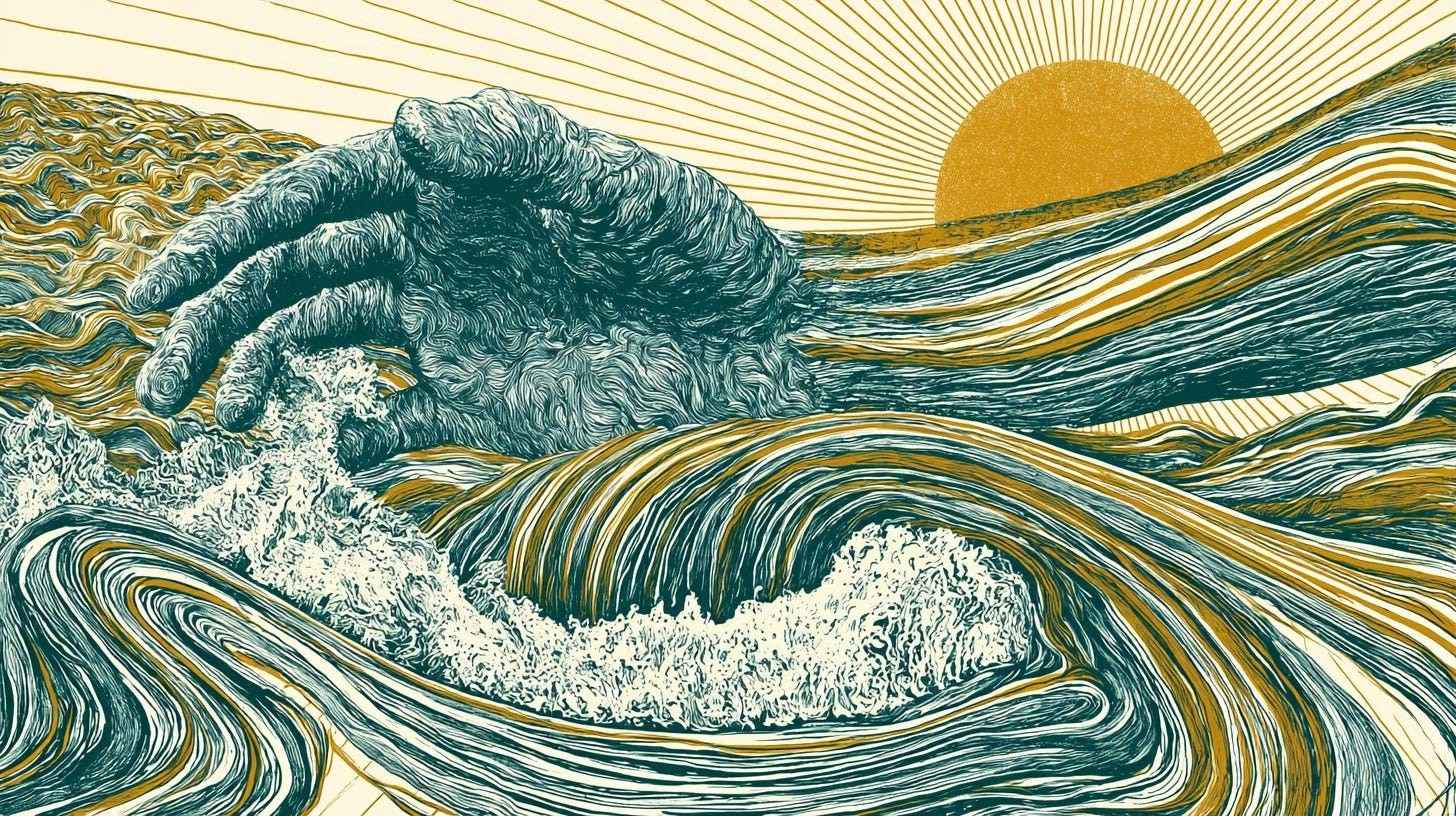
But wait, you say, these watchers don’t exist. The deathbed self is just as much a projection as an internalized father figure, and the sheer range of possible gods and spirits and angels across traditions strongly suggests improvisation. Why should performing for them produce anything more than performing for the TikTok audience?
Try it out. The next time you are unsure about a decision, imagine that your future self watches from the deathbed, and do it for the plot. Chances are that work stuff suddenly seems less important while that trip to Japan you’ve been postponing for five years becomes obvious. Partly because you used to watch Naruto as a kid and loudly slurping ramen with bits in it you can’t quite identify would close a loop you’d otherwise leave open forever. The deathbed self produces the coherence that the social media audience lacks. There is no way out of performing for a fabricated watcher; the only question is which one. A consciously constructed vertical beholder is safer than the horizontal ones, which feed back their own projections until you’re performing in front of a funhouse mirror.
If the deathbed feels too tame, upshift into the imaginal register and invoke the Daimon. That’s the bastard who is bullying me into disguising Soulmaking Dharma as film critique instead of making bank by selling automation to boomers. For Oscar, it’s the limo driver who keeps getting him to the next scene. The daimonic gift is a calling that doesn’t trace cleanly back to your preferences.
It is a fearful thing to fall into the hands of the living God — Hebrews 10:31
The upper stratum of the beholder opens up into participation in a larger pattern. When performing for the gods becomes liturgy, the gesture is offered to more than yourself. And this might get more intense than what you wanted. Nothing bursts you out of an “it’s all made up” frame like theophany. I had psychedelic experiences where the reality of the gods I encountered was not up for debate, even if I didn’t know their names. I certainly didn’t consciously construct them. It can also happen with both feet on the ground, like my friend Tyler offering his dance moves to Dionysus and finding himself in a tangle of witchy ladies soon after.
Real Enough
Through all the range of possible beholders, the posture of “Do it for the plot” stays the same: clear desire and decisive action but with no lust for results. There is an improv theater principle for interesting characters:
“Give it fully, or fully take it away”
Both are equally interesting. People on their deathbed mostly regret risks they didn’t take, not the times when they fucked around and found out. And utter failure does make for a good story. You should have seen me stumble across a catwalk in drag last month. Imaginal beings have a real appetite for the transformation that heartbreak generates. And the gods care less about the chaos of mortal life than your TikTok followers, but they might bless you with a moment of eternity if you play your cards right.
This doesn’t mean detachment; you are fully invested in the story of your life, and so is the beholder. The stakes are high, and higher with each progressive shift in verticality. If we go too far too fast, we risk falling right back into paralysis. The thought of the eternal return can put such a crushing weight on which cereal to have for breakfast that you decide to skip it altogether, maybe forever.
The question of whether the beholder is real becomes less interesting once you notice the effects on your life are. Pragmatism is where researchers, psychonauts, and mystics meet for tea.
And yet whether we see the beholder as real changes how it affects us. The realness is part of the construction (the hardest part). Luckily, you don’t need to visualize a deity at 1080p, down to the facets of the diamond in her tiara to get the effect. The modernist stance of dismissing the Daimon as a made-up projection will dampen it. Naively believing the Daimon is a metaphysical fact and obeying it literally will get you to a psych ward faster than you can say Eudaimonia.
Between these failure modes is Rob Burbea’s “imaginal middle way”, the stance of neither affirming nor denying the reality of an image. Fabrication is the throttle, emptiness is the brakes. This middle way is what distinguishes the practice from naive belief on one side and modern dismissal on the other. So if the eternal return crushes you, hit the brakes: It’s just a thought experiment.
Out the Bottom
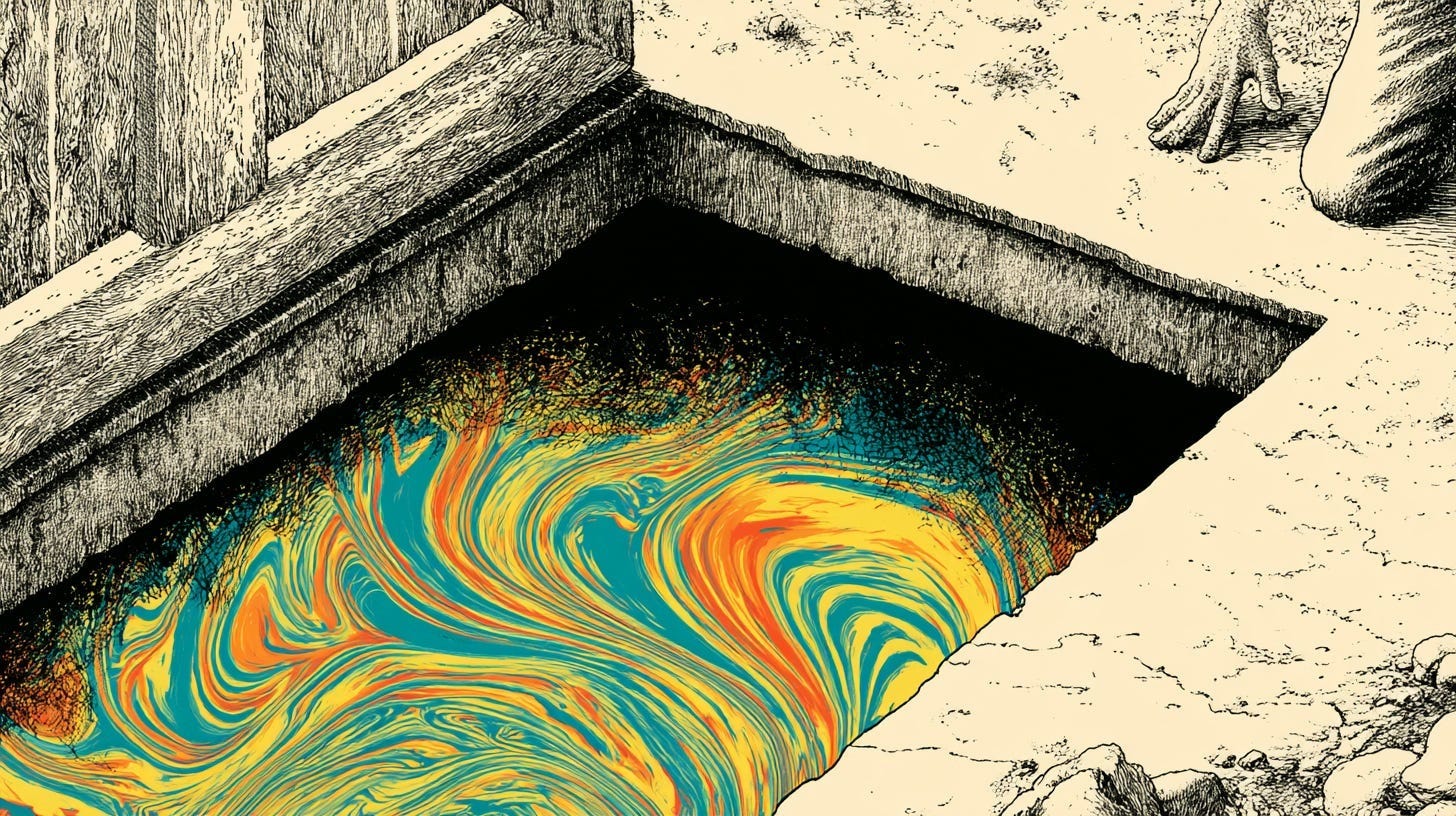
Sometimes the brakes are the whole answer. The initial “Fuck it” version of “Do it for the plot” is a necessary move to have in our repertoire. The decentering loosens the grip on outcomes because we reframe from the beholder’s view, and sometimes the right beholder is the empty set. Nihilism is a trap door out of paralysis. If nothing matters and you don’t really care what happens to you anymore, you suddenly find yourself free, despite the numbness in your stomach. Buckminster Fuller became Buckminster Fuller only after he wanted to kill himself and decided to run a few more experiments before that.
A direct experience of emptiness has the same function. While fabrication is not optional for most people, it is rumored that it can be suspended entirely at the further reaches of meditative attainment. From the absolute view, it’s all sparkling bliss-consciousness, all lives are equal, and no action is finally consequential. The recognition that there is no big Other, no final guarantor of meaning, is the deepest kind of freedom. But skillfully constructing one anyway can lead to richer meaning and a more enchanted life.
“Do it for the plot” is a trap door into meaning, dropping through the bottom of nihilism and upshifting through the registers. What matters most isn’t which beholder you choose but noticing who currently fills the slot, and toggling between them is how you get an engine for meaning. The rest is just driving.
Whether Oscar’s inner artist is real is the wrong question. By the end of the film, he’s still going, still climbing into the limousine for the next role. The audience is gone, and the cameras may not be running, but the performance continues because he dances for the spirits. The beauty of the act is real.
Want to conjure angels together? Book a coaching call.
In gratitude for Rob Burbea’s teachings
Ink Trails:
Profilicity describes the internalized social media audience
Jungian depth psychology adds otherness within the self
Crafting frames is a similar practice from the side of the self
Witchy ladies: check out Gordon’s take on the meme (rest in power) and Layman on the implied watcher in ritual