


How could you possibly love suffering? Suffering and loving seem like opposites. It is only a contradiction if you limit “loving” to feeling good. But a life of pure comfort is hollow. What you want is meaning. The question isn’t how to enjoy pain (another time, masochists), but how to find a deeper satisfaction in life that isn’t dependent on feeling good.
“I want to learn more and more to see as beautiful what is necessary in things;
then I shall be one of those who makes things beautiful.
Amor fati: let that be my love henceforth!”
Nietzsche said that “loving our fate” is the answer, but he never told us how. So I'm going to try to reconstruct the route. Meanwhile, Amor Fati has been tamed in modern self-help: gratitude journaling with Latin branding. “Make the best out of it”. Stoicism cosplaying with a thick moustache.
But Nietzsche wasn’t a stoic. Stoics believed in an ordered cosmos, while Nietzsche believed in primordial chaos that we project meaning onto. And he was talking about more than acceptance: love for the fullness of our random fate, including the suffering. Not tolerate it, not reframe it, not breathe through it or deconstruct it. Love the suffering.
That is a radical claim coming from a physically sick man who eventually went mad too. Nietzsche gave us the destination of Amor Fati but not the instructions on how to get there. I suspect that’s because he refused to go where that path ultimately led.
Gratitude

Before attempting to love our fate, it’s best to start by being grateful for the good stuff in our lives.
Yes, my eyes roll over too when I hear “gratitude”. It has become a productivity hack with prayer hands. As if “I’m grateful for my health” was a spell that banished cortisol and summoned inbox zero.
However, gratitude actually works. The trick is noticing what we’re actually grateful for, not abstractions we think we should feel grateful for. The feeling is the point - that warm upwelling of “thank you” in the chest. The words are just support. Once we can access that feeling at will, gratitude becomes base camp; a feedback loop of thought and feeling we can return to.
While the practice promotes letting go of entitlement, the self remains in charge: we’re curating, evaluating, choosing. I’m grateful for the sunshine, not the leaking sink. There’s a filter.
Still, don’t underestimate gratitude. The Eastern gods dwell in the Brahmaviharas - lovingkindness, compassion, joy, equanimity. But gratitude is where the Western gods hang out. And we can ride it all the way up the mountain of Amor Fati.
Amor Fati

After replenishing ourselves at camp gratitude, we start the ascent. We enter Amor Fati as we remove the filter of what we consider good. Amor Fati is radical gratitude: grateful not only for the good but for everything, including the worst suffering. There are two ways up that mountain.
The first is to just keep riding the momentum of gratitude. If we get really good at fanning the flame, our gratitude becomes progressively more omnivorous. From concrete to abstract, from close to far, from positive to neutral. Until it devours even the rotten, moist sticks of our sloppily suppressed anxiety. Gratitude burns itself into the lens we look through, independent of what we’re looking at.
There is also a more efficient route than brute-forcing our way into Amor Fati. Philosophical inquiries can directly subvert the filter of good vs. bad. Consider that good and bad are relative and mutually constitute each other. If we need a bad day to have a good day, we can’t be grateful for one without the other. The gratitude needs to include the whole wave, the crest, and the trough. The story of the Chinese farmer takes this further: we can’t predict the long-term consequences of anything. A horse running away leads to it returning with wild horses. A broken leg leads to avoiding conscription. This view suspends the judgment of good and bad in the first place.
Either of these two ways can overcome the filter, so we can become Nietzschean. Once we suspend judgment, we can create our own meaning out of the building blocks of experience. To “see as beautiful what is necessary” is to make things beautiful. We take full responsibility for our situation, instead of stoically retreating to a small circle of control. This is the stance of the Overman.
Whereas stoicism is robustness, Amor Fati is anti-fragility. Post-traumatic growth in the prophetic tense. The more bad stuff happens to you, the greater the call for meaning. That meaning retroactively validates the suffering, because your life was built on it. Amor Fati is the faith that we will be able to create meaning commensurate with the suffering. I heard a touching example of how the cancer of someone’s best friend gave rise to a sacred responsibility of “living for both of them.” Such radical gratitude requires a leap of faith, because it seems inconceivable at first to actually be thankful for the worst things that happen to us.
Suffering transforms you into someone else entirely.
The old self needs to die, and the rebirth proudly carries its cause of death as an adornment. Suffering activates vertical tension. The Buddha searched for enlightenment because he suffered. Nietzsche became dynamite through the acid heat of his suffering. This also applies on a mundane level: I remember distinctly what my teenage self thought while lighting that first cigarette: “worst case, overcoming this will be a great challenge.” Asshole. But I did overcome it eventually, and now I can not only love that little punk for it, but even the struggle to quit.
Révolte
Do not go gentle into that good night.
Rage, rage against the dying of the light.
Suffering calls us to alchemize it into a beautiful life. But that doesn’t apply to the suffering of others. Children die of cancer. That’s unacceptable. Old age, sickness, and death are the birthright of all of us. Preposterous! Underneath that rage, if we really let in the suffering of others, a glass wall in the chest finally shatters (it was never going to protect you anyway).
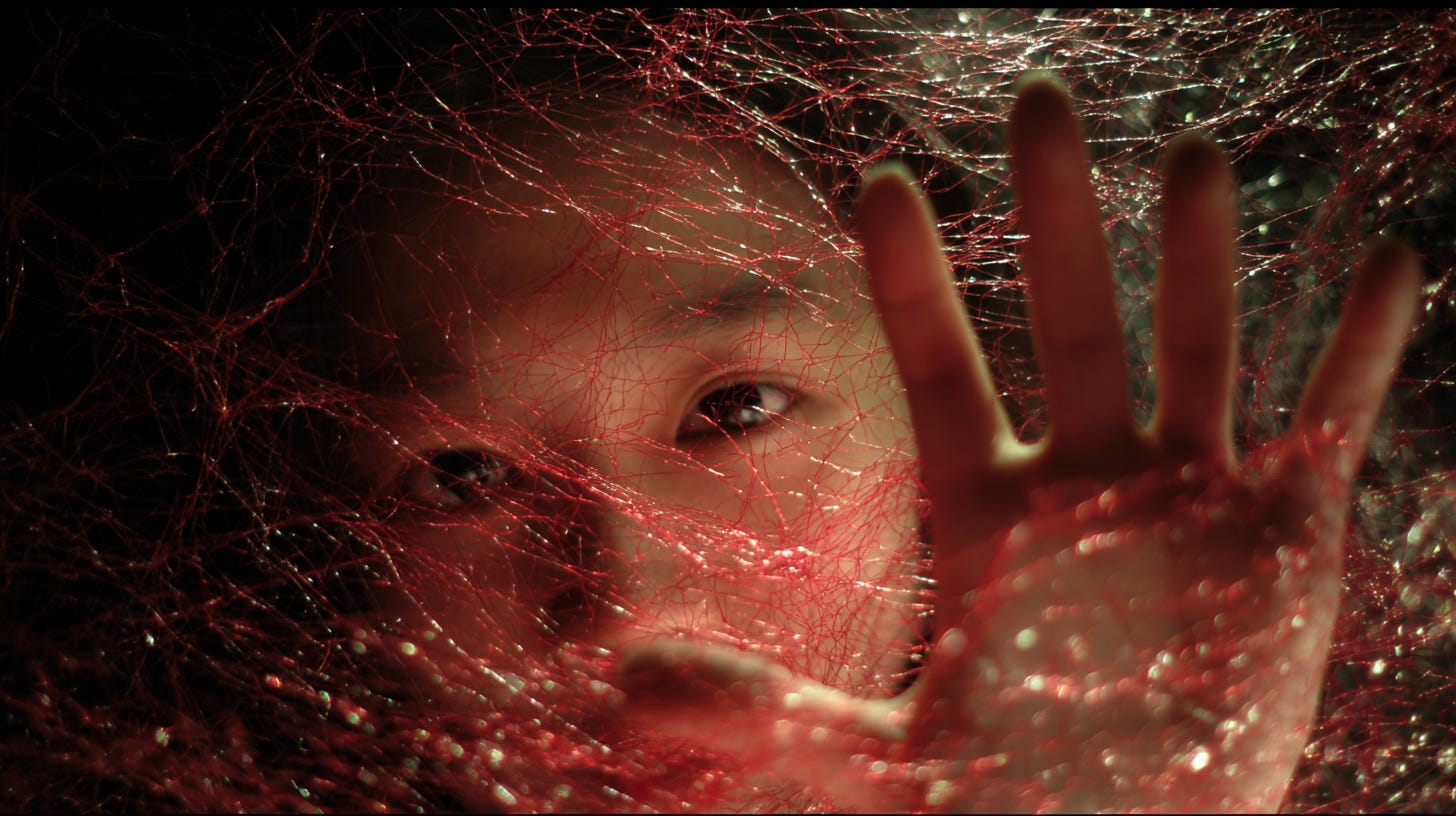
Sweet grief pours out like honey in salt water, and the mountain disappears. What's left are threads that connect us to everyone who suffers. With our hard-won Yes, we look around. And we see: we were never alone. The mountain was a solo climb, but suffering is a web, and we are caught in it together.
Camus called this “révolte”. The rebellion against our cursed condition is what unites us in our humanity, what reveals that we were never alone in it. It’s not just poor me that suffers. Everyone does, and some have it much worse. The fact that we share suffering makes any of our differences seem insubstantial. I rebel for the sake of those who didn’t have the privilege required to play mountaineer.
“I revolt, therefore we are” - Albert Camus
Révolte is the No that binds. The pain of my own suffering and the knowledge that others suffer too leads to compassion. This is where meaning-making breaks out of self-centeredness. Suffering is why anything matters; why life has depth and stakes. While my own suffering calls for self-transformation, other people’s suffering is my call to action. And there is so much more meaning in the latter.
Camus provides the missing piece: We can fully love suffering by recognizing that it’s what connects us to others. Because of suffering, we are not alone. Which doesn’t mean that we won’t rage against it. If we can hold both the Yes of Amor Fati and the No of Révolte at the same time, we have moved beyond Nietzsche’s Overman.
Grace

We’re bound in the net of suffering together. And it’s moving. The threads are sticky, connecting you to things you didn’t choose and can’t easily shake off. Some pull you forward to help others who suffer. Others pull you backward toward the ones who caused your suffering.
Follow the threads forward.
“With great power comes great responsibility”—but the power tends to arrive as a wound first, and the thread grows from that wound.
The way that my parents didn’t listen to me calls me to listen to others. How I’ve hurt my ex by lying is what compels me to be truthful. How I’ve hurt myself by abusing substances is why I want to help others with that same problem. On a good day, I pass the thread on transformed. On a bad day, I talk about my latest vibecoding obsession instead of listening to you (just like my dad talked about football instead of listening to me). It passes through me unchanged and tangles someone else up.
The threads create responsibility; but not the imposed kind. “Lineage” exists in spiritual, academic, and artistic contexts. Lines from teacher to student, through the millennia. In Buddhism, there are lineages traced back to the Buddha. The dhamma is taught for free. But the true payment is to pass on what you have embodied. Not because you “should” but because that’s what it means to have really learned something.
Students find their way to masters when their own developmental potential resonates with the living expression in front of them. We choose which lines to follow, but any development comes from somewhere and wants to go somewhere. The relaxation in movement I learned from my martial arts teacher Dragisa passes through me as I dance contact improv. I just dance, and there he is in the movement. The responsibility became invisible because it became me. There is no straining necessary to continue weaving since you are the weave.
Does your responsibility feel like a burden? If so, your Amor Fati is incomplete.
That’s the edge of your Yes.
Follow the threads backward.
You’ve become porous, a knot in a vast meshwork. The punchline that Nietzsche didn’t see coming is that if you say Yes to your suffering, you have to say Yes to what caused it. If you say Yes to what caused it, you have to say Yes to who caused it. The parents who didn’t listen. The bully at school. If I needed these wounds to become who I am, I also needed the ones who dealt them. Keep following that Yes and it becomes mercy. He would have hated this.
Three Times Yes
The first Yes is gratitude for the good things in life. The second Yes is Amor Fati: affirming even the suffering. The third Yes is harder. You discover your fate is not a mountain to climb, but a web made out of suffering. Saying Yes to that whole web, and not just your strand, is what makes responsibility weightless.
How do we love suffering? By letting it transform us. By letting it bind us to everyone else who suffers. And by following that thread until the Yes extends even to those who wounded us. Nietzsche wanted the Yes without the mercy. But the Yes has always been mercy.
Over the past year or so I have become reading-disabled due to AMD, and I have found that this, too, can be a source of gratitude. Listening turns out to be more enjoyable than reading has been for me in years. Music has become more central to my daily life — a shift I had long wished for but that never seemed to materialize on its own. Learning by ear was always my favored method, and now it is quite essential. And I find myself relying more on friends, which has brought us closer together. For all of these things, I am grateful.
This is incredible! I love pieces that draw connections between different schools of philosophy and this one is particularly powerful