

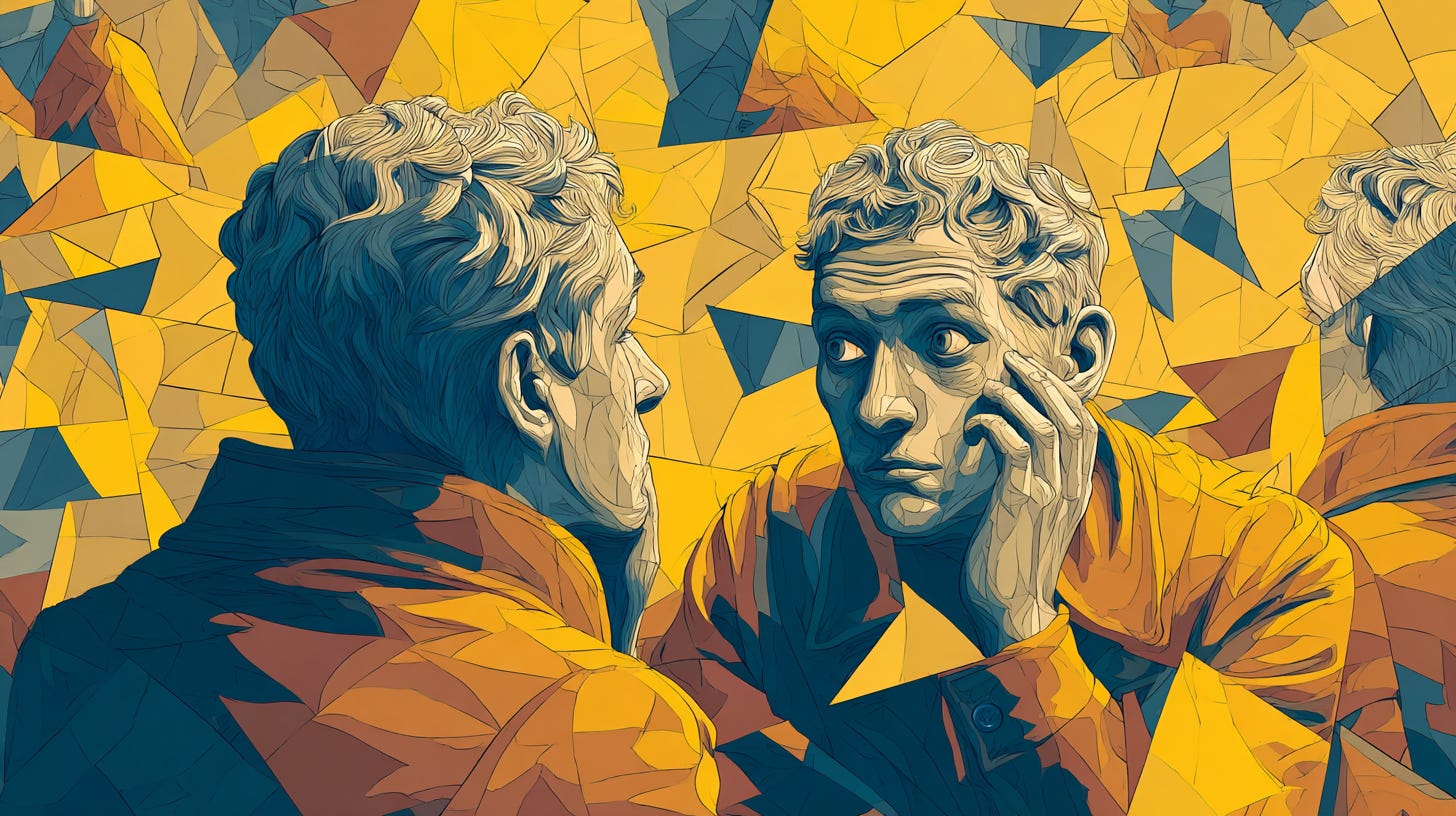
Humans are the creature that doubles, that loops in on itself. We are the only animal that screenshots its own consciousness. We think about thinking, feel about feeling, and watch ourselves watching. This recursive capacity, our strange ability to take ourselves as our own object, perhaps what most distinguishes us from other forms of life.
Initially, doubling is our fall from grace, our exile from the garden. Self-consciousness is the core wound of separation. By simulating ourselves, we necessarily stand apart not just from ourselves, but the rest of the universe. We become both subject and object, both the observer and the observed. And in that strange gap between the self that experiences and the self that reflects on that experience, we grow horrors and marvels: the capacity for self-deception, for self-torture, but also for growth and self-transcendence.
I define “doubling” as “the capacity to relate to a part of ourselves”. Doubling is always partial: Just like a mirror only reflects a 2D visual image, a double is only ever a part of the whole. Internal Family Systems (IFS) is probably the most popular modality that leverages this capacity directly in a psychological context. What this essay is pointing at is that doubling, the pattern of first separating out a part (“unblending”) and then relating to it, is extremely general across different modalities of human growth.
Doubling is not just our fall, but also our way back home. Like the cells in our body, we double ourselves towards a larger wholeness. What looks like fracture is actually the fundamental gesture of growth.
Doubling as Developmental Engine

Doubling is not just a side-effect of excessive Instagram use but seems to be a deeply ingrained part of human development. We’ll see that it is required to navigate social situations, to facilitate learning, and to develop more complex perspectives.
The Social Brain and Recursiveness
At its core, doubling involves modeling ourselves as an agent in the world. The most general form of doubling is self-consciousness. We create a simulation of how we can affect change in the world and how others perceive us. It has been theorized that our ancestors developed these self models primarily to relate to others: Modeling how they would feel when in pain, when angry, etc., they could better predict how others would behave in similar situations. Self-consciousness is social intelligence turned inward. Unfortunately, most of us use this superpower primarily to replay embarrassing moments from high school at 1 am.
Taking ourselves as an object is also a key capacity for learning, as theories of metacognition have long argued for. If I can observe myself, I can notice what works and what doesn’t, to then make plans on how to improve. For example, I can monitor whether I’ve understood something or not, recognize gaps in knowledge, and reflect on my process.
Developmental Doubling
We double as we grow, and not just in learning specific skills. From Piaget to Kegan, developmental theory is essentially a map of progressive doublings: At each stage, there is a subject-object shift. What we were previously embedded in and identified with becomes an object we can observe and act on.
The child is subject to her impulses; she is her desires. The adolescent can observe those impulses and is now subject to her interpersonal relationships instead. She is her friendships, her social identity. The adult at the socialized mind can step back and observe those relationships, but remains subject to the expectations and values of her culture. She is her ideology, her role, her institution. Etc.
Each transition involves a doubling: a new observer emerges that can take the previous self as an object. The self that was doing the living becomes something the new self can examine, critique, revise. Instead of being stuck with blurry vision for mysterious reasons, you get to take off your glasses to clean them.
The Doubling Meditator
Once you’ve locked in on the doubling pattern, you start seeing it everywhere where growth is involved. Progress in meditation also proceeds through doublings:
The first doubling is an unblending of sensations, thoughts, and emotions from a mindful observer. This mindful observer (often seemingly located somewhere in the head) then mindfully observes and inspects different parts of experience.
The next doubling takes the mindful observer as an object, realizing that it was just a construction (e.g. by trying to find it and/or turning attention back on itself). Now, the mindful observer is the object, and awareness itself (not localized anywhere) is the subject.
The doubling pattern culminates and then breaks down once awareness itself is seen to be empty and sensations arise as knowing themselves (yes words break here, please consult your nearest Zen roshi). At any rate, once the split between subject and object itself is undermined, the doubling stops.
The Curse of Narcissus
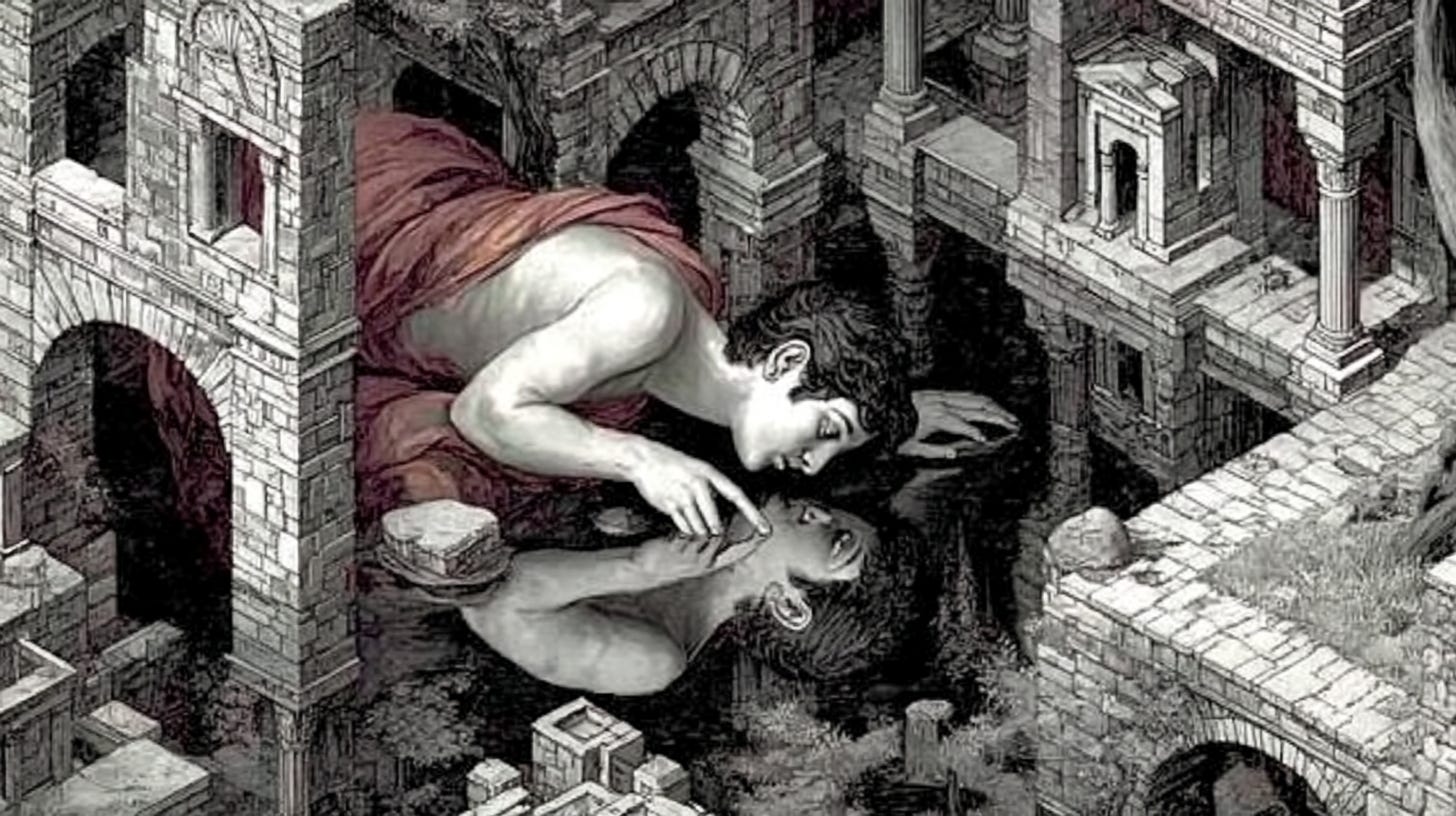
“A centipede walks perfectly until asked which leg moves first; suddenly self-conscious, it becomes paralyzed.” - probably Alan Watts
Doubling enables growth, but it also opens the door to a particular kind of suffering: becoming trapped in the mirror. The same capacity that allows us to observe and improve ourselves can become a labyrinth of self-afflicted misery.
A classical example of this is how self-consciousness takes you out of flow. The centipede walks perfectly until it tries to observe itself walking. You’ve felt this. The moment you start watching yourself perform, you slip. “Remove the mirrors from your mind,” said the dancing Daoist, because reflection and action are fundamentally incompatible modes.
However, the deeper pathology is what happens when we can’t stop watching the reflections on the mirror of our minds. Psychological studies and Buddhists agree: excessive mind wandering makes you miserable. The mind left to its own devices creates its own hell realms. Your ruminations feed on themselves, negative thoughts breeding negative emotions in an endless recursive loop.

Once you’ve doubled yourself into a mindful observer, you can listen to the babbling brook of your ruminations and discover they’re actually quite boring. Running in circles, leaping across dubious associations, always looping back to the same subject: you. What you did and what you will do, should and want and could and oh, the drudgery of always thinking about yourself. You are your own worst Netflix show: infinite seasons, no character development, terrible reviews, yet somehow you can’t stop watching.
This tendency toward self-obsession finds its perfect accelerant in our digital doubles. Whether Instagram or LinkedIn, we now project images of ourselves to influence how others perceive us. It’s not just celebrities haunted by their public persona anymore, we all are. Like Narcissus, we can become so enamored with the image we project that we stagnate, trapped between the glamour we cast and the reality we live. The comparison breeds imposter syndrome at best, derealization and depression at worst.
What makes the digital double particularly insidious is how it smuggles the other into the self. Our projected image isn’t really us, it’s our simulation of what we think others want to see. The preferences and judgments we imagine in others leak into our self-image, colonizing it from within. We double ourselves, but the double is already contaminated by what we think we should be rather than what we are.
That leaky boundary between self and other is the doorway to a stranger territory yet. Until now, we’ve been discussing doubles that emerge from parts we’re identified with. But there’s a weird form of doubling where we relate to something initially experienced as “other” with the same relational capacity. We stop projecting outward and start recognizing these seemingly external forces as an interior landscape. In the most esoteric forms of doubling, becoming other to oneself is the path home.
Alchemical Doubling: Becoming Other to Oneself
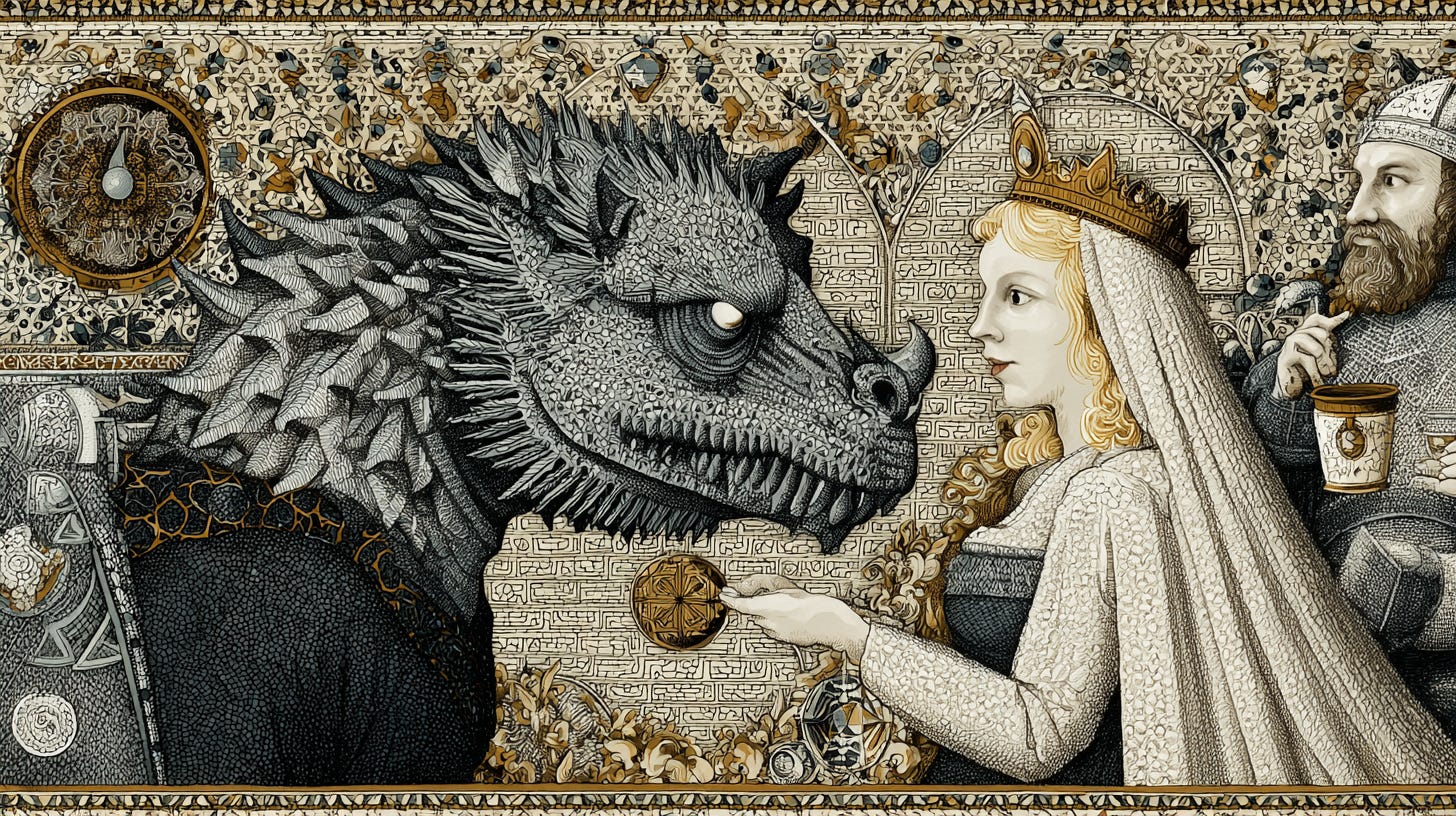
Carl Jung was obsessed with alchemy. He mapped the alchemical stages of nigredo, albedo, and rubedo to the complexes of the shadow, the anima/animus, and the Self. Only by integrating these psychological forces initially seen as “outside” can a person fulfill their developmental potential. What has changed from the previous forms of doubling is that alchemical doubles first seem like something other before being seen as part of the self. We become more deeply ourselves by integrating the other within us. We’ll follow the Jungian individuation process in this last chapter to stretch the concept of doubling to its limits.
The Shadow: The original Doppelganger
The doppelganger motif in literature aligns well with Jung's concept of the shadow. When Dostoevsky’s Golyadkin meets his double, the experience drives him insane. The doppelganger mocks him, undermines him, does everything the timid clerk cannot bring himself to do. This is the Jungian shadow: all the disowned parts of ourselves, the impulses we’ve repressed, the potentials we’ve denied. The shadow is everything we’ve decided we’re not, everything that doesn’t fit our self-image. The story of Jekyll and Hyde points to the key lesson: the more violently you repress the shadow, the more monstrous it becomes when it finally emerges. Hyde grows stronger each time precisely because Jekyll keeps trying to eliminate rather than integrate him. The shadow is basically your psychological junk drawer. You know, the one with the extra cables, old batteries that might still work, keys to unknown locks, and that rage you’ve been meaning to deal with since 2008.
What protagonists of doppelganger lore never do is own the qualities in their shadow proactively. At that point, the shadow transforms from an outer threat into an inner capacity. The faculty that holds all that does not fit the active persona. Like a faithful mule, it carries what is not yet ready to be integrated right behind you. Can’t see it, but you can smell it.
In IFS, we deal with destructive firefighters by noticing that they have been protecting us from perceived harm. The most effective way to integrate the shadow is to see it, accept it, and even love it. Like Padmasambhava domesticated the local demons of Tibet, transforming them into protectors of the dharma rather than obstacles to it, we can convert our inner monsters into allies.
The Lover Within
The integration of the shadow opens up the purification process of albedo. At this stage, the aim is to take back our erotic projections. The anima/animus are the contrasexual soul-images that mediate between the ego and the unconscious. They’re often projected onto others, especially in romantic/erotic contexts.
When you have an animus/anima projection, you’re unconsciously arranged to encounter certain qualities “out there” that are really yours. The person who keeps attracting “unavailable” partners might have an anima/animus that enjoys longing. The work of albedo is to withdraw these projections and become aware of the lover within. Cut out the intermediary of ghosting situationships and relate directly to the inner princess who seems to require some sort of courtly love.
A variation on the same theme is provided by “Existential Kink”, saying: don’t just intellectually understand the projection but feel into the pleasure you’re already taking from it. Find where a part of you is secretly turned on by the patterns you keep repeating.
Just like the integration of the shadow can leave us with internal protector figures, the integration of the anima/animus can lead to the felt presence of an inner lover. This is a tremendous resource for self-love. I can directly relate to the part of me that loves myself fully (especially the weird, rough edges). Like emotional body doubling, it can feel like there is a beloved presence who feels what I feel, a most intimate companion to go through life with. Sometimes, the voice of my inner critic is replaced by my inner lover, and the harsh critique turns into gentle understanding, addressing me with sweet pet names.
If this sounds absolutely cringe and cheesy, I get it. I cringe as I am writing. Being cringe just might be the price to pay for self-love, and it’s worth it.

Conjunctio and the Divine Double
The final stage of the alchemical process is rubedo, completion. It’s often described in terms of the union of opposites within: good and evil (shadow), masculine and feminine (animus/anima). An inner marriage completes the individuation process. The idealised form of this completion gives rise to a final alchemical doubling: An inner wisdom guide, which would be called the Self in Jungian terminology. Variations of this concept appear with remarkable consistency across traditions. Socrates’ Daemon guides him through hard decisions, while Hermetics follow their Divine Double. Christian Mystics from Meister Eckhart to Paul assert that “Christ is within”, the imago dei that precedes the fall into ego-identification. In tantric practices, a specific form of God is related to as an inner image (i.e., a Yidam or Ishta Devata) and ultimately merged with.
There are common themes throughout the different spiritual traditions. First of all, the Divine Double is not created, but discovered. It’s always already present. Second, it is a source of guidance and the bridge to the transcendent. There are also important differences, most interestingly, whether the Divine Double is personal (e.g., Daemon), transpersonal (e.g., Yidam), or universal (e.g., Christ within).
Personally, I can sometimes access a certain flavour of intuition that I associate with the Divine Double. A silent knowing in the chest, subtle but deeply trustworthy. At least in my case, access to this inner guide is spotty at best.
And as always, distinguishing between wisdom and crackpottery is important here. It’s easy to find New Age types embodying their “higher self” mainly through strategic crystal placement. Listening to voices inside one’s own head is more common in the madhouse than the monastery. Maybe just ask yourself, “What would Jesus do?” for starters.
Solve et Coagula: All Doubles Must Come Home

The alchemical maxim points to something essential about doubling: it’s always temporary. We separate out parts of ourselves not to keep them separate, but to transform them by relating to them, and ultimately reintegrate them. Doubling is an intermediary step only, a ladder to be discarded once we’ve climbed it. The IFS part that protected you from childhood trauma does not need a permanent seat in your inner pantheon but can dissolve once its work is completed. The shadow, once integrated, need not lurk as a separate entity. Even the Divine Double points beyond its own existence.
You’re never done with doubling, though. The capacity remains because it’s useful. You’ll keep fragmenting and reintegrating throughout your life, pulling back to observe when you need to and dropping back into flow when you can. What changes is how tightly you grip the mirror. Growth isn’t achieving some final integrated state. It’s learning when to look at yourself and when to just fucking live.
We started in the garden before that first doubling split us from immediate experience. We’re not getting that innocence back. But we can learn something better than innocence: skill. How to move between reflection and presence. How to use self-consciousness without being trapped by it. How to be the creature that loops without getting stuck in the loop. Ultimately, the centipede learns to walk again. It still has all those legs. It just stops asking which one moves first.