


Right, right, left, right. You are sitting on the toilet swiping. Your thumb has learned your preferences well enough to swipe faster than your mind can weigh in. You’ve gone more omnivorous lately, because the math for a sub-80th-percentile male is what it is. Maybe you are rushing because you can feel how every stroke is subtly degrading you by entraining the most blunt of male gazes (hot or not?) while the conversion rate is reminding you how unworthy of female desire you are. It’s just as bad for the ladies, I hear, in a different way: inundated by autocomplete opens that are the rhetorical equivalent of dick pics, plus the occasional rando holding a fish.
Shouldn’t this be easier? We have phones that can hail a car from anywhere on earth, translate a Cantonese menu in real time, summon Tarkovsky or a sleep-deprived Brazilian streaming Geometry Dash. Romantic coordination is one of the oldest problems humans have, and the entire history of technology has been the story of solving coordination problems. Why is dating so broken?
Nearly half of Americans under thirty are single. Friend-mediated meeting fell from forty percent to twenty percent between 1995 and 2017. The share of young men reporting no recent sexual activity has roughly tripled in a decade. In the same period, $150,000-per-year matchmaking services have quietly become a thriving boutique industry. Somewhere along the way, getting laid started looking like a luxury good.
The shape of the problem keeps recurring. Stock markets pointing up and to the right while normal people struggle to make ends meet. Shelves full of pop tarts and short on tomatoes. Material abundance at unprecedented scale, relational poverty alongside it. Markets are the most powerful coordination technology ever invented, and the root of evil. Economists and sociologists have been at each other’s throats over this for a century because none of them are trained in Zen koans.
Leviathan’s Tongue

De gustibus non est disputandum - economist prayer
Markets start with taste, the fact that humans want some things rather than others, and different humans want different things. You can’t argue about taste: the economist doesn’t ask why you want the thing, only what you’ll pay. Everybody comes in with their own taste and the market aggregates them into a demand function, that then, as it is matched with supply, creates a price. If the Leviathan is the collective body individuals assemble into, markets are the tongue of the giant.
For individual preferences to aggregate into this collective sense organ, they need to be normalized, compressed. The factory in Shenzhen can’t act on your longing for a felt sense full of potential around every corner while simultaneously having nothing to prove, but it can make a Mac Mini for $300. The dating app can’t act on your wanting somebody who gets both your kinks and your tasteful economics metaphors, but it can serve you a face and a horoscope. Markets transform rich private preferences into lossy encodings that can travel across physical and cultural distance.
Compression is not a problem in itself. The tongue is an evolutionary marvel: It compresses an enormous range of chemical signals into five scalar values and produces a coherent verdict in milliseconds. Markets perform the equivalent for billions of dispersed wants, and it’s the best way we’ve found to coordinate the economy (solving Hayek’s knowledge problem that haunted central planners). Yes, the lack of a better information aggregation mechanism is why we can’t have nice things (communism). Look around. Most items in your field of vision have been produced in this way.
This is the compression stack that information flows through before it reaches the market.
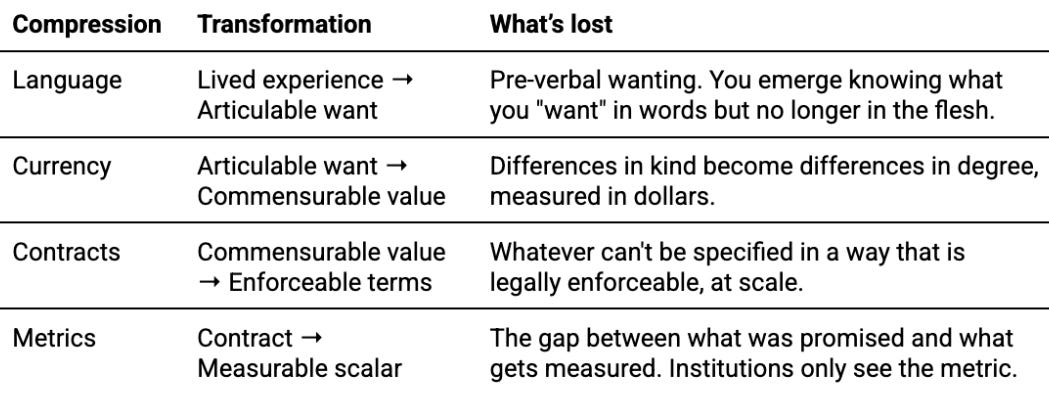
It started as a longing for someone who gets you, somewhere between your chest and your gut. It comes out as “tfw no gf”. Sweet and salt have words, but the body’s slower hungers don’t. Then language hands it to currency, which wants a number. If it feels weird to compare a Tinder Gold subscription with a matchmaker, or Grok’s AI companion with getting back together with your high school sweetheart, it’s because it is. By normalizing, we lose the relational texture, which in this case, is most of what matters. Then, contracts. You can’t buy “a juicy and meaningful relationship” because no court could enforce it. What you can buy is unlimited likes, one super-like, and a thirty-minute visibility boost for $9.99 per month. The final translation is done by the corporation from contracts into dashboards. Tinder is tracking customer lifetime value, which means it wants you to keep paying, and for that, it would be convenient if you stayed single. Goodhart’s law runs the feedback loop, and the optimized product drifts further from the want it started with, while you slowly get gaslit into believing you wanted cotton candy instead of a home-cooked meal.
Sawdust in your Coffee
I never intended the fact that I met my partner through friends to be a flex. Overlapping social context like friends, work, or a scene used to be how almost every couple met. The social embedding produced natural filtering and long evaluation periods. The occasional introductions by friends had skin-in-the-game because of reputation. Dating apps compressed this rich ecology into a bilateral transaction based on swiping pictures that sometimes include a height in centimeters.
Baumol noticed in 1966 that while the labor input for a string quartet hasn’t changed, the cost rose enormously because productivity gains pulled labor costs up across the economy. Services (where labor is the main input), from teaching to therapy (and yes, matchmaking) become more expensive while cheap substitutes flood the market. AI accelerates this to a whole new level: Any service needs to be either scaled and productized to compete with cheap offers for the masses or become a boutique offering for the few who can afford it. This dynamic is the same that led to merchants stretching coffee with sawdust in the 1800s.
The displacement compounds because the cheap proxy doesn’t just out-compete the fuller version on price; it erodes the conditions the fuller version needed to exist at all. The dating apps lead to bars and other meeting places being less frequented. As the marginal user switches to the apps instead of going out, meeting IRL becomes rarer and approaching someone in a coffee shop starts to feel like a misdemeanor.
Finally, people who have never experienced the real thing adapt their preferences to what’s available. Sugar trains the tongue to crave more sweetness until fruit only tastes sour, and Ben & Jerry’s Double Chocolate Fudge only seems like a moderate treat (you can’t take it away from me). A generation trained on dating apps will report, sincerely, that meeting someone through friends feels weird and inefficient. The umami of real connection doesn’t even register because there are no receptors for it. The two Ronalds (McDonald and Reagan) have been running this play, as above so below, until we forgot what real food tasted like.
Can We Patch This Thing
Leviathan’s tongue is lossy at every stage, and the losses compound. The obvious move is to make more of what matters survive the trip from the body to the trading floor, even if some of those interventions are a bit of an acquired taste.
Currency is the deepest compression we routinely accept without noticing. Every want, no matter how strange, gets normalized into a single comparable scalar before it touches the market. But normalization doesn’t require monoculture. While the global economy runs on dollars, the world doesn’t. Whether you denominate your contracts in USD, Yuan, or Bitcoin already expresses your alliances. There’s room for many more. Resource-backed currencies could carry planetary boundaries directly into the price. Robin Hanson’s sacred money can only be spent on sacred activities, with friction at the boundary where it converts into the ordinary kind. Reddit karma is already a version of this, badly. Tuned for improving the social fabric, a similar currency can buy you an introduction but not a swipe.
Contracts are where the demand side gets a chance to push back (and mostly fails). The boilerplate gets written by the supply side; take it or leave it. The fix is for the contract to track the actual want underneath. Matchmakers are the existing proof of concept: they get commission on marriages, not matches, which keeps the contract aligned with what the client came for. Their agreements are thicker too, with room for the qualitative parts that a Tinder EULA can’t hold. AI changes what’s possible. Consumer unions, organized through market intermediaries, could allow scattered wants to negotiate as a bloc against a corporation.
A corporation optimizes what’s measurable because that’s the definition of a corporation. Asking it to care about umami is asking a tongue to listen. Metric pluralism without structural change is greenwashing on a longer timeline. The only real intervention is upstream, in how the entity is set up to begin with. Companies that encode a larger purpose at the level of governance can run a triple bottom line and mean it. The rest will run whatever number ends in shareholder return, and do it well. It’s the retention dashboard that wants you single. Tinder is just the muscle that obliges.
Language is the one you can’t really fix. Somatic literacy doesn’t scale, and the wants that matter most resist articulation anyway. What you can do is build rooms where they don’t have to be articulated. Parks, libraries, scenes that meet on Tuesdays for no reason; the holy ground of illegibility.
Don’t put that in your Mouth

The usual critique of markets stays inside the cathedral: information failures, externalities, and power asymmetries. All real, all patchable in principle. Consumer unions can counteract corporate organization; better contracts can hold qualitative wants; sacred currencies can keep certain things from being convertible at all. Sometimes the market is the right tool badly calibrated.
Other times it’s the wrong tool entirely, and no amount of recalibration will help. The tongue evolved to recognize sweet and salt in milliseconds. It can name umami too, but slowly, and only when nothing else is shouting. It cannot tell you whether eating octopus is ethical (you go to hell for it). Some things just aren’t tasteable.
The moral argument against marketization is that some domains get corrupted by it. The mechanism design point comes first: some domains can’t be marketized because the market can’t perceive what’s there. Dating is one of them. What you want from a partner is the kind of thing that dies on the way to articulation, let alone price. Your friend’s reputation and the park where nothing is asked of you run on different senses entirely. Leviathan’s tongue was never the one for this job. You can run your tongue across every note in the score, and you won’t hear a single bar.
Inspired by conversations with Oliver and by the work of the Meaning Alignment Institute
Ink Trails:
Corporations need to be set up differently to hold a purpose larger than the metric
AI reduces transactions costs, enabling new modes of economic interactions
Trust enables cooperation that isn’t market-based
Incredible. Your posts are unskippable. Keep it going!
Unskippable title