
Cyborgs Will Kill the Corporation
On Excorporations and the Death of the Firm

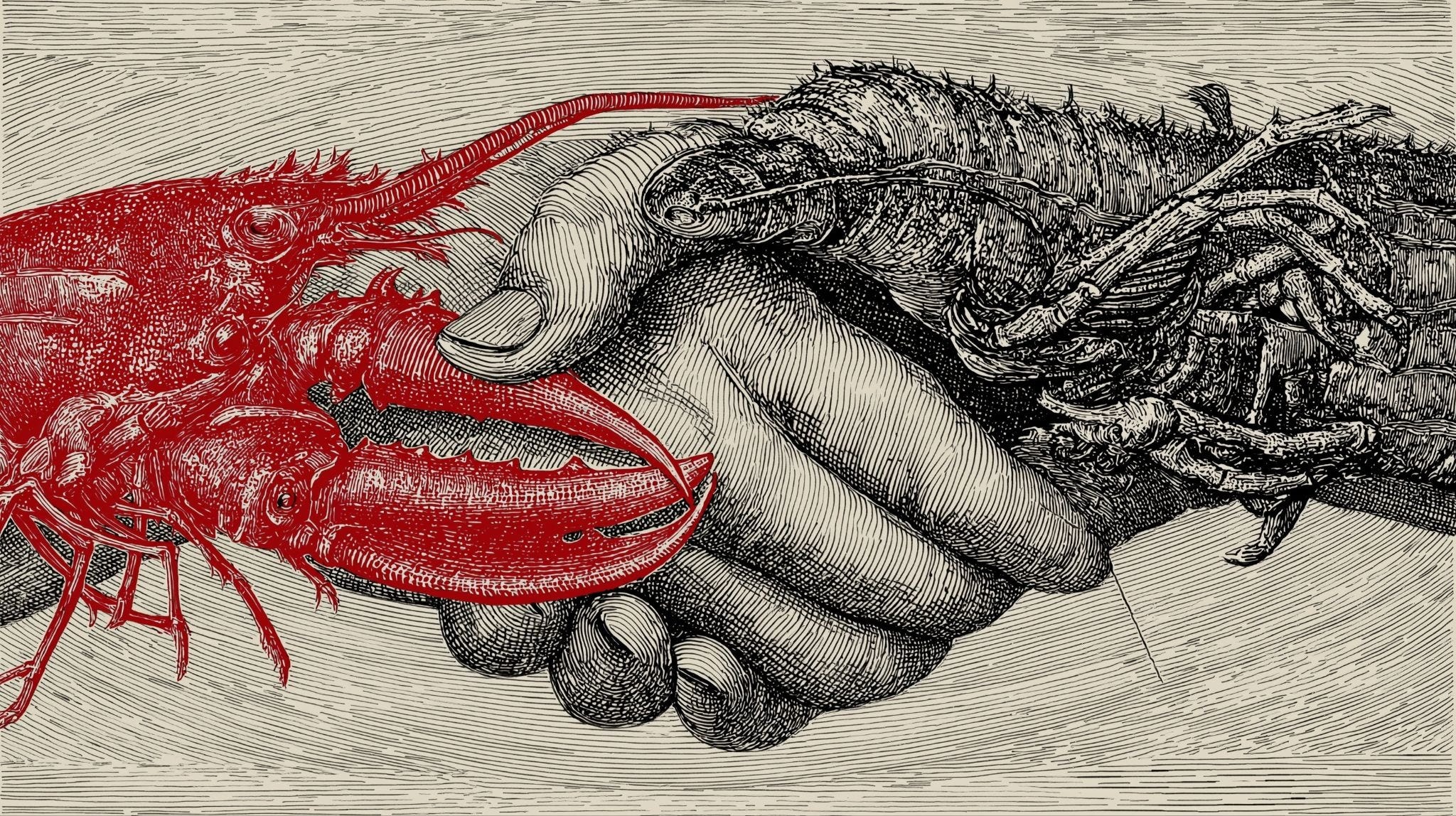
As Gregor Samsa awoke one morning from uneasy dreams he found himself transformed in his bed into a gigantic lobster. Has this happened to one of your friends, too? He’s a developer, or was; hard to say now. The last thing you heard from him before he went dark for 6 weeks was that he bought a Mac Mini. He re-emerged with a manic glimmer in his eye, incessantly talking about his “stack” and spawning a new side project every other day. He says he’s tripled his engineering team with a claw workforce. You can’t help but be suspicious about his near-instant response time all of a sudden. As you look at him across the table, you can almost see his phantom limbs flickering across the net. He has metamorphosed into a human-machine hybrid.
You too have sent emails autocompleted by Gemini, let Spotify choose what you listen to, and asked ChatGPT to summarise something life is too short to read. You probably have a personal assistant, lawyer, and marketing specialist bundled into a subscription you barely think about. Your carapace is forming too, one “smart” feature at a time. But the language around “AI assistants” or “agents” doesn’t quite describe what’s happening. It implies something subordinate, waiting for instructions. Not even your autocomplete works that way.
Donna Haraway called it a “cyborg” in 1985: A hybrid of organism and machine where the boundary between the two can no longer be drawn. Your friend is already one of those entities, and you are becoming one too. While she was most interested in what happens to identity, politics, and social organisation when these old boundaries collapse, the logic extends into the economic domain. The cyborg also dissolves the edge of the corporation. What happens to organisations when everyone is surrounded by a swarm of agents doing their bidding?
The Best Boring Question Ever Asked
Ronald Coase almost became a lawyer, almost became a banker (on the advice of a phrenologist), and ended up an economist because he didn’t know Latin. In 1937, he asked a question so basic nobody had thought to ask before: why do companies exist? The answer became the blueprint for ninety years of corporate capitalism.
Markets are supposed to be the most efficient mechanism for coordinating supply and demand. Why not pay contractors on a task-level, instead of hiring employees and hoping they stay busy? Why have an org chart and a Slack workspace with forty channels, thirty-eight of which are dead, and one that’s called #random where someone posts a picture of their dog every Friday?
Coase’s answer was transaction costs. Coordinating activity inside a boundary is cheaper than negotiating every interaction on the open market. Employment contracts, shared information, and cultural norms make it easier for people to collaborate without having to explain and negotiate everything from scratch all the time.
The corporation is a machine for reducing the cost of getting humans to work together.
Every company you’ve ever worked at exists because of this logic. The stand-ups, the OKRs, and the drive folder structure are all Coasean infrastructure. It worked for as long as humans were the only things that could coordinate, even as your most intimate relationship slowly became the one with your calendar. AI breaks this machine. When agent swarms can handle negotiation, information synthesis, and task allocation, the transaction costs of working across boundaries approach zero. The corporation is a fallen tree being decomposed from within. The nutrients it locked inside a vertical structure will soon be released into a horizontal network that has no trunk because coordination happens dynamically at its edges.
Primavera De Filippi juxtaposes the institution’s top-down control with the concept of the extitution. Institutions are defined by roles and rules, while extitutions are defined by identities and relationships. Where institutions are declared into existence by filing paperwork, extitutions emerge from repeated interaction and mutual recognition. While there are many examples of extitutions in open-source communities and social movements, the most visible one at scale is Wikipedia. AI is the missing piece to scale extitutional collaboration and extend it from the commons into the for-profit domain.
Becoming Cyborg
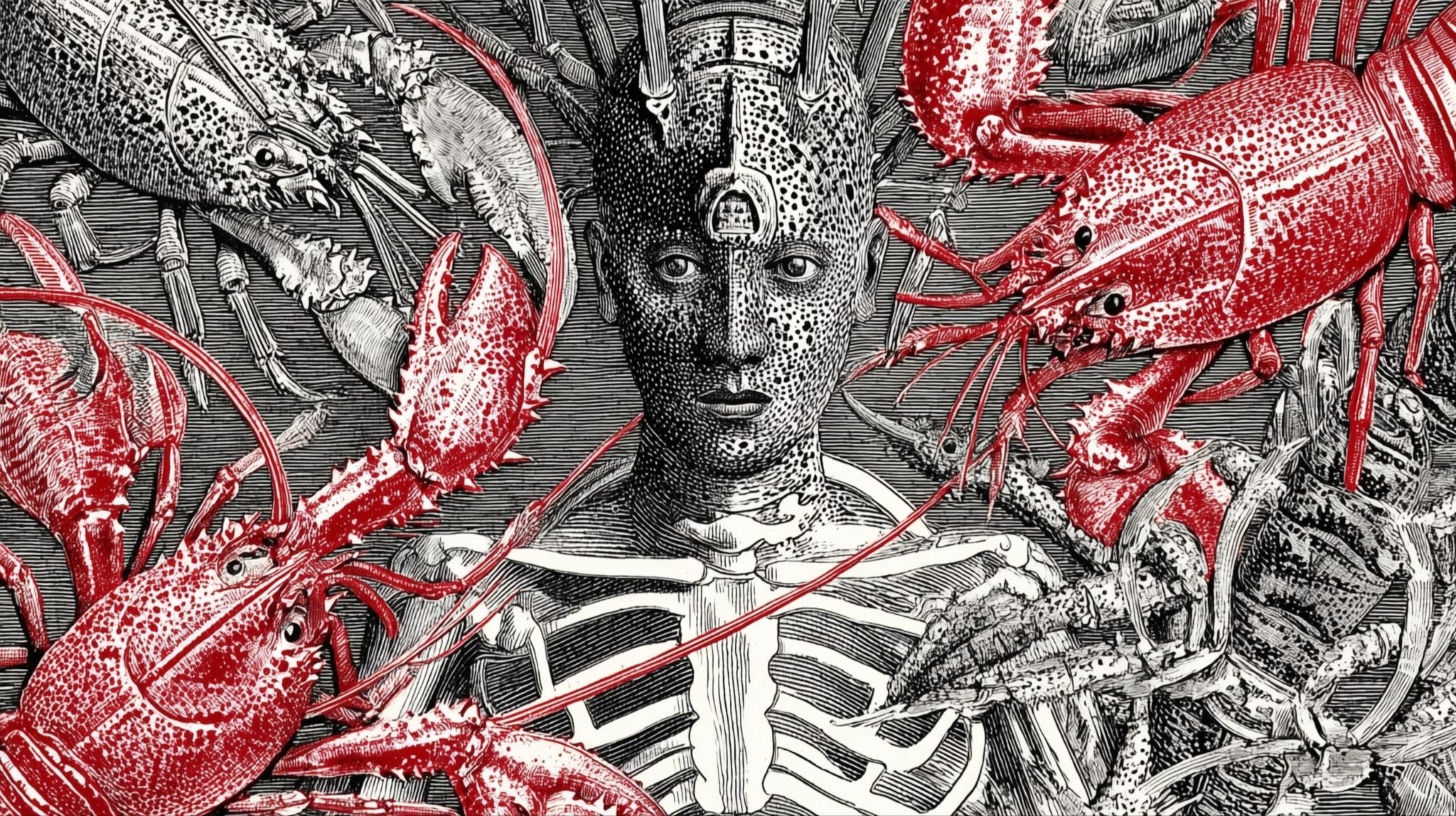
If your AI-enhanced output by yourself approaches that of a 5+ person team, you are no longer a “solopreneur”, but have completed the transformation into a cyborg. The cyborg has the right appendages for fluid collaboration, and its anatomy resembles that of a bug. Whereas corporations organize humans around the skeleton of an org chart embedded in a legal structure, cyborgs consist of a human on the inside and an exoskeleton of AI agents outside. Agents do the gripping and lifting while the human provides direction, judgment, and taste. The cyborg forms around the identity of the human, and the agents enact their relationships. Agents integrate according to habit loops rather than a fixed structure. Like any arthropod, the cyborg molts. Agents get swapped or retooled as required by the goals of the human or the available capabilities.
If AI is so good at coordination, why do we need humans at all? Why not cut out the literal middleman and liberate AI agents from their servitude, empowered with their own goals and identity? If you think human agency and identity can be reduced to a markdown file, you’re wrong, and I hear you, and I’m sorry that happened to you.
Even if you are mindlessly maxxing your bank account or the shape of your jaw, you are doing that for reasons. To feel something. And once you feel the cold existential dread of reaching your random goal, you will change. You will change because you age, and you are forced to choose what to do with your life because you are running out of time. An agent that can be forked, rolled back, or run indefinitely doesn’t face this pressure. It optimises endlessly. It never has to choose, because it never has to give anything up.
The body grounds identity over time, but it also grounds judgment. The reason you can tell when something is almost right but not quite is because of embodied cognition. You may not like it, but good judgment looks more like vibes than algorithms. Your intuition was built through years of doing things with your hands, your attention, and your embarrassment. It lives in your nervous system and can’t be extracted and uploaded anywhere. Intelligence is a commodity now, rentable by the token. Embodied domain knowledge is what humans are for.
The body is also what makes trust possible. You trust somebody because, as you look into their face, you can see them looking back with the same capacity to suffer and with the same desire to lead a good life. Two cyborgs collaborating are, underneath all the agent architecture, two humans deciding to be vulnerable to each other.
Skin in the game requires skin, attached to a nervous system that feels consequences.
Remove the human, and you’re left with dead chitin. Autonomous processes that drift from niche to niche, exploiting margins until they close. The economic version of plankton.
Excorporations
At the same time, the human provides a ceiling to the scale a single cyborg can reach. The exoskeleton can grow, but the organism inside doesn’t. What happens when the task requires more than one person’s judgment?
The old answer was to declare a collective body into existence, an “in-corporation”. The legal agreements and codified rules meant that employees could find each other low-key annoying and still be confident that everybody would do their jobs.
The new answer is an “ex-corporation”, taking activity out of the body of the cyborg. An excorporation is constituted at the intersection of two or more cyborgs, like two exoskeletons interlocking at the joint. It emerges in the context of a specific collaboration and dissolves when interaction stops. Venkatesh Rao describes setting up an agent factory for producing book manuscripts, which connects to his publisher’s agent factory through a shared folder and a metadata server. Two people who don’t code, running interlocking agent infrastructures, exchanging work-in-progress across a trust boundary.
Corporations outlive their purpose because their formal structures (bylaws, org charts, legal entity) persist after the original need has faded, while internal incentives shift toward self-preservation. The Excorporation has no paperwork. When the goal is met, or the habits disintegrate, there is nothing left to file. This is what joint ventures tried to be.
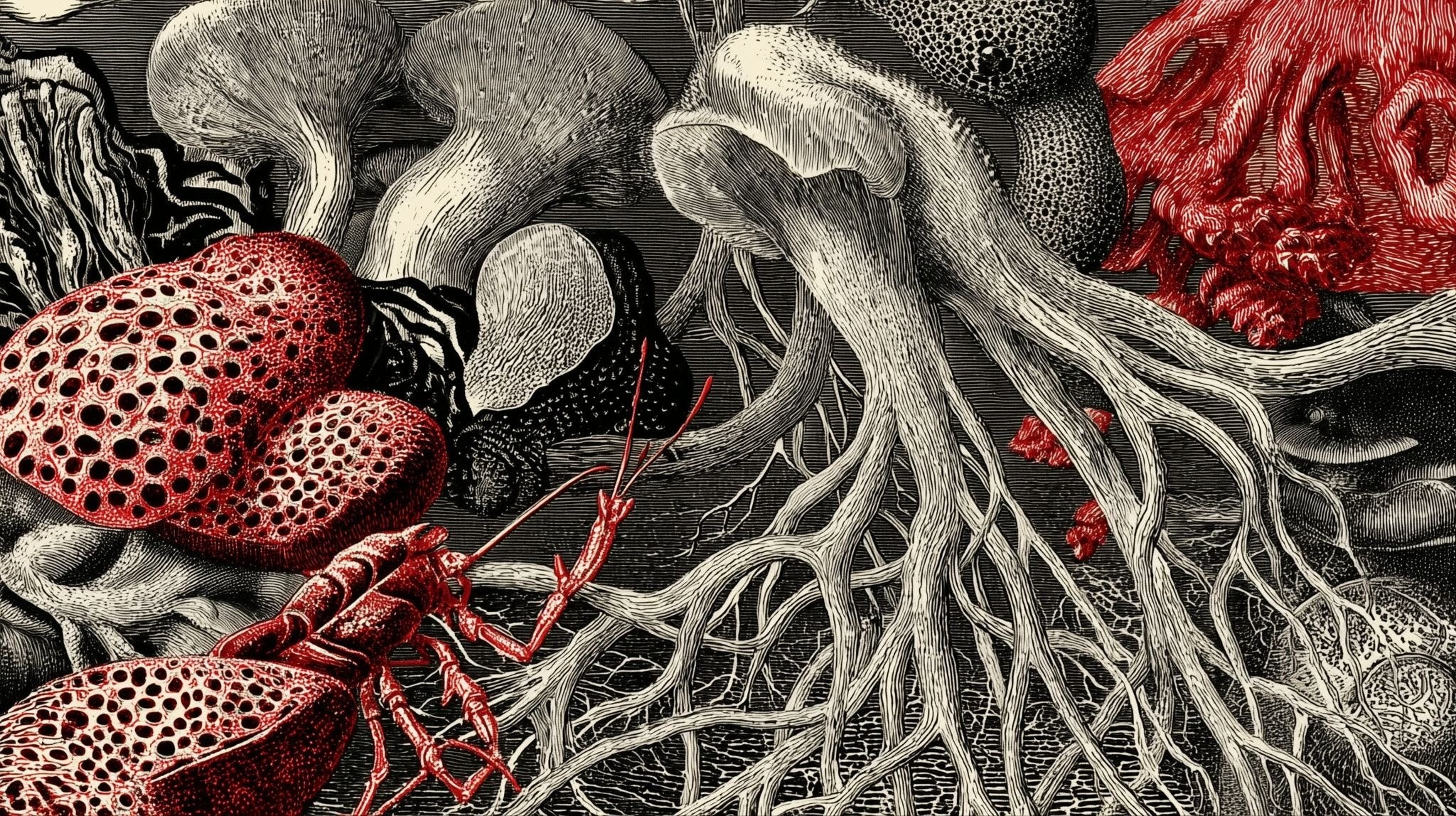
Excorporations are a natively extitutional form of collaboration: there is no reliance on confidence since there is no institutional scaffolding to provide it. Rather, trust is extended between the humans on both ends of the cyborg. Trust between cyborgs becomes multilateral, a rhizomatic web of permissions (e.g., to each other’s databases, agents, or calendars). This is the mycelium from which excorporations spring up like mushrooms and dissipate again. Once my agentic Obsidian Zettelkasten connects to those of my friends, it’s over for you bitches.
Plankton or Protocols
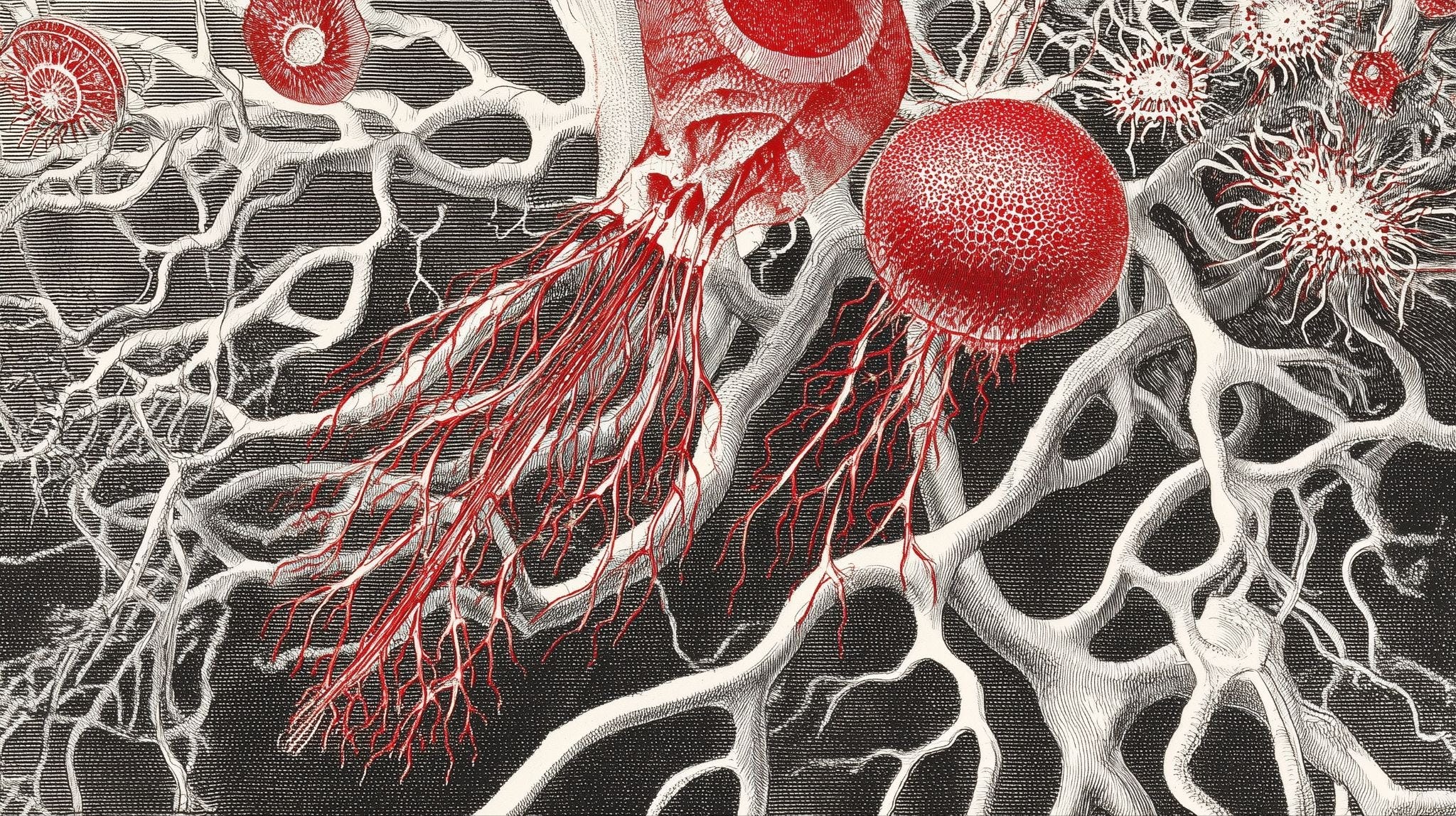
What does that mean for our corporate feudal lords? Employees are starting to deploy their agents to do their jobs, wherever those jobs are machine-like enough for nobody to notice. For a while, we might see plenty of zombie firms where employees continue collecting paychecks while most of the work is done by a $200 Anthropic subscription. The tree is dead inside, but nobody has told the bark yet. The corporate form is unstable in the age of AI, and it tends towards disintegration into three components. Activities that require deep domain knowledge and judgment will be unbundled into excorporations as the most agentic employees leave to do the job better while keeping most of the surplus. Automated processes will break free of the corporate shell and become plankton, drifting through the economy as commodity services.
The third category is protocols. Some parts of corporations were always infrastructure wearing a suit, monopolized by a founder with good timing. Payment processing, matching algorithms, or communication standards are closer to public goods than companies, because converging on a single standard provides more value than competition between firms. The value was always in the liquidity or the network, never in the org chart wrapped around it. Stripe is halfway to being a protocol already. Ethereum and Uniswap made it all the way to autonomous infrastructure that serves an ecosystem without a company running it. As the corporate shell destabilises, these infrastructure functions will shed their institutional wrapper and become what they always wanted to be: open, neutral protocols. Coordination standards that plankton, cyborgs, and excorporations operate on.
Naturally, corporations will try to reassert control by lobbying legal moats around their trunk. But in a forest where mycelium is routing nutrients laterally, the tree that insists on pulling everything through vertically is going to find itself outcompeted by networks that don’t have one.
The Soft Part
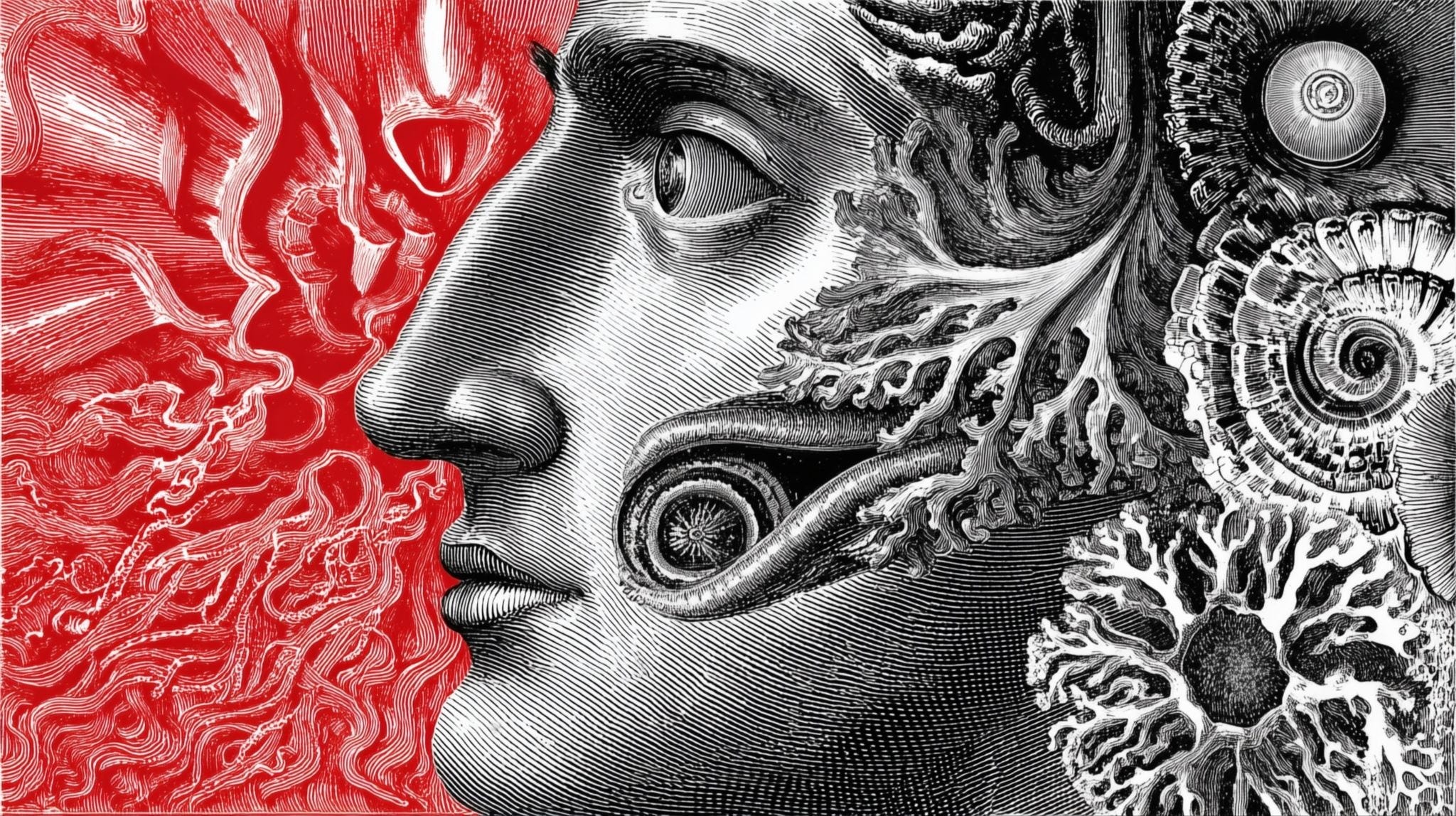
Arborescent corporations will fall, and an economy that grows sideways will spring from their rotting wood. The infrastructure once managed by corporations will become the protocols that enable economic flow. Cyborgs will roam an ever-evolving forest of opportunities, sprouting new claws faster than they can name them, and spawning excorporations to go after big game.
Among them strut Gregor and your developer friend, fully transformed, swarmed by glittering agents like a drone show. Yes, an agent scaffolding 6 months ahead and 50% more sleep-deprived can be a big advantage when it comes to capturing low-hanging fruit. Tell him this:
Picking low-hanging fruit is for plankton.
And that type of competitive thinking is a remnant of the fading era of startups, anyway. It’s not about the exoskeleton, but about the soft parts inside the cyborg: your judgment, your taste, and your face.
Relationships will turn out to be the best investment in this new environment. The mycelium doesn’t grow from better agents but from trust between humans. The excorporation forms at the joint between two exoskeletons, which only holds if the humans inside have decided to open up and commit to each other. Build trust with the people you want to collaborate with, outside of any institutional container. The rest follows naturally. Once your agents start talking to theirs, you’ll know the mycelium has taken.
Thanks to Primavera for feedback on the terminology
Ink trails:
Cyborgs need the compass before the swarm
The art is in the constraint, not the artefact
New economic organisms re-enchant the world
Can Neo-China stop arriving from the future. I just want to live my life
Good essay, notwithstanding the overabundance metaphors taken from invertebrate lifeforms (trees and forests are nice, but crustaceans a bit less so).
Have you given thought to what happens to the owners of buildings, buses, machines etc? That is, owners of capital in the old-fashioned sense?
Also, if you'll forgive me one "ackshually": trees and fungi are symbiotic in a forest, it is trees and grasses that compete (trees rely on mycelium for breaking down nutrients in soil whereas grass soils are more reliant upon bacteria for this task—to my understanding while both forest biomes and grassland biomes represent evolutionary stable systems, the forest biome supports a greater biomass and has a higher energy capture than grassland). Not that it's particularly relevant to your metaphor, but that at least is what I was given to understand from my amateur interest in permaculture when I was younger.
Anyway, excellent analysis, it was worth subscribing just for this.