
Why You Can’t Just Do Things
A Postcard from Agentia

“Agency is not a meme—it’s a worldview,” I found myself saying to a friend. After making fun of myself for spitting slop, it dawned on me that this is actually an important insight. We were talking about how to get other people to quit their bullshit jobs and get to work (you know, reinvigorating culture, rebuilding all modern institutions, and ushering in a golden age). Perplexed that people didn’t leave even if they admitted their jobs were pointless, he suggested that we build a system that funds people’s initial forays into non-traditional work. They surely just needed a bit of extra security and courage in financial form? I don’t think so. Neither capital nor courage is the bottleneck. Agency is. And agency is not an idea that can be acquired. It doesn’t help to plaster “You can just do things” all over the place, from your bio to your coffee mug. It’s not about the meme. It’s even deeper than behaviour. Agency stems from our very way of being in the world.
Turns out this was a blind spot for my high-agency friend. Konrad lives in a world that is contingent, responsive to his actions, fundamentally malleable. He is jamming with reality, expressing his intentions while he responds to what’s happening. Like a jazz musician, attuned but ready to go for a solo when the moment is right. Most people don’t do jazz. They can’t even play an instrument. They are in a karaoke bar, choosing from a list of pre-approved songs, timidly performing a sanitized version of someone else’s passion.
So why can Konrad improvise while others can only pick from the setlist? Understanding this requires going into the structure of how we know and relate to the world.
Four Layers Deep
“You can just do things” is like saying “you can just play the violin”. It’s true, but not particularly helpful since it skips over all the messy steps of developing the capacity in question.
Agency goes even deeper than know-how, through all of Vervaeke’s four kinds of knowing.
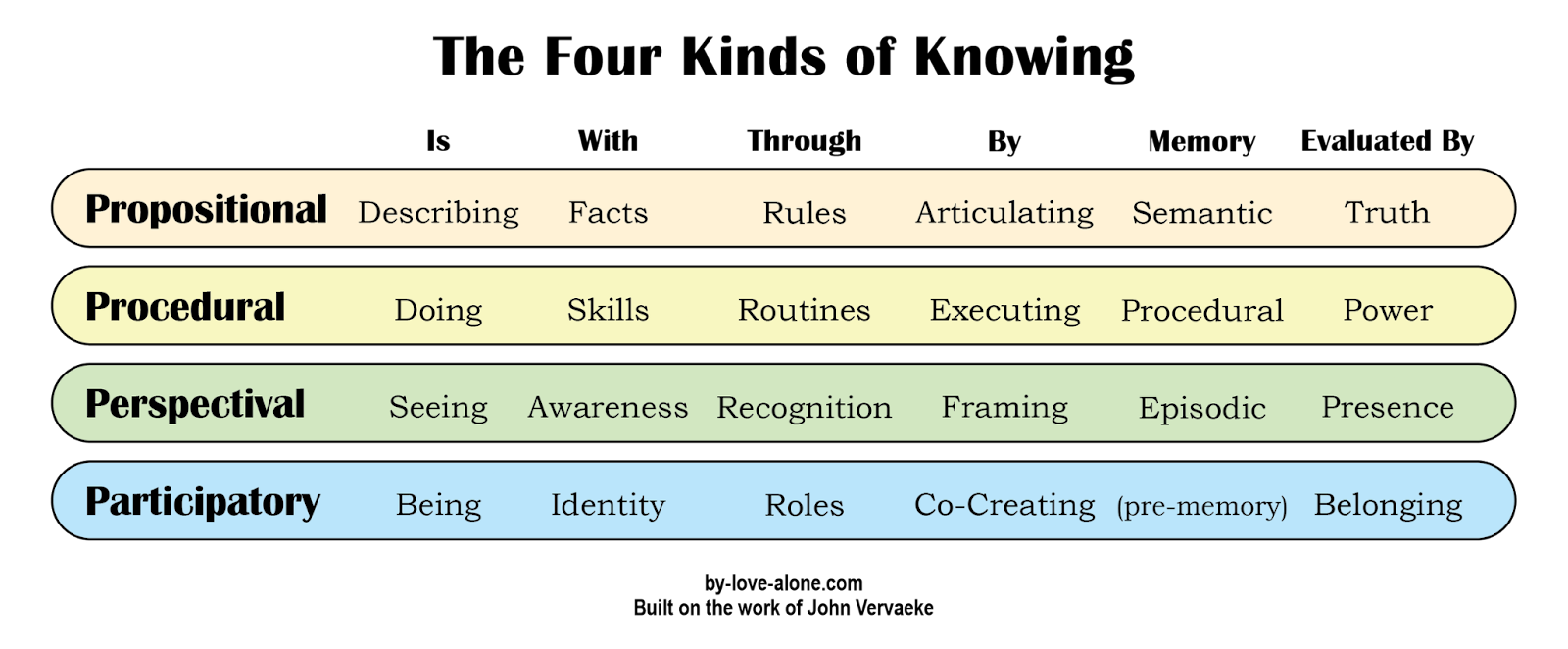
“You can just do things”, along with other memes, stories, and descriptions, sits at the most superficial level, the propositional. This is talking about agency, which has little to do with having agency. Don’t get me wrong, it’s better to have a concept for it than not, but “agency” explicitly points at doing.
Procedural knowing is where the rubber meets the road. This is agency as a form of doing, as know-how. Visa’s “Do 100 Things” is great advice for building skills. We’re getting closer. But agency isn’t really about doing anything in particular, but about the capacity to do stuff in general.
That’s where we enter the realm of perspectival knowing: Agency as a way of looking. Your worldview determines your affordances, the “handles” reality offers you. For example, nothing seems worth doing to a depressed person, while a manic person urgently wants to do everything all at once. As Chapman argues in “How to Think Real Good”, effective action stems from problem formulation more than problem-solving. You need to see which distinctions matter and which are irrelevant noise.
Most fundamentally, agency lives on the participatory level. Self and world co-constitute each other through interaction. The jazz musician doesn’t represent the song in their head and then play it; they’re embedded in the jam, responsive, shaping and being shaped by the musical space. Doing stuff means bumping into the world. Fucking around to find out is usually the most effective way to make progress.
If people could swap qualia, it would blow their minds more than that third hit of DMT. Agency emerges from the deep structures of our world-model. It would break your brain to experience just how differently other people move through the world. If you’re high in agency, this post will give you a glimpse of how most people see the world. If you’re low in agency, you will get counterintuitive advice on how to increase it. As somebody somewhere in the middle of that spectrum but with a flamboyant imagination, I’m in just the right spot to show you around.
Coke or Pepsi?
Most people experience agency as choosing between pre-defined options. I remember doing that. This is how I made all of my life choices until my mid-twenties. Football or basketball? Which college do I go to? Which internship do I apply for? I never considered whether I wanted to play team sports or go to college in the first place. The default worldview, as it relates to agency, can be described as:
I must choose between the options given to me
If this is you, the following description will feel familiar. You decide what you do based on your options. Except for a job board and unusually frank parents, the options are usually not explicit, but you infer them from the actions of those around you. More precisely, you infer them from what others seem to desire. The list of available options is the equivalent of the Overton window, but for agency rather than opinions. I call it the Menu.
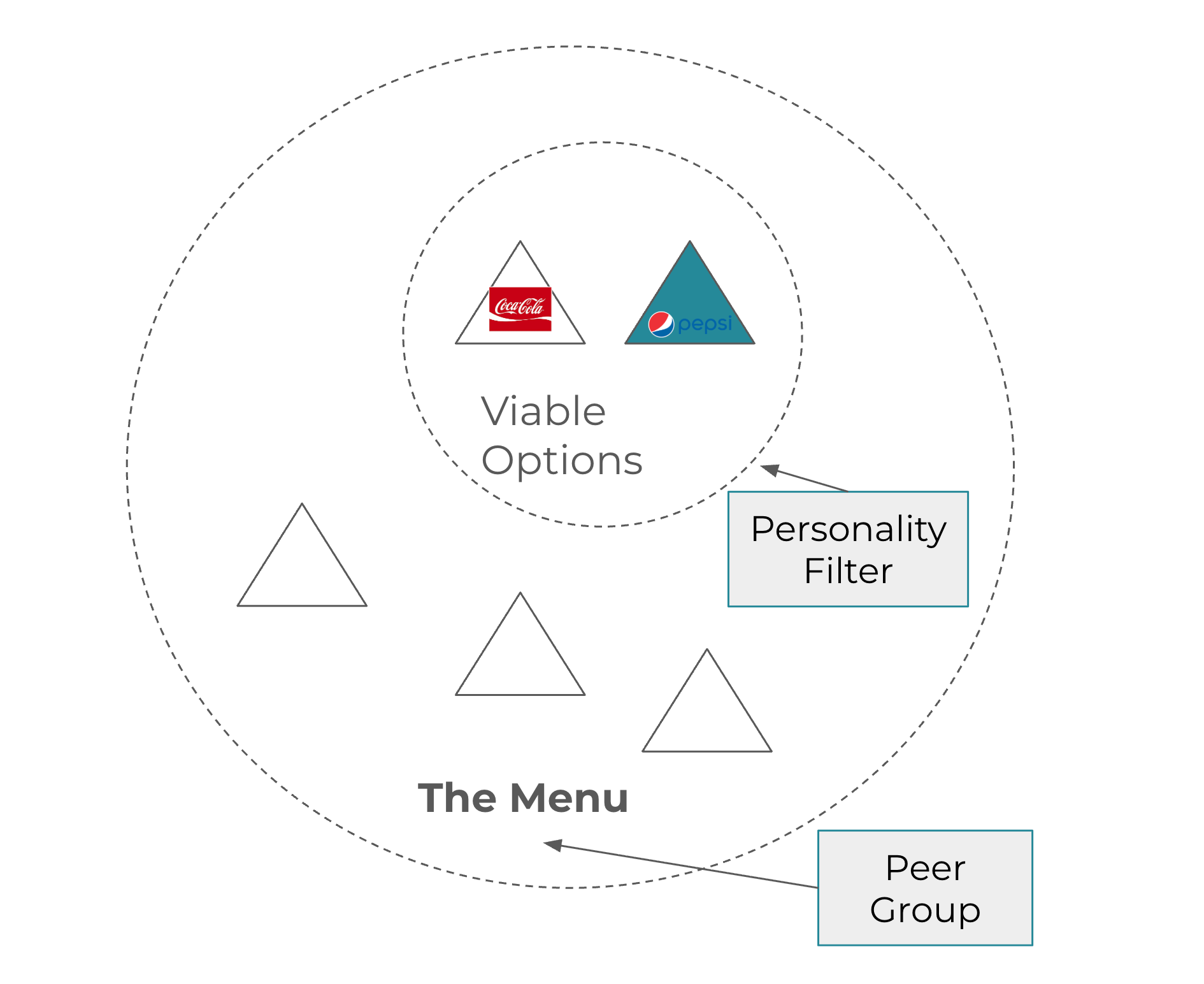
Initially, the breadth of the Menu correlates with your success. If you are at the top of the class and good at sports, you can get into any college or bedroom. Privilege and status also expand the Menu. Life has more options if you have a trust fund. However, as soon as you are actually successful, the Menu contracts again. As a cracked engineer, you might go into quantitative finance, but you don’t even consider starting a Reiki practice. Our society rewards specialization, following the path you’ve previously taken. More importantly, you have something to lose once you’re successful. Loss aversion, path dependency, and sunk cost decimate the scope of your menu.
There’s also a second filter comparing Menu options with your personal preferences. Call it the “personality filter.” It applies what economists call a “utility function,” which means to rank your options by vibes. The filter is full of contradictions, applied subconsciously and instantly, so you mostly think about what comes out the other end: your viable options. You pick one by simulating yourself in both variants and going with whichever seems more appealing.
As if in mockery, your viable options always seem to contain only two items. Coke or Pepsi, vote blue or red, career or family?

The same pattern covers your life as a fractal, from your relationships to your hobbies and the color of your shoes. Has it ever occurred to you that you could wear yellow shoes? No? That’s the Menu working.
Meanwhile, in Agentia
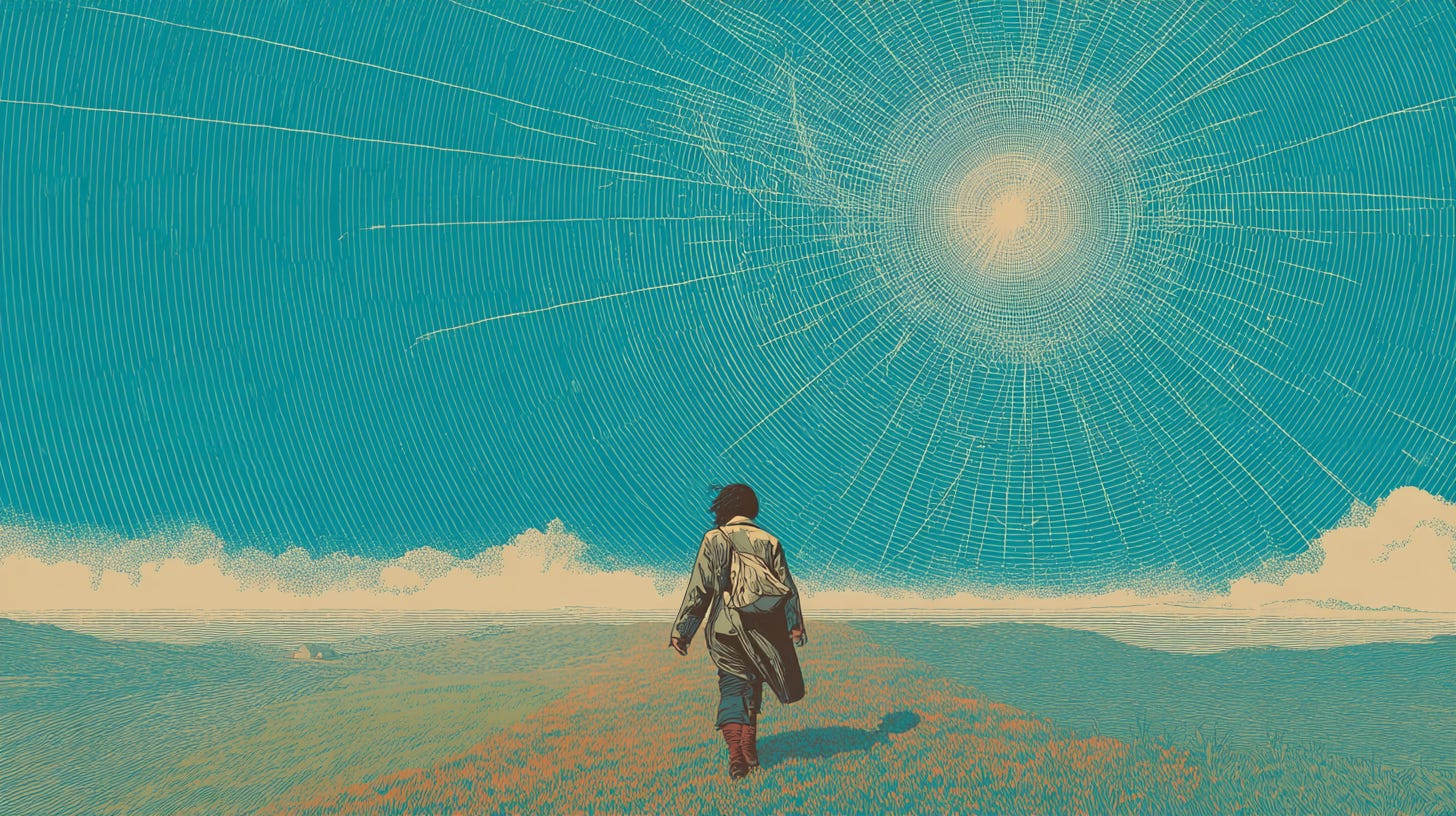
As a high-agency person, you are literally living in a different world. It’s spacious here. And there is a lot that happens before any action is taken.
Whereas low-agency people start with the Menu (provided by others) and volition comes at the very end, this picture reverses for agentic folks. You start with will. The impetus for any action is a growing internal desire, like a magnetic pull towards something just beyond the horizon. You are native to the world of potentials, of all the things that could be. The different lives you could live, the worlds you could contribute to. Which one do you choose?
Often, you don’t know. And you’re okay with that. A neglected aspect of agency is slack. Non-agentic people are victims of zugzwang; they need to decide. You don’t. Agentia has glorious open skies and no deadlines. You can chill here.
But sometimes, that internal resonance becomes strong enough that your will coalesces. The more internal coherence you have, the more clearly this happens. It’s as if the different parts of your personality have aligned to form a magnetic chamber, a compass pointing towards the potential you want to actualize. You know where you want to go, but how do you navigate?
Non-agentic people navigate by GPS. Turn-by-turn directions to a list of saved locations: work, gym, that one bar everyone goes to. As an agentic person, you navigate by compass. You have a direction, not a destination, and no instructions telling you where to turn. You look at the actual terrain, talk to people you meet, and adjust (or swim) when you hit a river. Sometimes you discover places that aren’t on any map, or you get lost for a while. The path emerges from walking it.
Being high-agency means bumping into the world. You don’t spend much time simulating different tactics. You try stuff and adapt based on the feedback the world provides. You still use simulations and maps for choices, but you think of every choice as provisional. You identify yourself with the compass, not with the choices. Since the compass is uniquely yours, made of your hopes, desires, and dreams, comparing yourself with others doesn’t even occur to you. Not caring what others think increases agency.
Agency is Illegible
Sometimes, agency looks like rocket science and world domination. But much more often, it goes unnoticed. Agentic people are illegible and don’t fit into pre-defined boxes.
Their life paths tend to be winding and idiosyncratic. Buckminster Fuller treated his life as an experiment and spent years just thinking, not producing anything. The slack was essential to the eventual geodesic domes and synergetics. Simone de Beauvoir described how The Second Sex gradually became impossible not to write, how the internal pressure built until the direction became undeniable.
Henrik Karlsson names Brian Eno as an example of creative risk-taking. I think he’s also a great example for agency: Eno follows his internal compass to different weird projects. Some become a hit, but he turns down the money people want to throw at him to go back to doing something nobody cares about. When Roxy Music blew up, he quit to conduct orchestras of deliberately bad musicians. When ambient and Talking Heads production made him a legend, he moved to Thailand to create light art. This is what the compass looks like from the outside—baffling, almost perverse. He doesn’t feel like “abandoning success” because he is not comparing himself. Brian doesn’t register the Menu.
This explains why TPOT can be both obsessed with agency and seemingly only produce illegible projects: The illegibility is what agency looks like in the real world.
Get Weirder Friends
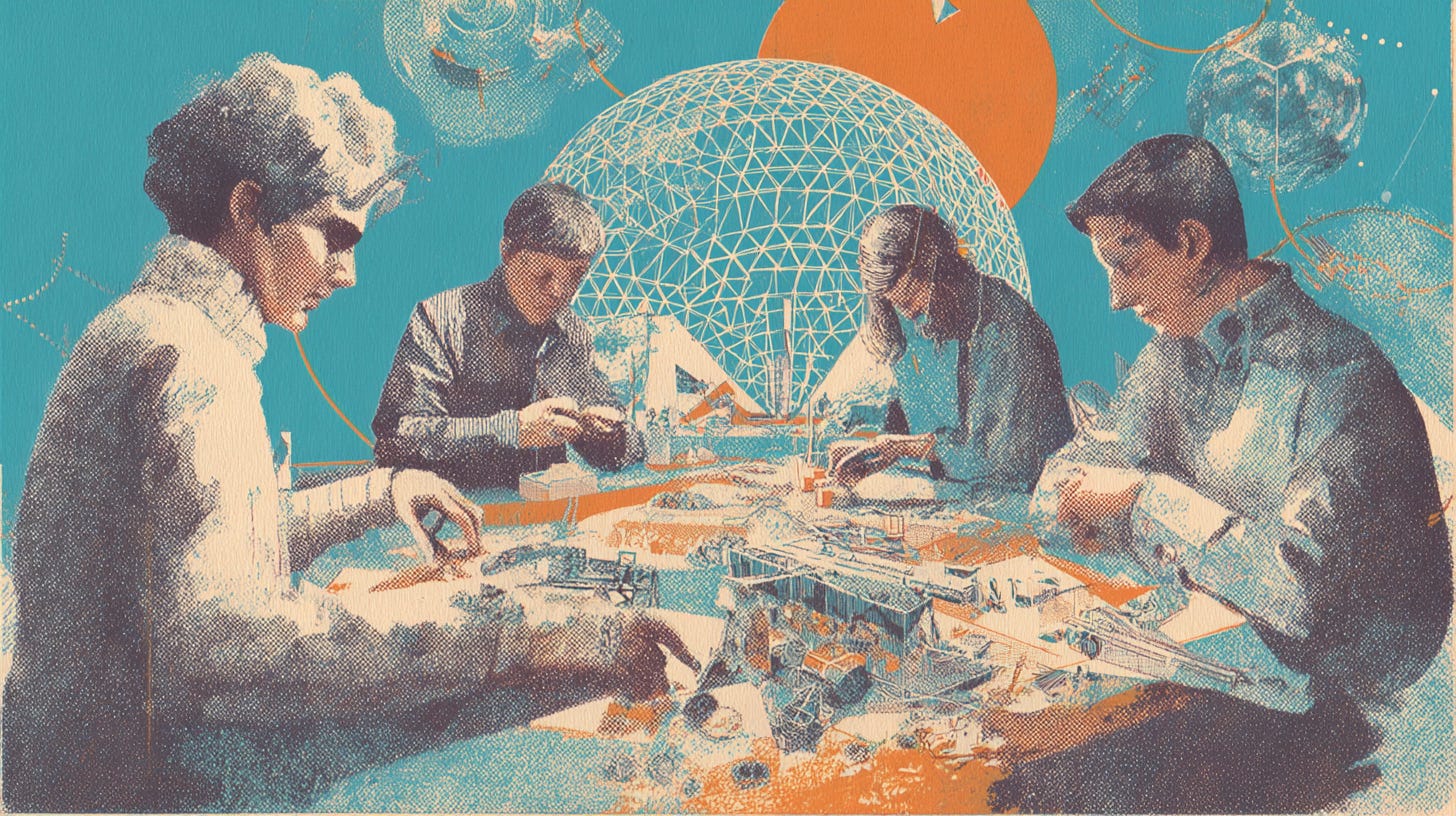
Counterintuitively, the answer to “how do I increase my agency?” is not “do more things.” It’s “hang around high-agency people until it rubs off.” As I made more agentic friends, I transformed through osmosis. Agentic ways of being are infectious: Seeing the world as malleable, looking through what is to what could be, and reaching deep into one’s own being for direction on what to do next. I’ve witnessed multiple times how a friend went from having an idea, to running experiments and then making it happen. “What if we could build a nooscope for tracking how ideas spread?” “I want to crowd-source people’s confessions and make an illustrated book on shame.” These goals are so specific that they are impossible to imitate. Instead of falling into mimetic desire and all competing to get rich and famous, people’s deeper desires are as different as they are. That’s how “You can just do things” actually sinks in: Seeing your friends repeatedly do it. Gradually, you pick up their ways of looking and being in the world. Seeing somebody unapologetically imprint their own weirdness on the world not only gives permission, but begs the question “And what do I want, really?”
The bad news is that most desire is socially mediated pseudo-desire. The good news is that development is social too: A social scene that encourages self-knowledge, slack, and bias to action is a scaffolding for agency. In such an environment, people will not just start companies but universities, new art forms, or entire cities. There is no single solution to our crumbling institutions and dying culture. Thousands of solutions to thousands of problems are needed. And conveniently, people’s compasses point in wildly different directions. All they need is the permission to turn inwards before running somewhere, and a little help from their eccentric friends. The golden age isn’t going to usher itself in.
Ink trails:
Find your compass
The Menu’s bestselling item is the dream job
Break the frame of the Menu
I like “the menu” a lot as a framework for thinking about this. I’m not sure “agentic” is a single thing though, actually… I ca think of a couple of axes:
- conformity vs individualism: that’s where the “get weirder friends” advice fits in. Personally I had a really hard time fitting in when I was younger even when I wanted to, which kind of kicked me out of some of the more straightforward menu options
- fear vs risk-taking: sometimes people eye stuff that’s not on the menu but are too afraid to order it. I think this is a continual growth area even for “agentic” people where you keep growing in your own confidence of what’s doable
- falling in love with doing something: I think most people who do impressive or unusual things fall in love with an activity, whether it’s sports or writing or coding or painting or getting to know strangers or whatever. This is the heart of the matter, why you would WANT to be agentic
I think you probably need a little of all 3 to do something really interesting with your life, but I think the mix varies by person
I don't generally experience mimetic desire so it seems like this kind of thing should be right up my alley. But I'll confess to not understanding something quite basic: how do such people earn money to live? Brian Eno is a neat example of the vibe but I have to guess that contributing to some pop music hits secured a lifetime of rotalties, an uncommon payoff.