


I’m greedy for life. Insatiable, even. I want to be an entrepreneur and a writer, an artist and a mystic. I want love and knowledge and power and inspiration. And what I want above all is more of it: more sweetness and richness and surprise. The challenge with my omnivorous appetite is choice. As I’m painfully aware, I won’t get to live it all. Again and again, I need to decide on certain activities, people, and places, and I hear the doors of other potentials slam shut. Those paths not taken used to haunt me. I had fomo about every party I didn’t go to. And every time I met someone interesting, that interest came with a subtle sting of envy.
Should I be doing AI safety research after all? I could have written that unclenching essay. Damn, I wish I could rock silver chrome nails.
I thought that anxiety about alternative timelines was just part of the human condition. I found out that fomo and envy require a stack of constructions ultimately resting on where I draw the boundaries of the self.
Don’t covet your neighbor’s downward dog
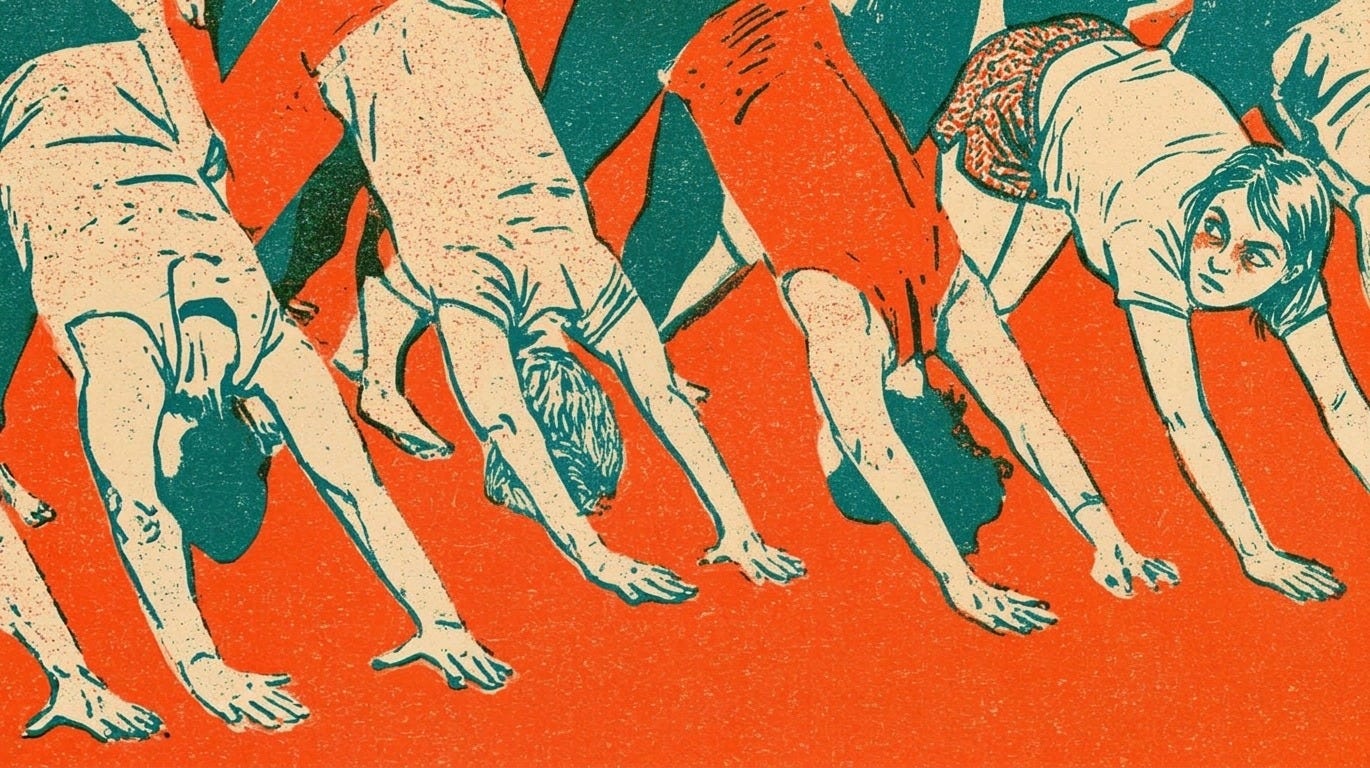
The neighbor in “You shall not covet your neighbor’s wife” is not accidental. Envy seems to arise more easily the closer the person in question is. If the person you went to high school with is signaling moolah through an expensive watch, that likely bothers you more than Jeff Bezos buying a mega yacht. This is curious because people close to you getting something you want should make that thing easier to get. If your classmates are getting good jobs, they could help you land a similar one. If your friend got in shape, you might have a workout buddy that pushes you further than you would get on your own. So why do you envy your friend’s downward dog while finding it inspiring that your yoga teacher casually sits in full lotus?
I went through this as I became friends with Guy. As long as he was just an anon account on Twitter, I found him mostly interesting and occasionally irritating. Only after I met the person behind the account and we became friends did I notice he had over 20,000 followers. I watched eyes light up with admiration as he revealed that he was behind the infamous @nosilverv account at TPOT gatherings. Now I was envious. He felt close enough that whatever he had seemed within reach, and because I respected him, his appetite for an audience looked worth striving for. Suddenly I wanted more Twitter followers.
Status olympics
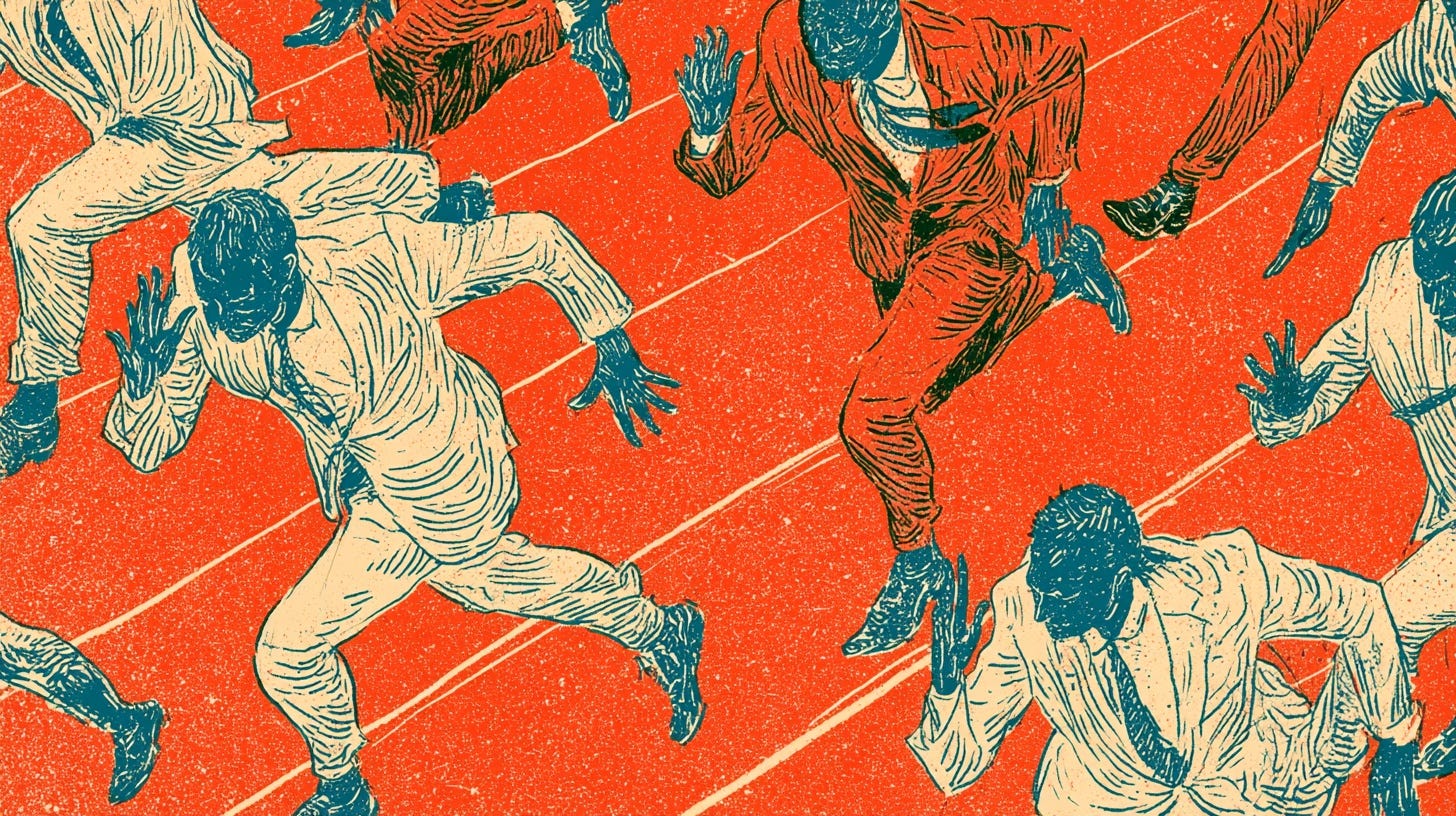
Why the friend and not the yoga teacher? Because you are competing with your friend (even if you won’t admit it). You can feel competitive about things that aren’t zero-sum (unlike the wife): money, followers, yoga postures (ok maybe that one is just me, I’ve been trying to get more flexible). That’s because a layer deeper, the competition is for status. The shiny object is just a reference point to set up a particular status competition.
If you have decided you are a yogi, you will look for flexible peers to compete with over the depth of your forward fold. The way you define your identity decides your reference frame for status, and who you’ll compete with. The more common way to get trapped in status games is the other way around, starting with the peer group and then competing for whatever they like. Girard’s insight, mimetic desire, is that most people decide what they want by mimicking what other people seem to want. Whether you start from the object or the peer group, the two mutually construct each other to trap you in silly games. The yoga teacher and Jeff Bezos are outside your peer group, so you can elevate them without losing status.
One layer further down is the cultural prior. We learn the mindset of competition in school, sports, and anywhere a master metric has colonized the field of value. But that mindset rests on a separate sense of self, an alienated individual trying to get stuff from the world to meet its needs.
It hurts to lose status to your friend because you connect it to your self-worth. At the bottom of this stack of constructions sits the human need to be accepted, expressed as the belief that you need status and resources to be loved. An unconscious fear of rejection has driven me to compete in status olympics that were mostly in my head. I competed around grades, job titles, obscure references, and, very briefly, Twitter followers.
So you want my life?

That last one didn’t stick because I suck at posting on Twitter. Guy had honed a behavioral pipeline that turned thoughts and experiences into tweets shaped to resonate with his audience. I recognized insights from conversations I’d been part of IRL showing up on his timeline. To get to a similar output of tweets, I would have to build a machinery of interlocking habits and shift my day-to-day around being a poster. I realized I didn’t care that much. I was relieved about not having to do what it would take, which freed me up to be impressed with Guy without wanting to emulate him.
The magic trick for dissolving envy is considering all it would take to get that object of desire, realistically. At the limit, you would need to become the other person.
Would you swap your entire life for theirs?
There isn’t a person in the world I would enter that trade with. I don’t want Guy’s life, and much less that of Jeff Bezos (imagine the psychological state he must be in, and the constant barrage of pressure and projection).
And you wouldn’t want my life either. Yes, it’s fun to travel the world and experiment with new ways of living with artists and entrepreneurs. Most people would be drained by the airport immigration lines and the code switching across cultures, overwhelmed by the uncertainty around life trajectory, not motivated enough to keep texting friends on the other side of the planet.
At the same time, there is valuable information hidden underneath envy: a possibility that tickles your psyche. Closed doors only haunt you if you don’t know what you want, and every instance of fomo or envy points at a desire. Mine was to express myself and to connect with people I vibe with. That’s why I’m writing essays. And I got to learn from Guy: I started taking notes and stopped hedging all my claims.
At the deepest level, whether my admiration flows into envy or compersion depends on where I draw the boundaries of the self. And that means the whole stack of constructions can be swapped out, starting from the bottom.
Your win is my win

In the other stack, the underlying desire is to figure out what is mine to do. I can ask that question because I already feel part of a chosen tribe, so my acceptance isn’t what’s at stake. I don’t need anybody’s permission to live according to my values and support others who share them.
It’s possible to move the locus of identification from I to We, to the point where a win for you is a win for me. I suspect this happens most often in parenthood: It seems easy for parents to delight in their children’s success because to some degree, they see their children as a continuation of themselves. I’ve found that shared genetic material is not required for this move.
I’ve previously written about virtue fingerprints, how the values we espouse are a robust way of defining the self. Me was based on values all along, and expands to Us as I recognize those who share and enrich them (by navigating value trade-offs differently).
Instead of a peer group to compete with, I get collaborators who are working towards the same future that I want. We might share desires, but the way of getting there is different for each person, which breaks the frame of competition. We both want to feel alive in our bodies, but you do rogue yoga and I dance like a lava lamp on a moving train. We still seek recognition, but in a heterarchy rather than a hierarchy: nobody has figured out how to rank your invented poses against my wobbly moves.
Both stacks work through identity. Paradoxically, the frame of individualism flattens the individual so that it can compete on ever more abstract metrics (from your grades to your law firm to your salary). In contrast, a group based on shared values thrives on difference because members find and do the work they are uniquely suited for, which can’t be compared directly.
There is a never-ending amount of work to shift our trajectory towards the Good Timeline, and if somebody else picks up one task, I get to cheer them on because we’re pulling in the same direction (and I’m happy that they chose that over the law firm). This is easy when friends work on areas I appreciate from a distance, like mapping how ideas spread or making art that surfaces inner experience. Affective empathy creates an echo of the other’s feeling inside myself, so if a friend is celebrating a success, I can participate in it directly. This circuit can also be trained so it becomes stronger and more readily available (Buddhists call it mudita, sympathetic joy).
Identifying with the open conspiracy even lets me celebrate people doing work close to mine. Stephen is writing a book on technological metamodernism, at the intersection of tech, systems thinking, and cultural change, right where I hang out in idea space. Despite the proximity, I’m proud to report that most of what I feel is wanting to support him. The remaining trace of envy was quickly transmuted into the thought that I might like to write a book at some point too, just a different one.
Turns out the way to satisfy my greed for life is through teamwork. Instead of spreading myself thin, I can drop bucket list items that my homies pick up. Stephen is already on that one, and he’ll do a better job because this particular task has called him more deeply. I’m happy for him, and relieved I’ll get to do something else.
Longing for the campfire
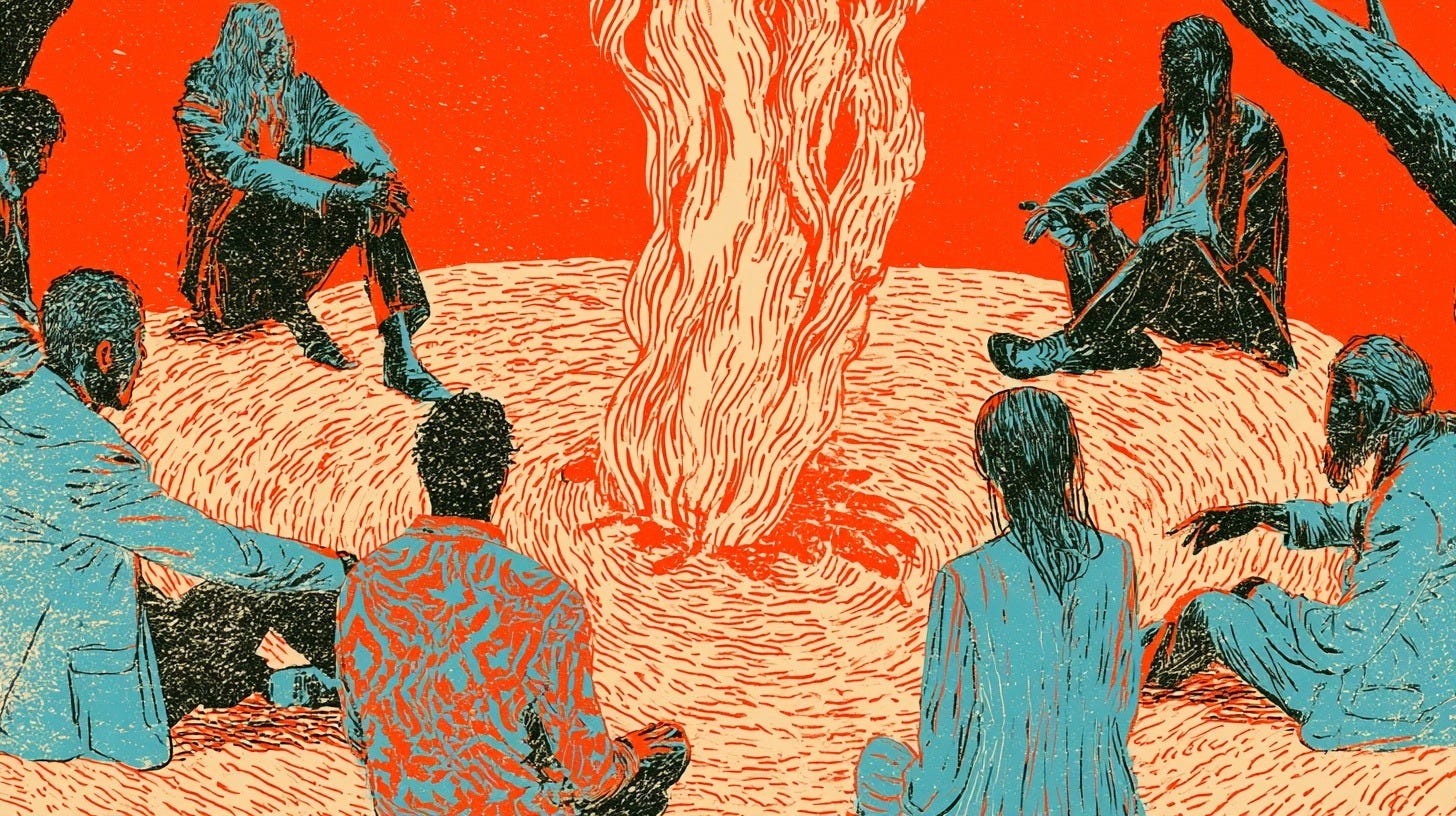
We’re sitting in a big circle after the meditation retreat, and a gray-haired woman with a face that reminds me of a mouse describes how the circle touches something in her, conjuring the campfire that our ancestors sat around for hundreds of thousands of years. My heart is struck like a Tibetan singing bowl. I, too, long for the campfire. I’ve had glimpses of it at closing ceremonies of events or at community check-ins at co-living spaces, even silently sweating around hot stones in the sauna. My chosen tribe already exists in virtual form and periodically spawns into temporary gatherings. I want more of it: more physical proximity, more often. I can be myself in the most uncompromising way if I know my friends have my back. And I want to live my other lives from up close.
Ink trails:
The same glue that holds your past and future selves together can hold you and your homies together
The status olympics are fueled by feeling not enough and secretly special
Quit the status olympics and join the open conspiracy
I don't want to be famous. I only envy people who have enough resources they don't have to work for others at all. All I desire is freedom to do what I want with my time without anyone telling me what to do. Anyone who does not have that is not actually free. I haven't figured out how to achieve this yet in my own life, so I envy those that have.
what brings me ease is sharing my envy openly with friends. i acknowledge that it exists in our relational field as a Part and i bring it up when it is friend-insecure.
the shift from I to We is challenging for me. the We lens are very untrained in me, unnatural.
let me train this We lens live:
my friend is twitter micro-famous. it is through her i can experience / witness that desired micro-fame from close up. and maybe she can be my teacher.
ah. i seek more ways for training and embodying the We lens!