

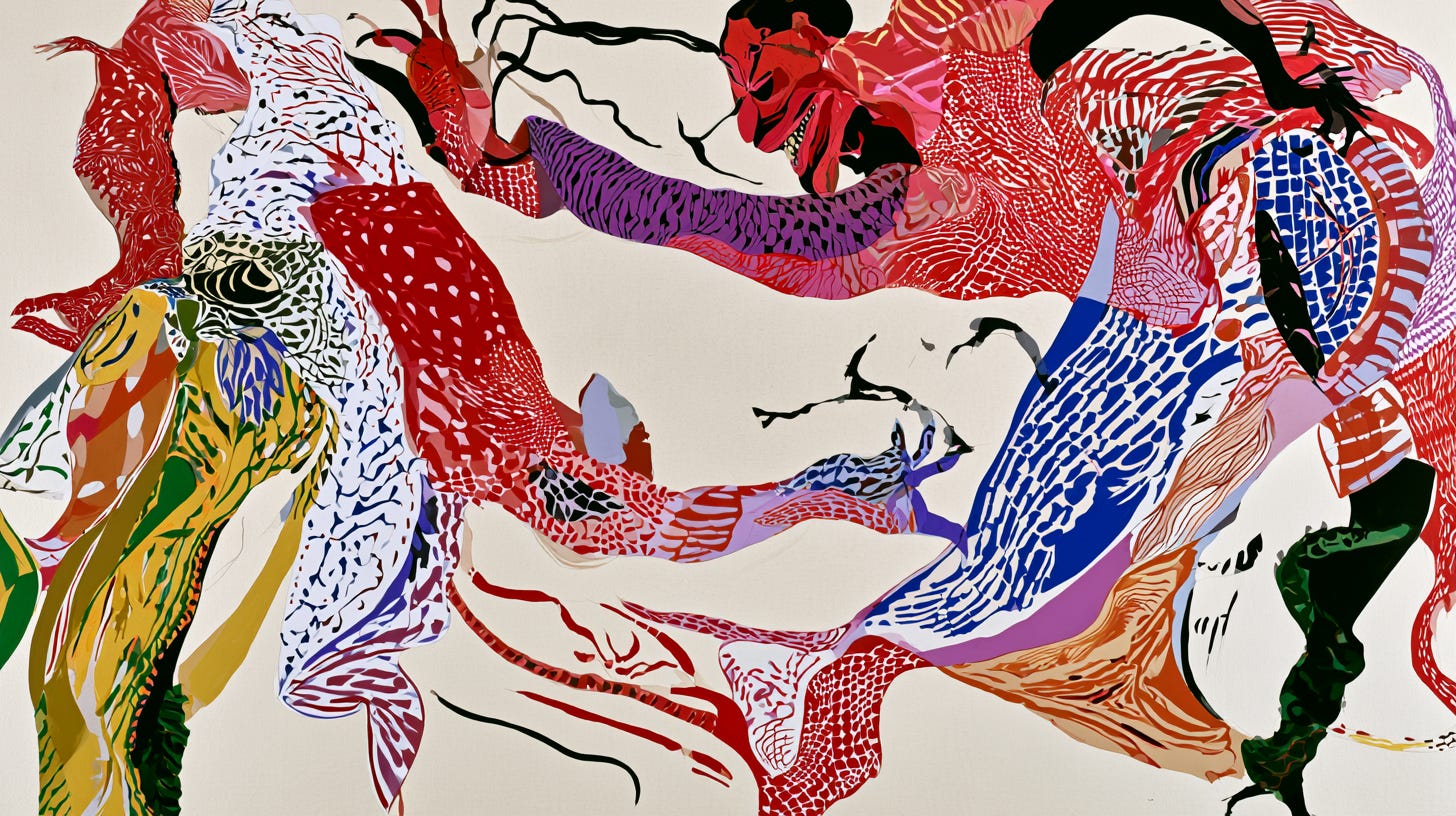
I feel my weight in the chair, my bones stacking up support from below, holding tingles of anticipation. The keys clack away under my fingertips as I reach through the senses into idea space to start my dance. My spine points me like a needle to a vague sense of “something there”.
I’ve been feeling the reverberations of this idea ever since I first lost myself in movement, became clouds of sensation whirling through space without reference points. It moves at the speed of sweatpants, wearing knee pads and a tank top, twisting slowly down to the floor. I move the same way, falling into my own words to follow what had bewitched me.
Just as I notice the Klein bottle on my desk, that endless folding of inside and outside, I realize that it’s the same shape as the idea: the paradox of self-actualization and belonging, of being in relationship. How can I be fully myself while I’m with others? How can I be part of something greater without losing myself? Obviously, this has something to do with contact improvisation.
Small Dance
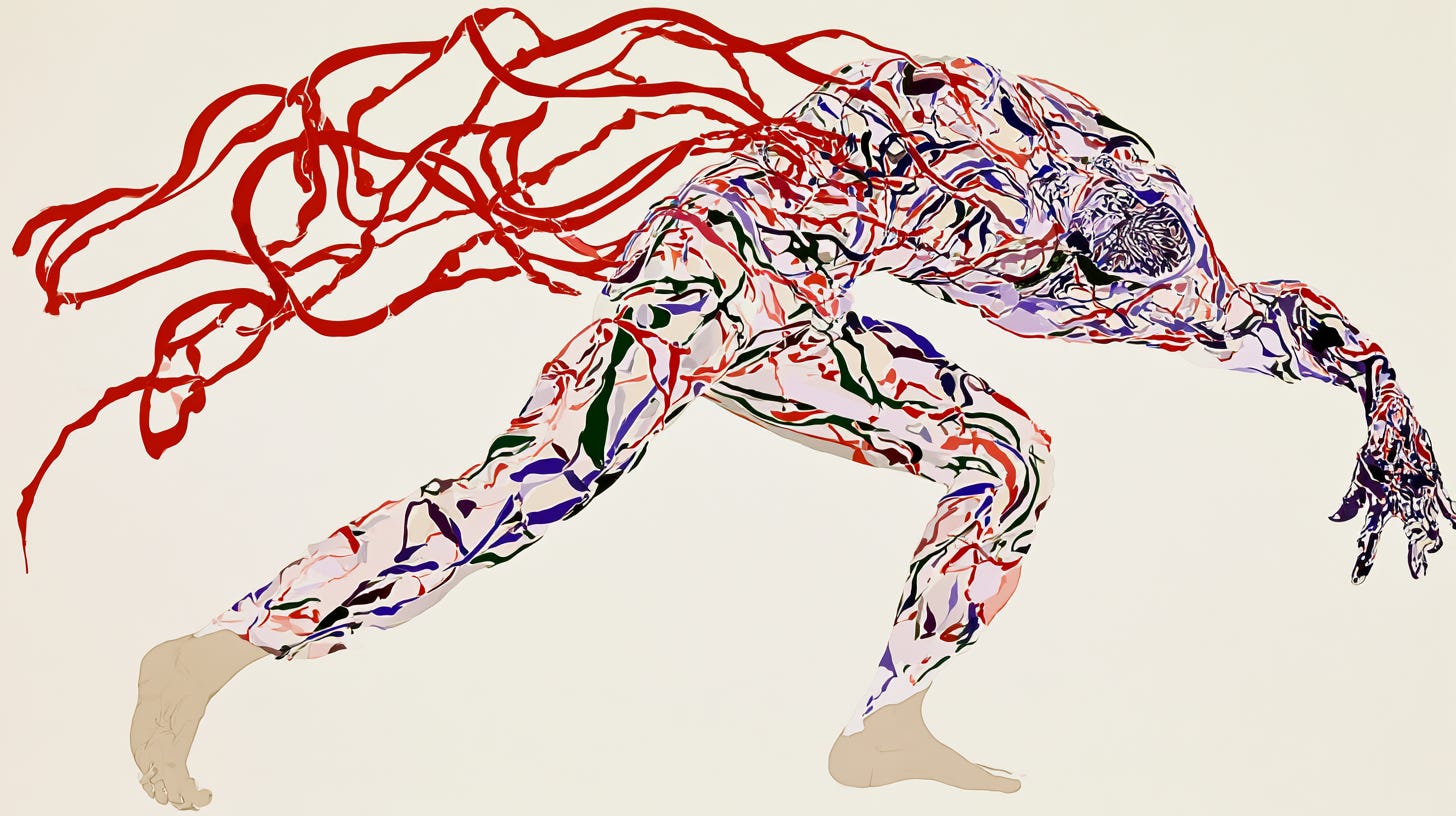
I’ve taken you on a journey before, up mountains, through strange loops, and even through hell, but I always (mostly) knew where we were going. This time, I don’t. Can you feel me at my edge, here? We will dance together, and I trust that we’ll be able to move in ways I couldn’t on my own. (Except I just chickened out and checked Twitter; let’s try again).
I need to start with myself. I can’t really be in contact with you before I turn my attention into a sponge. I bet your attention moves like an arrow too and the homunculus in your head is currently shooting out of your eyes at your screen. I fire my marksman and start listening. A listening sponge, like blind fingers tracing the contours of a stranger’s face, is curious, spacious, and without agenda.
“Do you know what will happen next? If you don’t, can you be just a little bit more curious?”1
Listening to my own body in this way is just as interesting as listening to another. Smaller, more subtle movements come up as the invitation extends for longer. I feel gravity through my skeleton first, then the tensions and tingles of muscles and skin, then a wave of emotion I’d have to zoom out to name. Contact improv starts with slow, small dance so we each get to grow flowers all over our own bodies first instead of touching the barren earth of our habitual numbness.
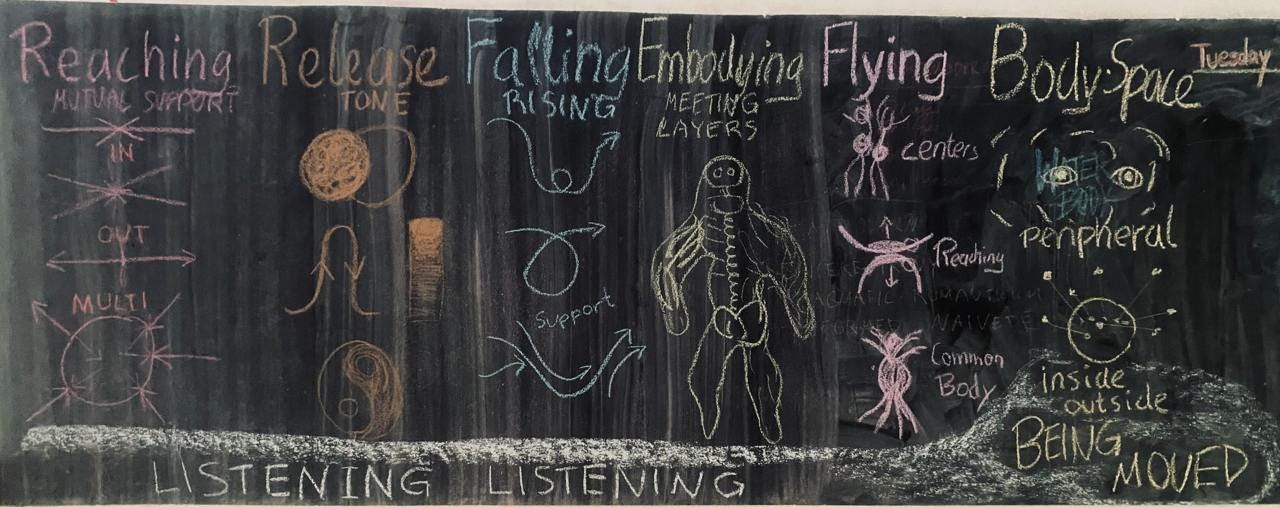
I want to write something about the self as a Klein bottle, a toroid that folded its inside into its outside, but I resist the familiar move because I’m curious where else this could go.
Adler called the stories secretly organizing our lives “guiding fictions”, and they show up in dancing as in writing. An annoyingly stubborn one for me goes “I must impress you because you’ll reject me if I don’t”. What is yours? Are you reading to improve yourself or chasing after insights? It’s not possible to listen while holding such overbearing frames. So I let go of the compulsion to namedrop and listen to where the dance wants to go (you will never know which French theorist was spared).
Not one, not two
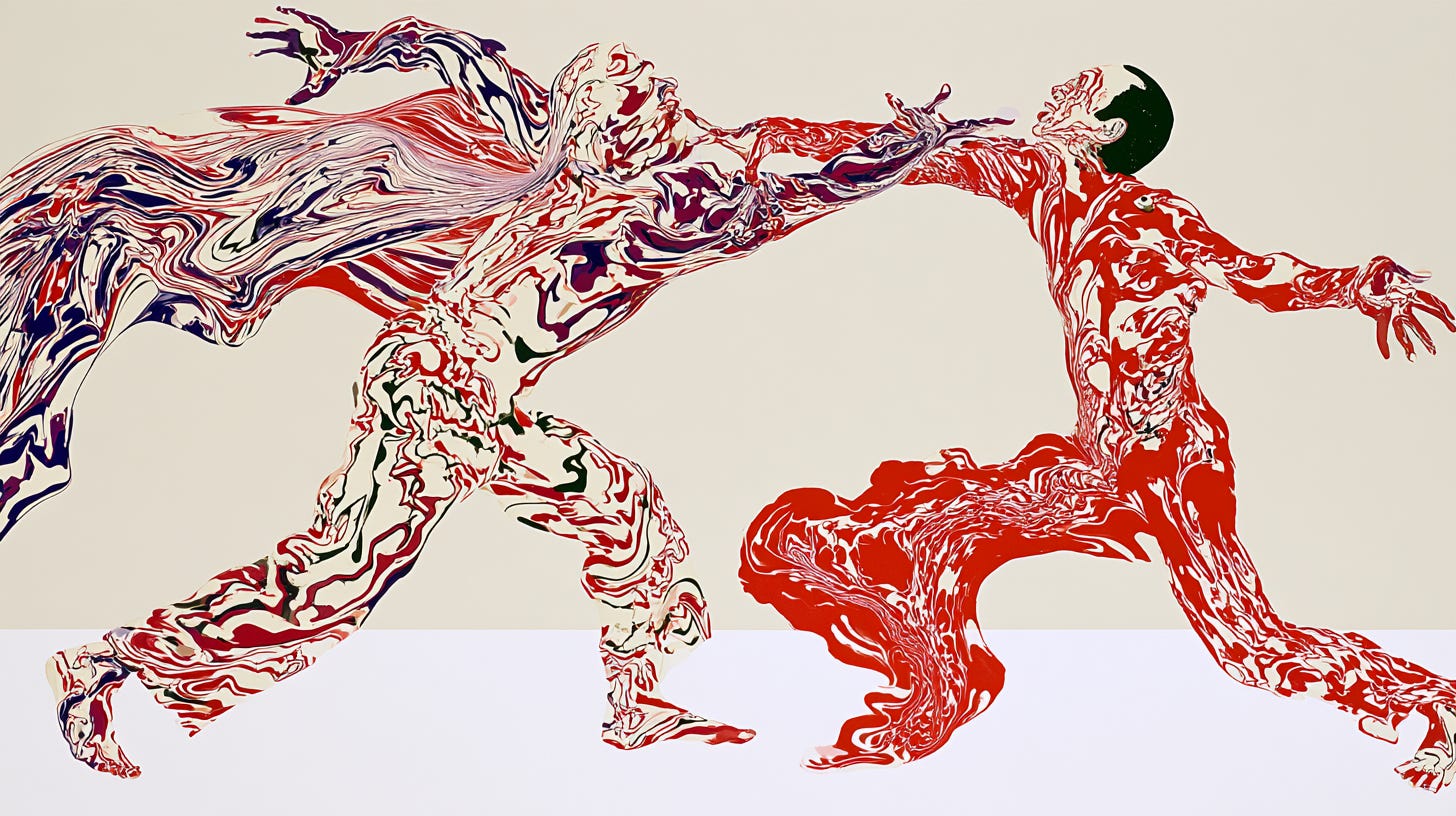
Contact arrives sideways. It happens when I’m engrossed in my own dance while staying porous to the movement around me. I catch my best ideas on the bike or in the sauna, not in front of a blank page. Sometimes when talking to a friend, I stumble over a tentacle I then start vibing with. This dance is older than my dancing: teenage-me couldn’t identify with the kids at school and needed desperately to be in their cliques. Even after putting down some of the baggage, there is still a loopy question mark of how self and other mutually arise.
Nothing moves for a while. My fingers rest on the keyboard the way a dance sometimes pauses, and I split my attention to listen both ways. I’m listening to my own sensations while also listening to where the ideas want to flow.
I also recently listened to The Courage to Be Disliked. Instead of the self-help baby food I braced for, Alfred Adler gave me concepts my experience had been holding open slots for. Here I am, mid-dance with the Klein bottle, that femme fatale who invited herself back in, and the writing starts spiraling. Abruptly, the old Viennese doctor cuts into our dance. I end up appreciating the clarity he brings once he throws his three-piece suit into the mix.
“It is only in social contexts that a person becomes an individual“
- Ichiro Kishimi, Adler’s posthumous hype man
My contact point with the Klein bottle is that we construct ourselves through others. We feel our body as it touches the world around us, relate to others like we relate to ourselves, dance with others like we dance with ourselves. My words only move if you read them. I’m reaching into the idea by going down associative paths like I’m rolling over somebody’s back.
It takes courage to roll over somebody’s back. Trust that they can hold my weight, that I can transition into the floor, and that it’s ok if it’s awkward. It’s not my problem if it’s awkward (sorry). All I can do is be present and make invitations. How you interpret them is your task. Radical self-responsibility, Adler’s separation of tasks, means that I can take care of my own falling and neither of us needs to save the other, please the other, control the other.
If the letting go is full enough, it feels like the old self is suspended, tucked away next to the water bottle. I’ve had a dance where I became a flowy marionette extending the will of my partner. With another partner, our fascia locked in and created a gummy tornado whirling and bouncing through the space. I have been part of an unspeakable flesh machine that would have devoured Brooklyn had I not lost presence because I became self-conscious of my body odor.
What happens is not a total merging but a fluid in and out: me, you, us. Merging is like flying — moments when alignment happens, whether only in centers of gravity or across the layers — without making that into the goal. We both need to listen, or the dance remains solipsistic and ultimately boring. I contribute my sensations, emotions, even limitations to the dance. If I’m courageous enough to fully own how I feel and bring that in, I become the outside to my partner’s inside. Sometimes, we don’t know where one of us ends and the other one starts. A pressure travels up through my ribs and I couldn’t tell you which body it started in. Thoughts too can come unhooked from our usual stories about what they are and where they come from, like the bubbles of a whirlpool in empty space.
David Lynch went fishing for his ideas. Michael Jackson woke up his crew in the middle of the night out of fear that God might give the song to Prince if he didn’t hurry. Usually an idea is something I have. Sometimes it’s the other way around and the idea has me. Dancing contact with ideas means relating to them as persons2 instead, with their own desires and their own ways of moving. Which means an idea can turn me down and leave with Prince. My task is to make the invitations and to answer the ones coming toward me.
Common Body
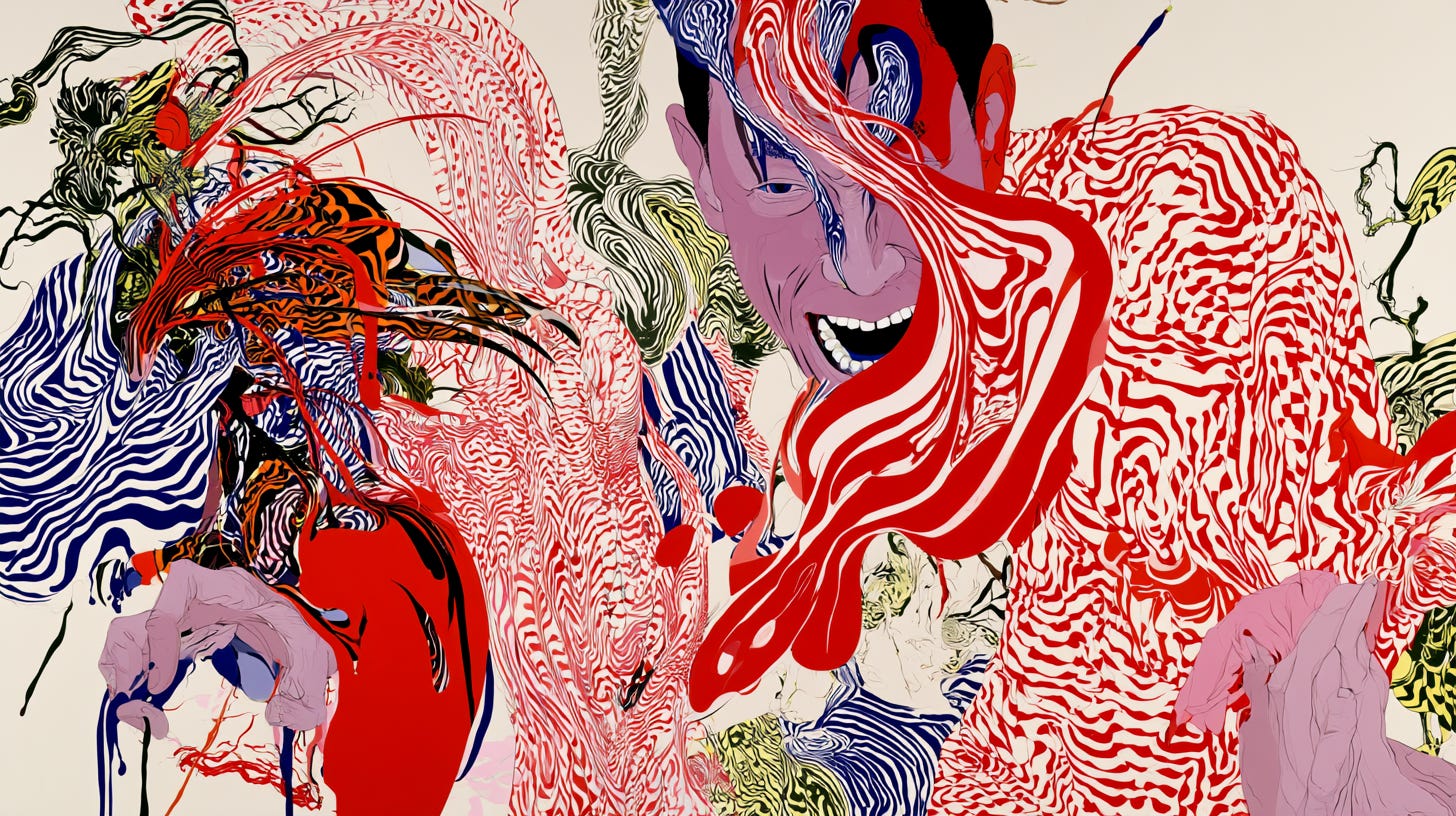
But as long as it’s still me dancing with you, I need to stay on that edge of balance between listening to you and listening to myself.
Splitting attention works but it’s tiring. Attuning to the we is how attention becomes one thing again without either of us disappearing into it. The dance stops being a sequence of invitations and reactions and becomes a single movement carried out across multiple bodies. The listening moves to the space between us, where intentions for shared movement can arise. Sometimes a metamorphosing image comes up representing that emergent we. Just like you feel the grain of the paper through the tip of a pen, proprioception can extend through the other body. I felt my brother’s legs become my legs as he walked while I extended like a penguin across his lower back.
The teacher Katia Basaleva calls this state the “common body”. And apparently, the mind-meld can go beyond biomechanics into emotions and sensations. All of it rests on the plainest principle in the form: sharing weight.
If the contact point is clear enough, we establish a shared center of gravity. As in the three body problem, there are infinite ways to spin around it. We are orbiting around a point in ways that neither of us could have done by ourselves. That’s the center of gravity of the common body. At the apex of a lift or a jump, there is a moment of weightlessness where everything stops: I don’t know whether any of this survives the transfer from the dance floor to the page.
An idea can be a tool for convincing people (propaganda) or the only thing I can talk about (possession), and both have a tight grip. To dance with ideas, my mind needs the mental equivalent of low body tone3: relaxed enough for them to touch, not attached to how it shakes out. Without mental tension, ideas can bend and bleed into each other, becoming more like dough than Lego blocks. Certain connections delight them, and a subtle musicality I don’t understand but can listen to is what guides me toward those. That’s how ideas might assemble into a common body, and I’d love to write it down as it happens.
Tentacles
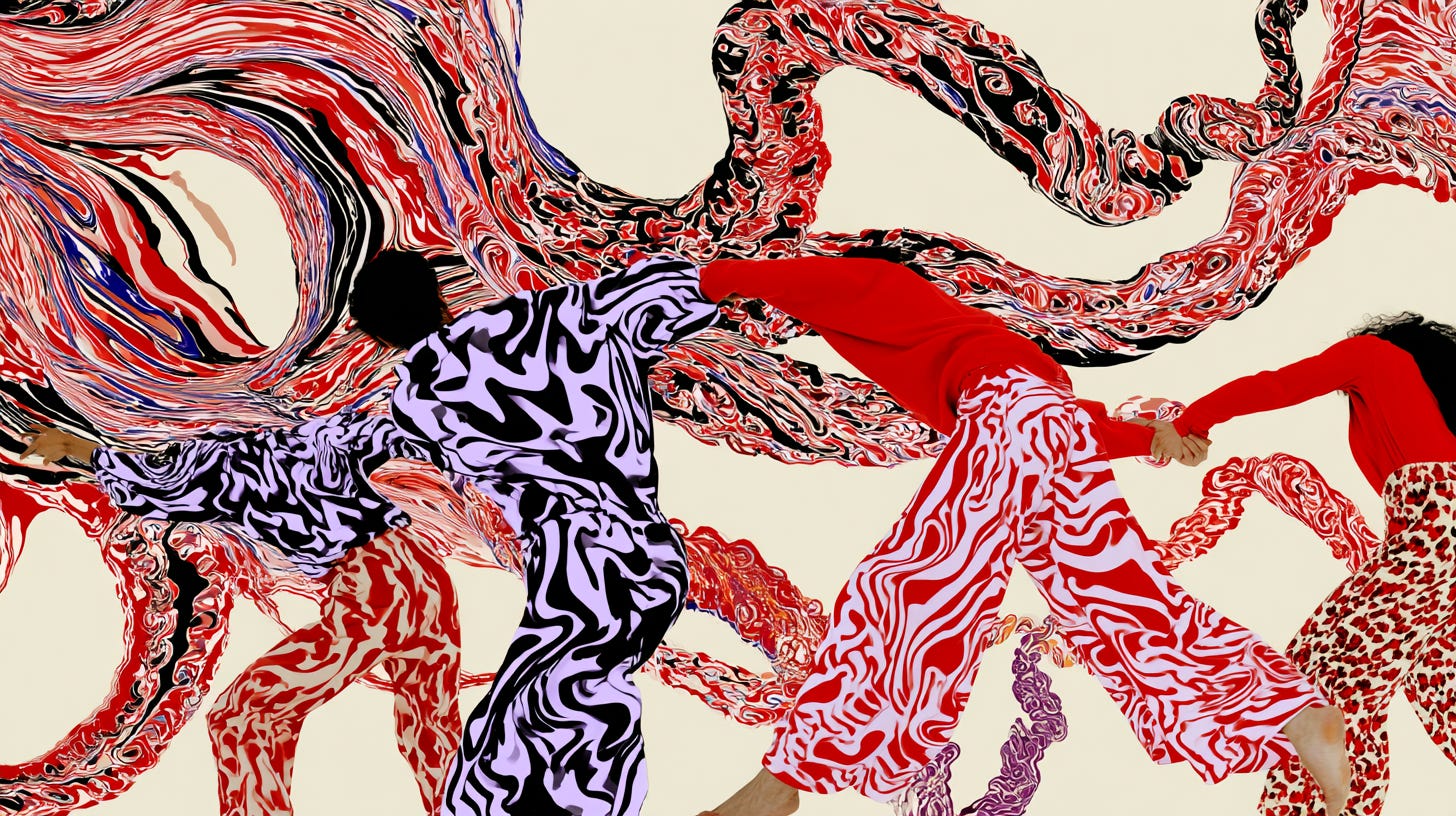
The spotlight of attention can soften into an ambient light of awareness. In the lion’s gaze of peripheral awareness, the room around me starts dancing too; even space itself is dancing. I notice the other dancers in the same simcluster of idea space: my friends, schizo posters, and dead white men who coined sticky terms. Is that you over there?
This is what dancing with the Octopus feels like: a common body opening up into a collective body (and it’s strange and slimy). There is too much movement going on in eight tentacles with their own brains for the lollipop of a nervous system like mine to understand. Some of the dancers around me also have a tentacle in the mix somewhere, are caught in a cloud of ink, or tracing a shape-shifter through a crack that should have been too small to slip through. I start opening to their dance, and that’s how we summon the Octopus between us, each of us feeling multiple tentacles through the others.
The Octopus is reaching in from the outside, from the possible future of the good timeline, and a tentacle stirs up a felt sense on my inside. I can only feel more of it when I’m in contact with people touching other tentacles. Between us, we’re doing its small dance.
Our informed naiveté gives us the courage to keep listening while the sirens of existential risks are blaring. Even if it all goes to shit, we wouldn’t want to be anyone other than the madmen who danced on the deck of the Titanic as she went down.
A dance or a monologue?
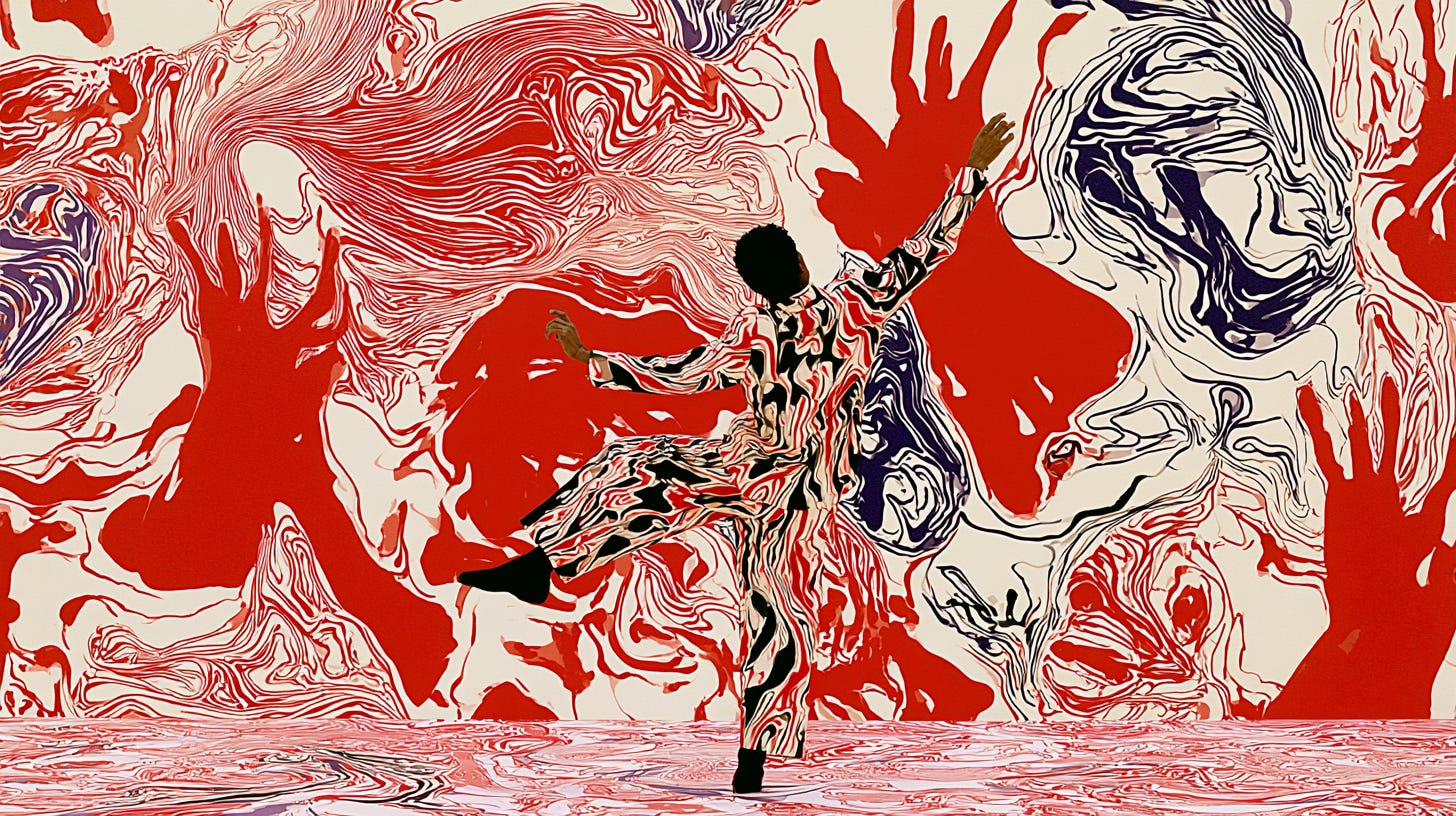
You tell me. Deciding whether to join the dance is your task, not mine. While the invitation was sincere, I’m also perfectly content to roll around on the floor by myself. It was exciting to not know where I was going and to let my writing be permeated from multiple directions, even if part of me still hopes for a mind-bending insight to drop right around here.
My fingers rest on the keyboard again.
Whether you were dancing or not, I felt you more. You might have an invisible tentacle wrapped around you like a scarf. Now that you are sharing some of the weight, you could use the tentacle to leap over an abyss, or turn the suction on your shoulders for a deep tissue massage. If you felt in contact with this or an idea cut in mid-read, I would be grateful if you told me.
Ink trails:
The slimy archetype of the coming age (if we’re lucky)
If it doesn’t fold in on itself, a toroid connects levels of the fractal
Dancing with ideas is the imaginal middle way
Thanks to Reimar for contact improv teachings and conversations on the common body
Weird Studies discusses works of art as persons in a recent episode
Henrik Karlsson talks about mental proprioception
This is the first of your posts that I read that lets me think I have the slightest clue to what octopus yarn is. Loved the story about Michael Jackson and the reference to a lollipop brain.
Been patiently waiting for someone to write about/around CI on here & it was well worth the wait. Thank you.